Version 1.9 Page 37 of 170
The function for associating each athlete with a photo is useful, especially for trainers and coaches
with many athletes to assess. This can be taken from a file previously saved on disk (in .jpg or .bmp
format), or taken 'on the spot' with a previously connected webcam. In the first case click on <From
File> and select the desired photo from a folder; in the second case, click on <From Video>, wait for
the Live image to appear, frame the patient and press <Acquire>.
4.1.1.1 PATIENT DATA INPUT MASK
To edit the data of a stored patient, select the entry with the mouse and
press <Edit Patient>: within the patient data input mask, fields can be edited
and saved (or cancelled, returning to the list).
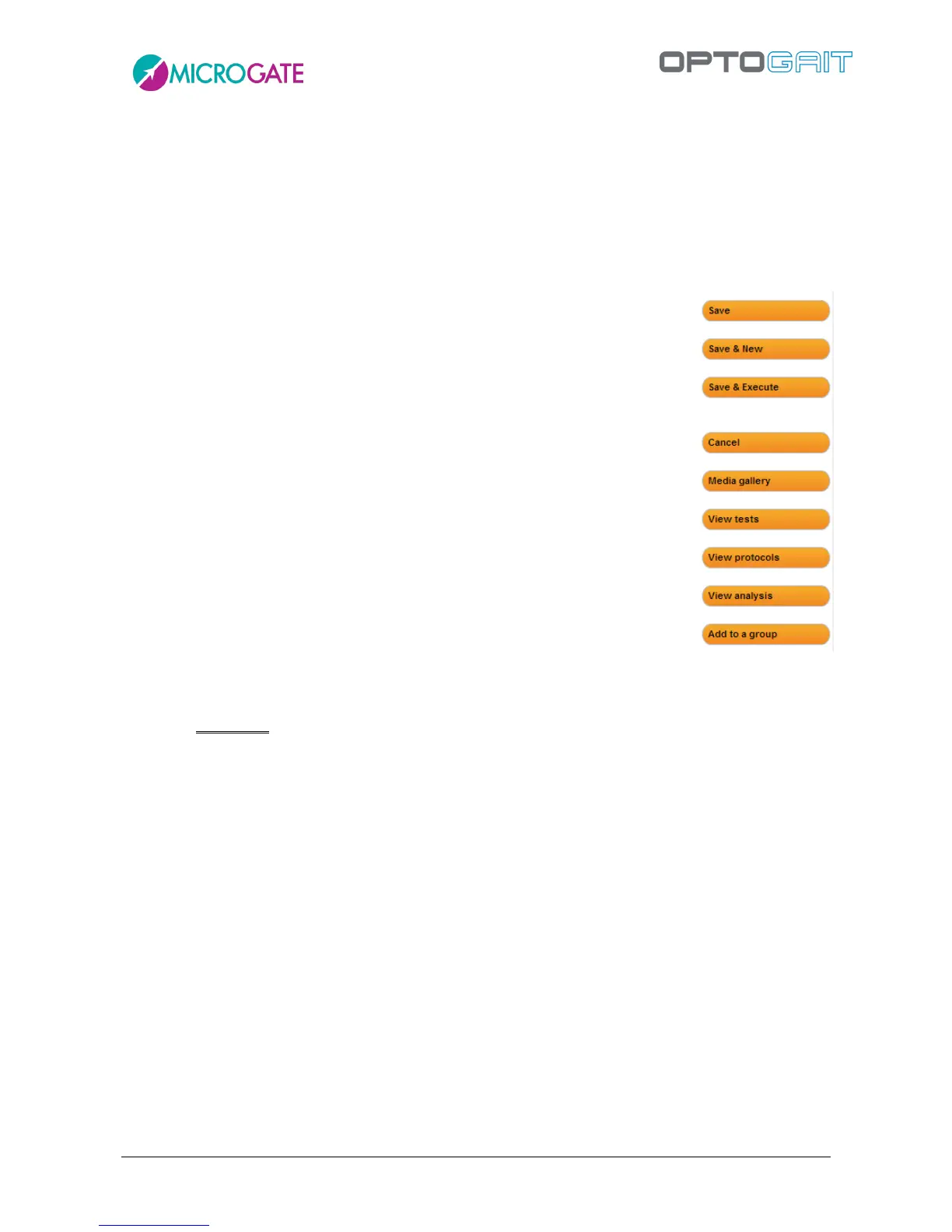
Furthermore, three buttons allow the user to view tests, protocols, and
analyses of the current patient (actually a filter is created as explained in
section 4.3.1)
The command <Capture foot> measures the foot in cm (i.e. in 'number of
LEDs’, which are then converted into centimetres or inches according to the
unit of measurement used). Click the button, position one foot inside the
bars (parallel to them) and click <Confirm>. After a few seconds the
measurement is displayed and can be confirmed or repeated.
The measurement is essential for the treadmill tests; the value is saved in
the database associated with the patient and is displayed in the mask; the
editable field 'foot' is only for personal data and can be used to write the
measurement in any unit (e.g. 41 EUR, 7 ½ US, 8 UK, etc.).
In the patients list the following commands are available: To eliminate him/her, press <Delete
Patient> (WARNING: When deleting a patient, all his/her tests, protocols, and analyses will be
deleted without any possibility to restore them).
To insert a patient into a group, select from the list, press <Add to a group>, select the group to
insert him/her in (possibly using the right arrow to select a dependent subgroup) and press <Add to
a group> again. Press <Back> to return to the patients’ list.
For the management of groups and other ways of associating with groups, we suggest you read the
next section.
By pressing <Export>, patients’ personal data can be exported to a file with the extension 'xml',
which can be used with Excel (Excel versions XP, 2003, 2007 and 2010) or with other programs.



 To Next Page