Version 1.9 Page 65 of 170
Test Timeout [ms]: this is the end of test timeout in milliseconds; if during a Sprint/Gait test
with ‘Timeout’ stop type no input or output signal is received from the measurement area
by the OptoGait device for a period longer than or equal to the time set here, the test is
considered completed.
3rd/6th/9th step speed reference: insert the reference speed for the 3rd/6th/9th step in
m/s; this option can be disabled by inserting the value 0.
Discard first step: discard the first N steps (N=input value) when entering the area; this
parameter (and the following) are useful when we want only consider the central part of the
test and we do not want enter&exit (usually with lower speed) to affect the average.
Discard last steps: discards the last N steps (N=input value) when exiting the area.
Foot filter at start/end of system: if set to YES does not consider the steps in and out of the
system if there are at least 2 obscured LEDs; in this way you avoid fingerprints half in and
half out of the measurement area.
Filter GaitR IN and Filter GaitR OUT [LED]: the two parameters expressed in number of
sensors (LEDs) indicate the minimum number of sensors interrupted by the gait and
triggering the start of the foot contact time (GaitR IN) and the end of the same time (GaitR
OUT). See also chap. 5.1.6
For this test type the structure of the system has to be defined as well, (i.e., how many bars the
system is composed of and whether there are gaps between the bars).
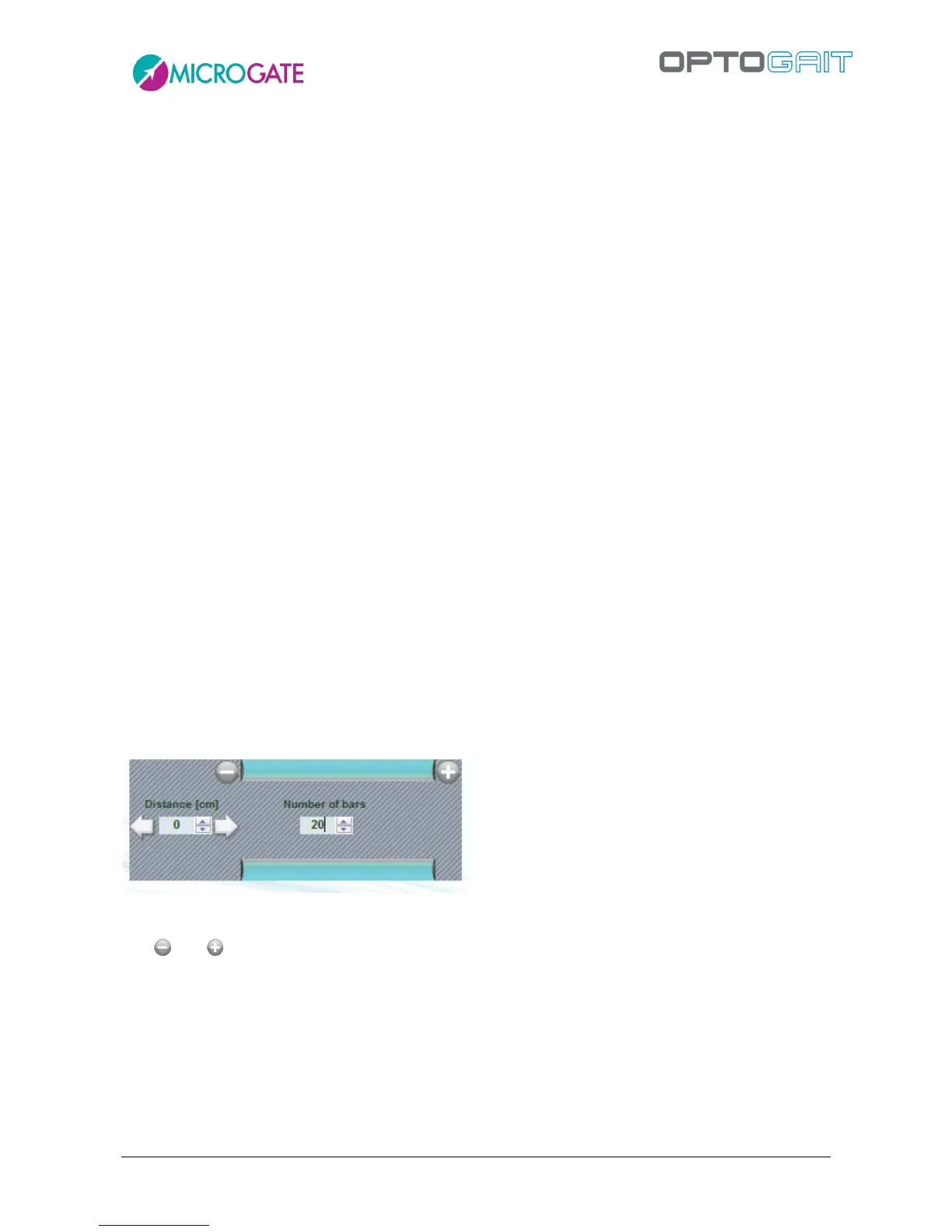
In the field ‘Number of bars’, the number of connected bars must be inserted. This field is necessary
for correct test acquisition. If the inserted number of bars differs from the number of bars actually
installed, the software will signal this error suspending the test currently in progress.
Example: A system is made of 20 meters of OptoGait bars, all connected, without gaps. The settings
to make are the following:
The and buttons are respectively for removing or adding blocks of OptoGait bars. This function
can be used, for example, in hurdle jumping, where between one hurdle and the next one
interruptions are made connecting bars with a flat cable.
The ‘Distance’ field is for indicating the distance between the blocks in centimetres. The first
‘Distance’ (D
0
) corresponds to the distance between the patient’s initial position and the first block.
For example, in athletics, if the start is from the blocks, the distance from the springboard to the
first block must be calculated. The other distances (D
1
, D
2
, etc.) indicate the distance between the
last lens of a bar and the first lens of the following bar (end and beginning of the two half moons).



 To Next Page