ELECTRICAL SYSTEMS-HOUSE - 8
141
CAY M A N 2 0 0 7
NOTE:
When 50 Amp shore service is not
available, care will have to be used when
operating the appliances and using the
outlets to avoid overloading the shore
power service.
Generator:
The generator can be selected for use when
shore power is unavailable. The maximum
amount of generator output power, measured
in watts, is calculated at an elevation of 500 ft.
above sea level. This gure will decrease slightly
at higher altitude. Ambient temperature also
effects total maximum output. The amount of AC
electrical load applied to the generator determines
fuel consumption.
Inverter/Charger (Optional):
The Inverter/Charger is an auxiliary 120 Volt
AC power source that inverts 12 Volt DC house
battery power to 120 Volts AC. This device has
limited AC power output, measured in watts,
and operates only selected appliances and
outlets. The Inverter/Charger also converts 120
Volts AC power, supplied from either shore
power or the generator, to 12 Volts DC power,
to recharge the batteries. When dry camping, the
Inverter/Charger may be used to supply power
to selected outlets.
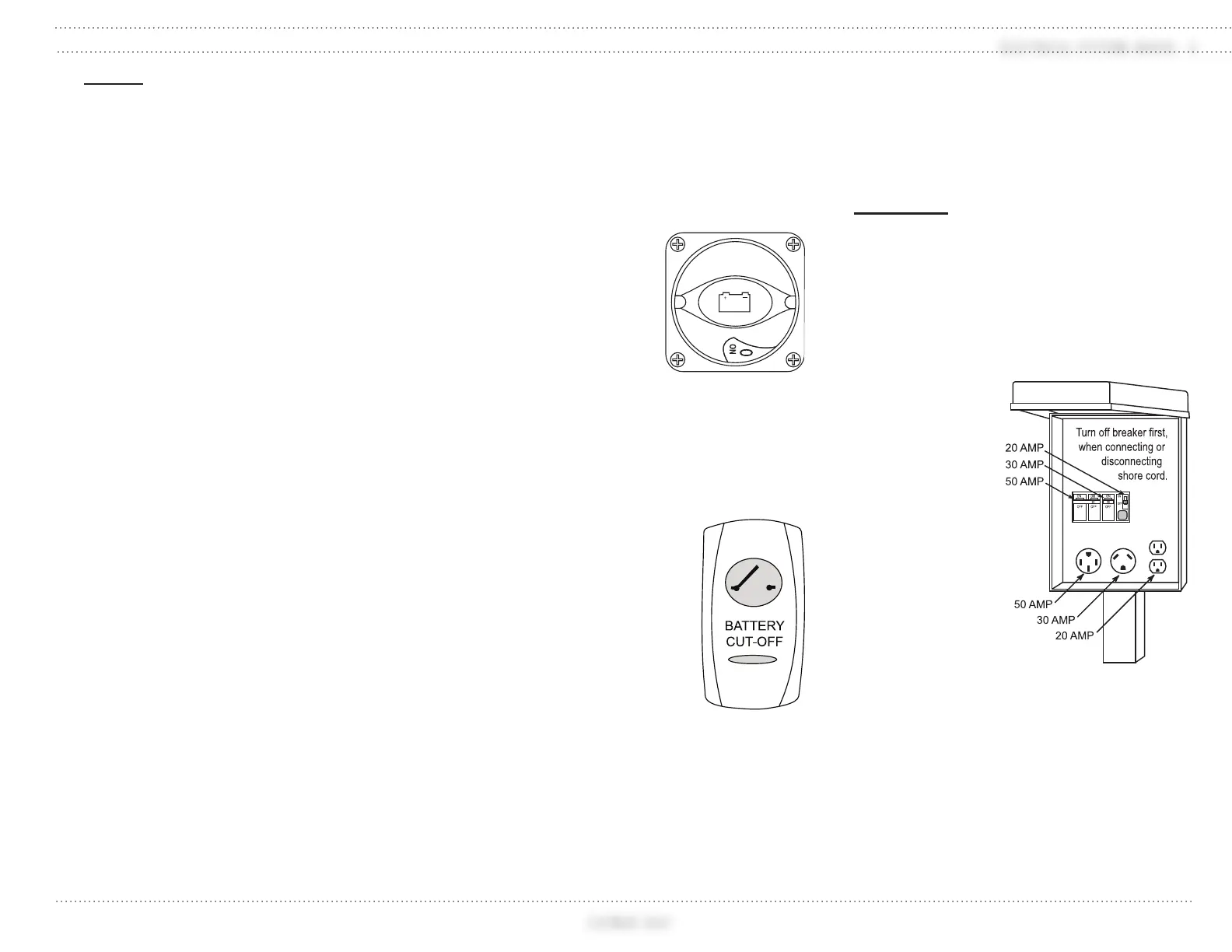
BATTERY DISCONNECT - HOUSE
The main house battery disconnect switch
turns the house battery power supply on or
off by disconnecting 12 Volt DC power to
the following items: inverter, domestic fuse
panel in the bedroom, and the domestic fuse
panel in the front electrical bay. Turn the
house battery disconnect switch off when the
motorhome is going to be stored for more
than 48 hours or before performing electrical
maintenance. If possible, leave the motorhome
plugged into outside electrical service with the
battery disconnect switch on to help prevent
the possibility of dead
batteries. Use of this
battery cut-off switch
will not turn off all DC
electrical items or other
parasitic loads present
on the house battery.
Some are federal mandate
items such as the LP-Gas
detector.
BATTERY CUT-OFF
The battery cut-off switch is
located inside the motorhome
next to the entry door. This
switch controls the 12 Volt
DC power to the domestic
fuse panel. When the switch
is activated, power is supplied
to all interior DC lighting and
DC operated appliances. Some
appliances will require both
DC and AC power to operate,
such as the roof air conditioner.
This switch is helpful when
dry camping to conserve house
battery power.
Refrigerator operation is unaffected by the use
of this switch. When the interior house power
is off there are still parasitic loads on the house
batteries; therefore, it is not a substitute for the
main battery disconnect switch.
CAUTION:
Avoid flash damage to electrical
contacts. Turn off the interior lighting
before operating the battery cut-off
switch.
SHORE POWER HOOK-UP
The power
requirement for the
motorhome is 50
Amp 240 Volt AC
single phase. The
motorhome can
operate from 30
Amp 120 Volt AC,
but with limited
capacity. The shore
cord is stored in
a rear roadside
compartment. If 50
Amp shore power
service is available,
connect the supplied
shore power cord. If less than 50 Amp service
is available, electrical adapters will be required
and power consumption must be reduced to
avoid tripping the shore power breaker.
Located in the
battery compartment.
060077
080375g
020125
Typical Power Pedestal



 To Next Page