DRIVING & SAFETY - 2
CAY M A N 2 0 0 7
33
Inspecting & Pressure
The Load and In ation Table will help
determine correct tire in ation pressure after
properly weighing the motorhome. All pressures
are rated at a cold psi. Cold psi is de ned as
early in the morning before the day’s ambient
temperature, sun’s radiant heat or the heat
generated while driving have caused the tire
pressure to temporarily increase. This means
the tire in ation pressure should be checked
early and when the motorhome has not been
driven more than one mile. Check tire in ation
pressure regularly. The check interval should
be in the morning, before the “drive” trip and
every morning on extended trips. A quality
truck tire gauge with an angle airhead is needed
to access the dual wheel positions of the drive
axle. Ensure the valve cap is replaced on the
stem after the in ation pressure is checked. Use
valve stem caps with a positive seal to prevent
air escaping from the valve stem. If there are
extension hoses on the valve stem, make sure
they are good quality reinforced stainless steel
braid. Attach hoses securely to the outer wheel.
The valve stem cap guarantees the valve core
will remain free of dirt and foreign material.
Material lodged between the valve core and
internal stem can cause slow leaks resulting in
tire failure.
Optimum tire performance is achieved at
proper in ation pressure for the load carried.
DO NOT mix tires of different tread patterns,
size or construction on the same axle. The
difference in traction could cause rear end gear
bind and mechanical damage to the drive train.
CAUTION:
Never let air out of a hot tire.
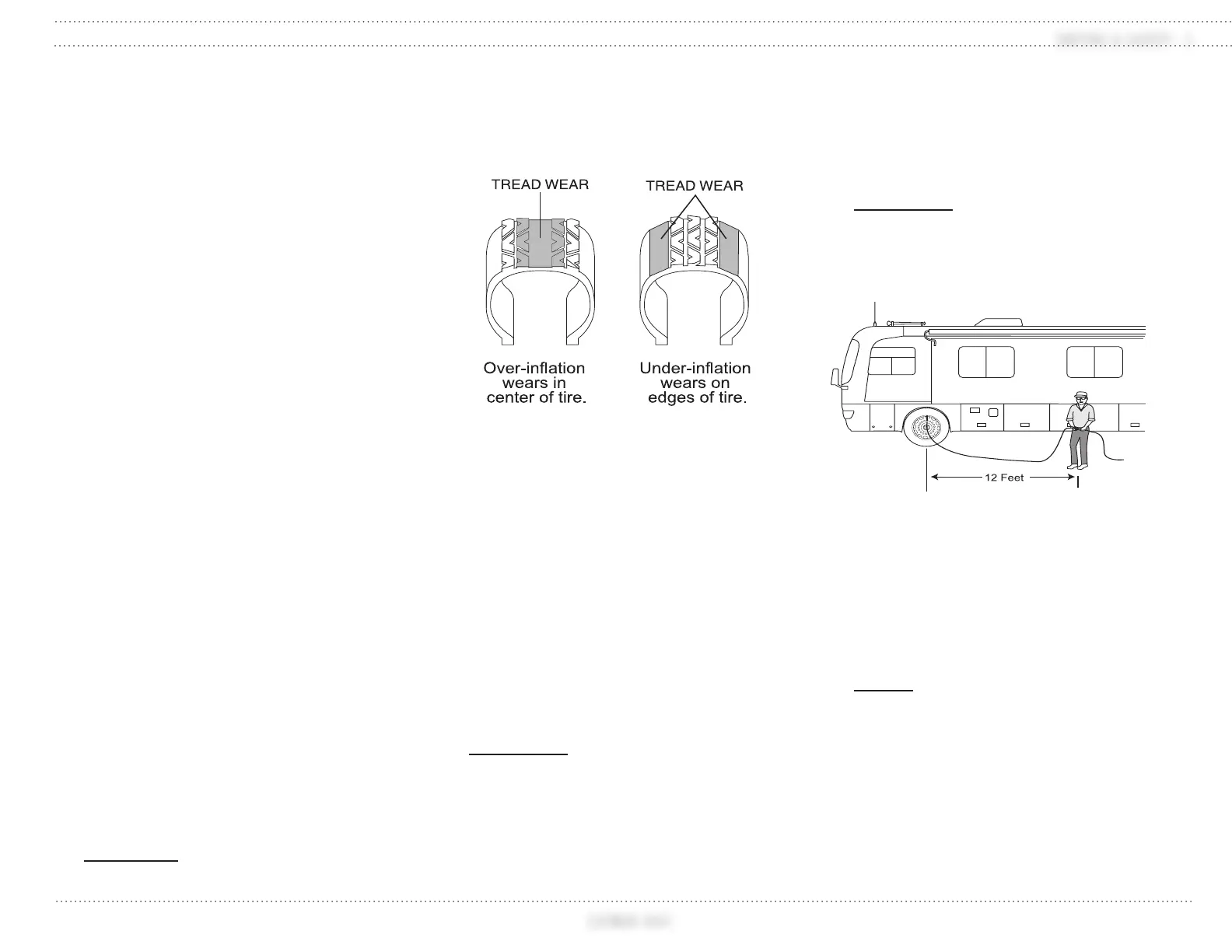
Over-infl ation can cause:
Hard ride.
Tire bruising or carcass damage.
Rapid tread wear in the center of the tire.
Under-infl ation can cause:
Tire squeal on turns.
Separations.
Rapid and uneven wear on the edges of
the tread.
Circumferential breaks.
Tire container may bruise or rupture.
Higher risk of road hazard.
Tire cord breakage.
Loss of casing durability.
Excessive tire temperature.
High fuel consumption.
Reduced handling quality.
WARNING:
A slow leak may go unnoticed on one of
the dual tires. This can cause the good
tire to fail by exceeding the load limit.
Tires with damaged sidewalls can burst
upon inflation. A flat or nearly flat tire
can also generate enough heat from
friction to ignite.
Unequal tire pressures on same axle can cause:
Uneven braking, swerve upon
acceleration.
Steering lead, torque steer.
Reduced handling quality.
WARNING:
For safety purposes, clear the area of
people and pets during tire inflation.
Inflate tires using a remote inflation
device.
Air Pressure Checklist
1. When inspecting the tires, con rm
the tires are cool before increasing or
reducing air pressure. Driving a short
distance can heat up tires.
NOTE:
If the motorhome must be driven a
distance to get air, check and record the
tire pressure first and add the recorded
calculation when reaching the pump.
It is normal for tires to heat up and the
air pressure inside to go up as driven.
NEVER “bleed” or reduce air pressure
when tires are hot.
2. Remove cap from the valve on one tire.
090440b
020161c



 To Next Page