DRIVING & SAFETY - 2
CAY M A N 2 0 0 7
31
The tire performs additional functions of
traction for moving, stopping and steering, as
well as providing a cushion for the motorhome.
Modern tire technology blends a unique mix of
chemistry, physics and engineering to provide a
high degree of comfort, performance, ef ciency,
reliability and safety. To obtain the maximum
wear and best service from tires, it is helpful to
understand their components and functions.
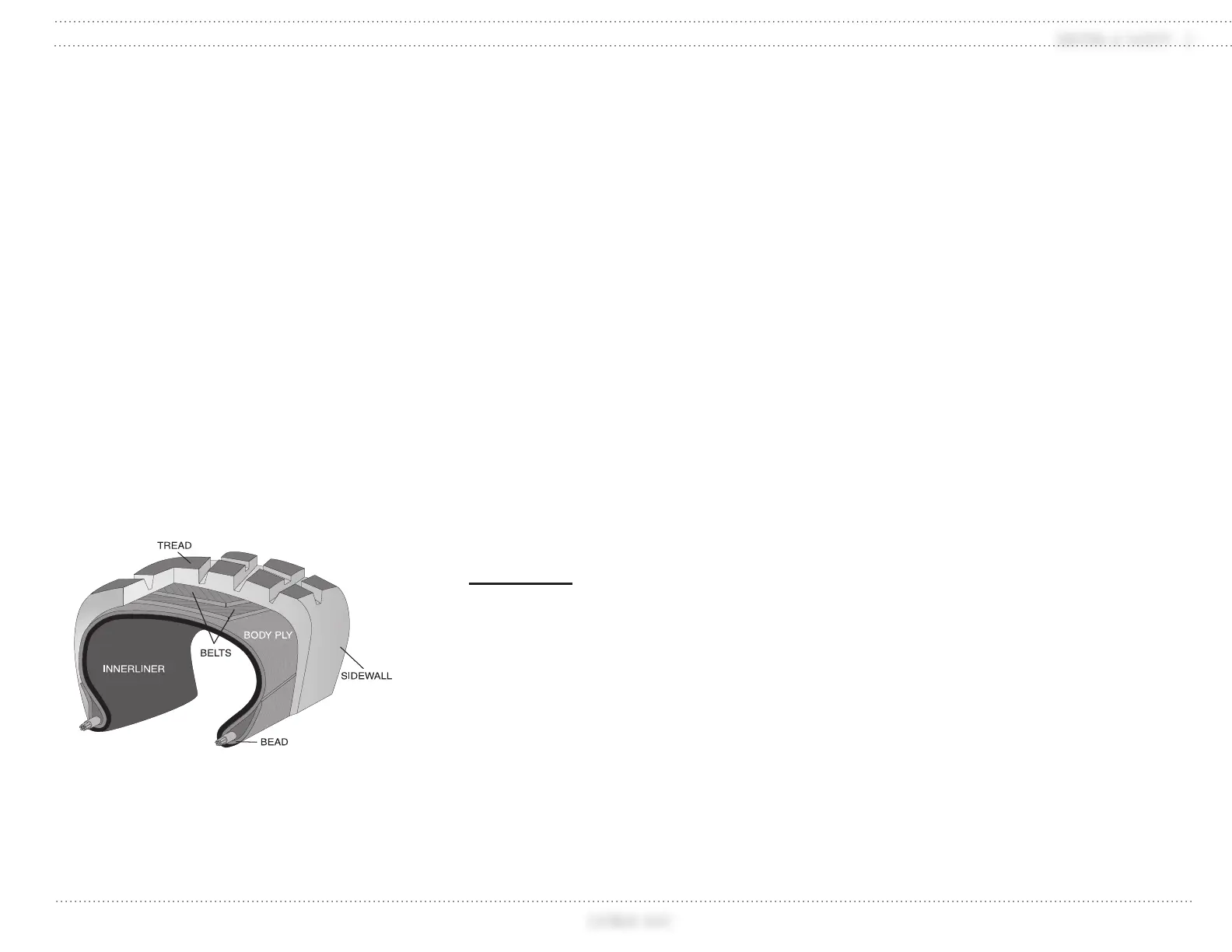
Tire Components:
Tread: Provides traction and cornering grip.
Belts: Stabilize and strengthen the tread.
Sidewall: Protects the side of the tire from road
and curb damage.
Body Ply: Gives the tire strength and exibility.
Bead: Assures an air-tight t with the wheel.
Inner Liner: Keeps air inside the tire.
Importance of Air Pressure
The most important factor in maximizing
the life of the tires is maintaining proper
in ation. Driving on any tire that does not have
the correct in ation pressure for the load of
the motorhome is dangerous and may cause
premature wear, tire damage and/or loss of
control of the motorhome.
An under-in ated tire will build up excessive
heat that may go beyond the design limits of
the rubber and radial cords and could result
in sudden failure. An under-in ated tire will
also cause poor motorhome handling, rapid
and/or irregular tire wear and an increase in
rolling resistance that results in decreased fuel
economy.
An over-in ated tire will reduce the tire’s
footprint/contact patch with the road, thus
reducing traction, braking capacity and handling
of the motorhome. Over-in ation of a tire for
the load will result in a harsh ride, uneven tire
wear and is susceptible to impact damage.
Maintaining correct tire in ation pressure for
each loaded wheel position on the motorhome is
of the utmost importance and must be a part of
regular motorhome maintenance.
WARNING:
Driving on a tire that is under-inflated
can exceed the design limits of the
tire and may damage the sidewall.
A damaged sidewall can burst upon
inflation resulting in serious damage,
injury or death. Aged tires are also
susceptible to sidewall damage.
Tire Pressure Inflation Guideline
Federal law requires that the speci cations
for the tire’s maximum load rating be molded
into the sidewall of the tire. The amount of air
pressure to use is dependent on the weight of
the motorhome when fully loaded. The tire
chart indicates the weights that can be properly
supported by varying air pressures. Decreasing
air pressure decreases load carrying capacity.
Always comply with the tire manufacturer’s
recommended pressure in ation guideline.
The actual weight of the motorhome can vary
signi cantly depending on how it is loaded. For
optimum tire wear, ride and handling always
comply with the manufacturer guideline. A tire
in ation chart listing proper in ation pressure
for different loads can be found in this section.
The tires of the motorhome are in ated to
pressure(s) appropriate for the actual weight on
each axle in the unloaded, shipped condition.
When the motorhome is loaded, check and
adjust the in ation pressure on each tire as
needed.
Always in ate tires to the pressure indicated
in the tire chart for the load carried by
the tire. DO NOT OVERINFLATE OR
UNDERINFLATE THE TIRES.
The Gross Axle Weight Rating (GAWR) of
the axles listed on the federal certi cation label
attached to the motorhome is the maximum
allowable loaded weight on an axle.
When the actual loaded weight of the
motorhome and the weight on each axle is
unknown, follow the recommended tire in ation
pressure(s) listed on the federal certi cation
label. When loading a motorhome never exceed
the motorhome’s Gross Vehicle Weight Rating
(GVWR) or the GAWR for each axle.
Contact the tire manufacturer for further
information concerning proper tire pressure
in ation and other tire issues.
090438



 To Next Page