CHASSIS INFORMATION - 10
204
CAY M A N 2 0 0 7
Adjustments:
The Centroid sender has two adjustments:
1 - EMPTY: Adjusts for length of sender.
It is set at the factory, covered with a
sealant and should not be changed.
2 - FULL (Full Adjustment): The full
adjustment can be used to correct
for slight differences between fuel
meters. During installation it was
factory calibrated and does not need
re-adjustment.
The correct calibration technique is with a full
tank of fuel parked on a level surface. Start with
the full adjustment completely clockwise. This
should cause the reading to be above full. Adjust
slowly, rotate counterclockwise, until the full
mark on the gauge is reached. The intent is to
always adjust downscale rather than upscale.
Troubleshooting:
A. Electronic Output: The sender has
a transistorized output to prevent
an ohmmeter from getting a correct
reading of output resistance.
B. Fuel Only: The sender will not work
correctly in conducting uids such as
water (it will read above full all the
time in water). One possibility is that
when there is a constant above-full
reading there may be water in the
bottom of the fuel tank.
C. Contact Centroid: Probably 90% of
the return Centroid tests work okay
on the bench. If you have incorrect
readings contact Centroid (telephone:
800-423-3574, or preferably, fax: 386-
423-3709) with the symptoms. A short,
“ ll in the blanks” troubleshooting
test is provided to test the sender. It
is easier to nd the problem that way
than after the sender has been removed
from the system, since the problem is
not necessarily with the sender.
Fuel Lines & Hoses
Make a visual check for fuel leaks at all
engine-mounted fuel lines, connections and at
the fuel tank pick-up and return lines. Leaks in
this area may best be detected by checking for
accumulation of fuel under the tank.
Engine performance and auxiliary equipment
is dependent upon the ability of exible hoses
to transfer lubricating oil, air, coolant and
fuel. Maintenance of hoses is an important
step in ensuring ef cient, economical and safe
operation of the engine and related equipment.
INSPECTION:
Check hoses for leaks daily as part
of the pre-start inspection. Check all
fittings, clamps and ties. Ensure the
hoses are not touching shafts, couplings
or heated surfaces, including exhaust
manifolds, sharp edges or other obvious
hazardous areas. Vibration from the
engine and road can move or fatigue
clamps and ties. To ensure continued
proper support, inspect fasteners
frequently and tighten or replace them
as necessary.
Fuel Filters
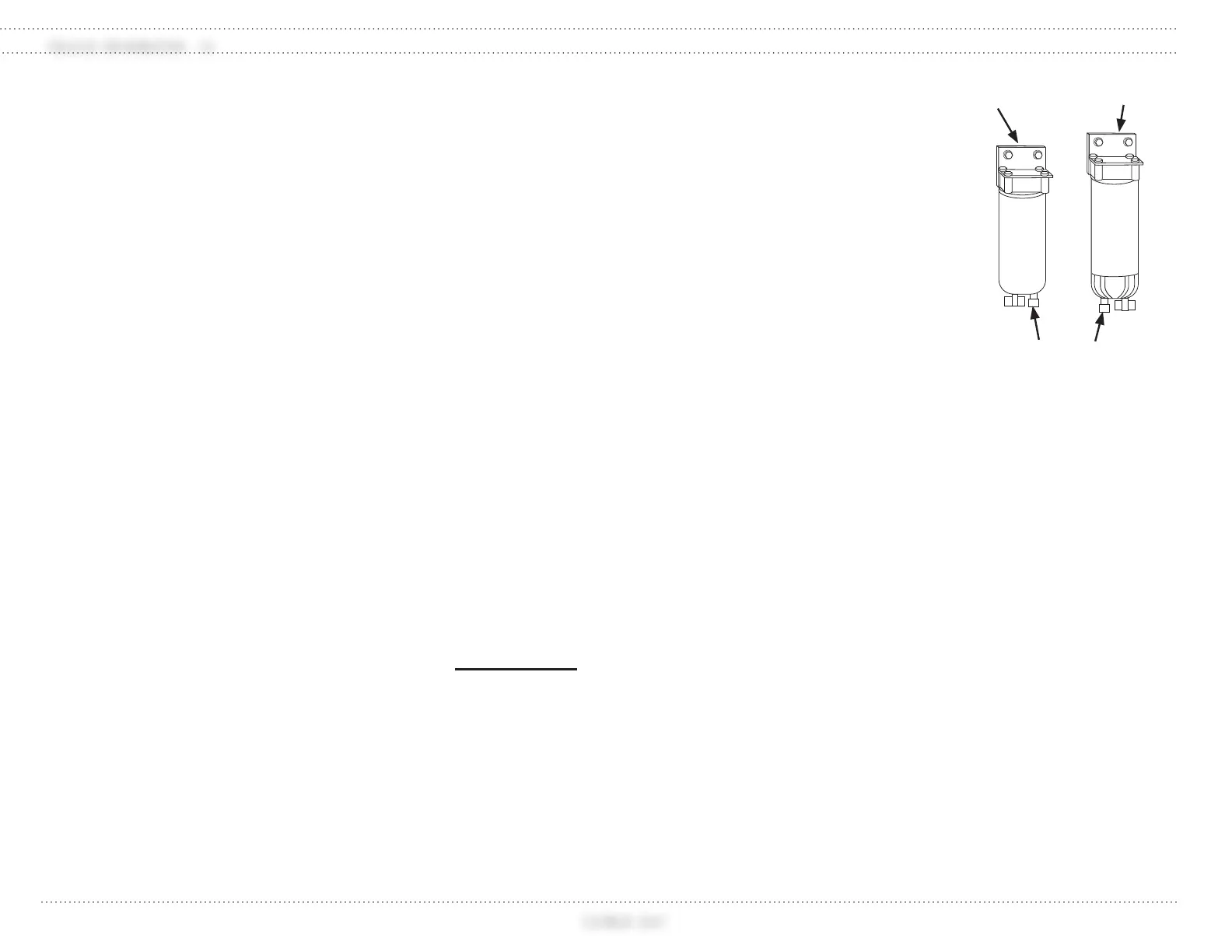
The fuel lters
are located on
the curbside
frame rail next to
the engine. The
primary fuel lter
has a drain and
a clear sediment
bowl (located at
the bottom of the
lter), and it can
be accessed from
underneath the motorhome on the curbside. The
secondary lter also has a drain but no clear
sediment bowl, and it can be accessed from the
interior engine access. Water is heavier than fuel
and will collect in the sediment bowl. Water can
accumulate in the fuel from condensation in the
fuel tank or contamination upon refueling.
The fuel lters should be drained daily. The
appearance of water in the sediment bowl is
easily identi ed by the inability of water to mix
with the fuel. The water should be drained at
the rst opportunity. If water passes through the
lters it can cause engine mis re and damage
fuel injectors.
Shut off the engine and open the drain valve.
Turn the valve counterclockwise approximately
1½ to 2 turns until draining occurs. Drain the
fuel/water separator of water and sediment until
clear fuel is visible. Turn the valve clockwise to
close the drain valve.
090426g
Primary
Fuel Filter
Secondary
Fuel Filter
Drains



 To Next Page