CHASSIS INFORMATION - 10
192
CAY M A N 2 0 0 7
If the jacks fail to extend or retract:
Apply the park brake, turn the ignition
to the On or ACC position and place the
transmission in Park.
If jacks still do not operate, check
the leveling system fuse in the front
distribution box.
NOTE:
The hydraulic pump is equipped with an
internal thermal breaker for protection
against overheating. If the pump is used
repeatedly in a short period of time the
breaker will trip. It resets automatically
in 5 to 30 minutes.
Drive-away Protection:
With the jacks extended and the park brake
released, or transmission placed in gear, a
warning alarm will sound and all LEDs will
illuminate. The jacks will automatically retract.
A full visual inspection is required to con rm full
retraction of jacks before moving motorhome.
Maintenance:
At weekly intervals, use silicone spray on
the jack rod. This will help prevent moisture
damage to surface of the jack rod. If parked near
coastal areas, apply more often. Occasional oil
or grease on the extended jack rod is normal.
Remove dirt and road debris from the
jacks as needed.
Check the uid level every month.
The uid level should be within ¼" of
ll port lip and checked with all jacks
retracted.
Inspect and clean all hydraulic pump
electrical connections every 12 months.
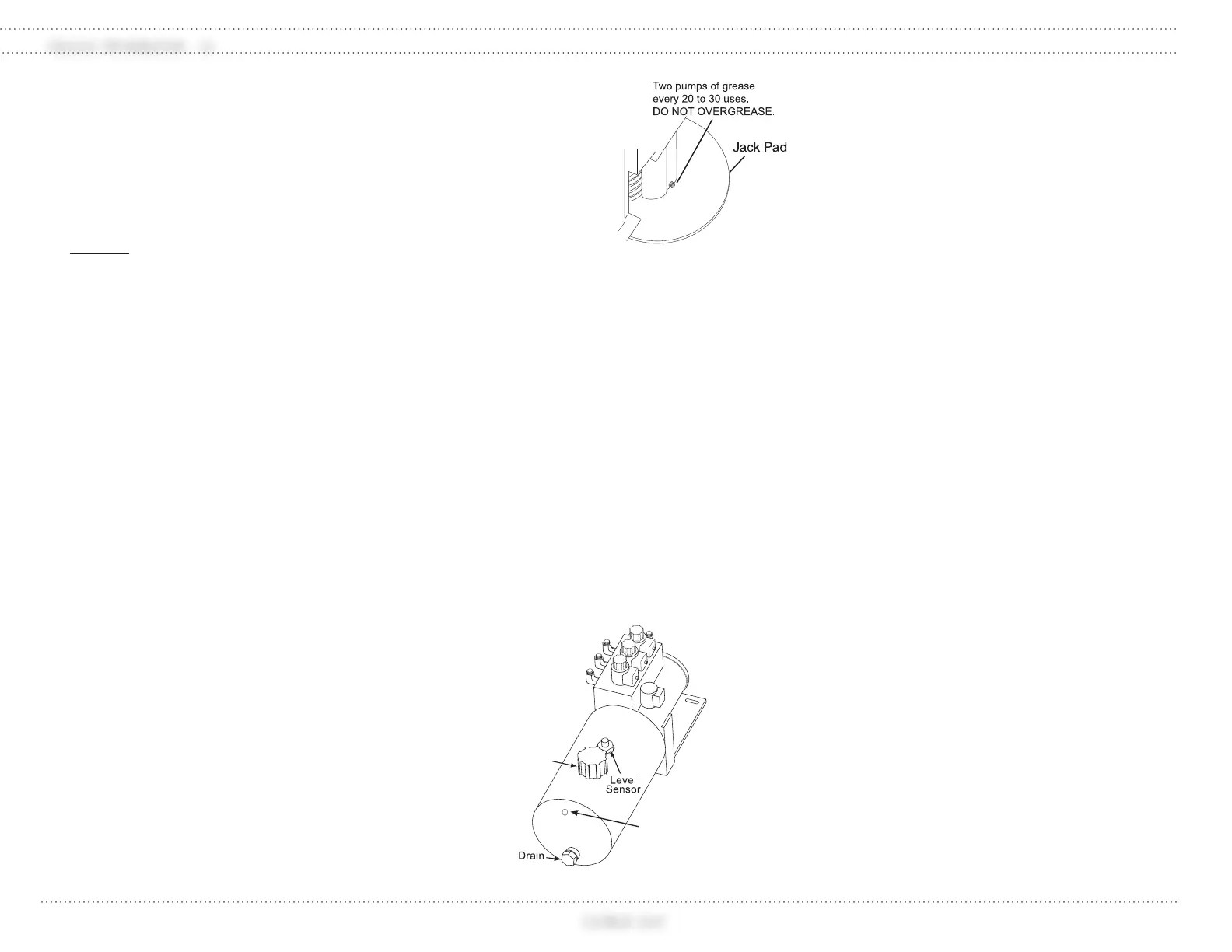
For jacks equipped
with a grease tting
at the bottom of
the cylinder, two
pumps of grease
should be suf cient
for 20 to 30 uses.
DO NOT over
grease. Damage to
the rod seal will occur.
Fluid change interval is 36 months.
Adding Fluid:
If the leveling system makes unusual noise or
the alarm sounds when driving around corners or
over bumpy roads, this indicates a low uid level.
1. Ensure all jacks are retracted.
2. Chock a wheel fore and aft for safety.
3. Remove the weep-hole screw.
4. Unscrew the ll cap from the top of the
pump. Slowly ll the reservoir with
uid until uid seeps from the weep-
hole.
5. Replace the weep-hole screw and ll
cap.
ENGINE - GENERAL INFORMATION
The diesel engine operates differently from
the conventional gasoline engine. Gasoline
engines control engine speed using a butter y
throttle plate controlling air/fuel mixture inlet
ow. As the throttle plate opens, vacuum
created by the piston velocity draws the
metered fuel/air charge into the combustion
chamber, then ignites from a controlled electric
ignition source. Closing the throttle plate limits
the fuel/air supply, slowing engine speed,
increasing intake manifold vacuum.
The diesel engine in the motorhome controls
engine speed by varying fuel supply only. No
throttle plates are used. An exhaust driven
turbine system (turbocharger) compresses the
fresh air supply into the engine. The fuel is
injected under pressure into the combustion
chamber. Ignition of fuel/air charge occurs
from heat generated by rapid high compression.
The turbo boost gauge registers amount of
intake manifold pressure measured in lbs./in².
Therefore, no intake manifold vacuum exists.
Diesel engine RPM (revolutions per minute)
operating speeds are generally much lower than
that of the gasoline engine. Peak torque and
horsepower output values occur at much lower
engine speeds. Idle speeds between the two
engine types are similar, however maximum
engine speeds are quite different. The gasoline
engine generally is not regulated to a maximum
engine speed. The maximum engine speed on a
diesel engine is controlled by an engine speed
governor set by the engine manufacturer.
070185c
020027h
Weep-hole
Screw
Fill
Cap
Located in roadside storage bay.



 To Next Page