ELECTRICAL SYSTEMS-HOUSE - 8
154
CAY M A N 2 0 0 7
These discharge gures are calculated with
the battery starting at 100% state of charge
with the battery at 80º F when the discharge
cycle begins. However, increasing the discharge
load applied to the battery from 5 Amps to
10 Amps on a 100 Ahr battery does not yield
ten hours of discharge time. This is due to the
internal reactions which occur when a battery is
discharging. Actual discharge time for a 10 Amp
load may be closer to eight hours of discharge
time. Increasing the load applied to the battery
to 20 Amps will not yield ve hours discharge
time but may be less than three hours. It might
be understood as a point of diminishing return.
Calculating applied loads to an inverter to
approximate run time from the battery amp
hours available is not an equal trade up when
voltage is inverted and amperage is calculated.
When the inverter is used to operate an AC
load it uses approximately ten times the DC
current needed from the battery when inverting
12 Volts DC to operate the 120 Volt AC item.
There is also a small ef ciency loss of about
10% when inverting. For example: When using
the inverter to operate an AC electrical item,
which has a current draw rating of 2 Amps, the
inverter will use over 20 Amps DC power from
the batteries.
Determining Current Consumption:
First determine the amount of current used
by an AC item. For example: The television is
rated at 200 watts at 120 Volts AC. Calculate
watts to amps. Divide 200 watts by the
operating voltage of 120, this equals 1.6 Amps.
Multiply 1.6 Amps AC current by a factor of
ten the inverter will use, this equals 16 Amps
DC battery current. Add the revised 10%
ef ciency loss gure, this calculates to a total
of 17.6 Amps DC. If the battery bank capacity
is rated at 500 Ahrs., actual elapsed time to
the suggested 50% state of charge would net
viewing time for the television at approximately
13 hours in ideal conditions.
The run time gure will vary greatly with
the actual state of charge of the battery bank
when the discharge process begins. Ambient
temperature, combined with other working
loads, such as lights and parasitic loads applied
to batteries, affect run times. Calculating the
exact run time is not precise due to all the
variables and equations involved; however,
an approximate time gure can be obtained.
Proper battery maintenance and charge cycles
affect battery performance. Observe the
battery condition with hydrometer and voltage
readings. Use only distilled water when lling
batteries. To achieve the highest quality of
battery performance and longevity maintain the
batteries in their proper operating range.
LIGHTS
Interior Halogen
The bulbs inside the halogen lighting are
replaceable.
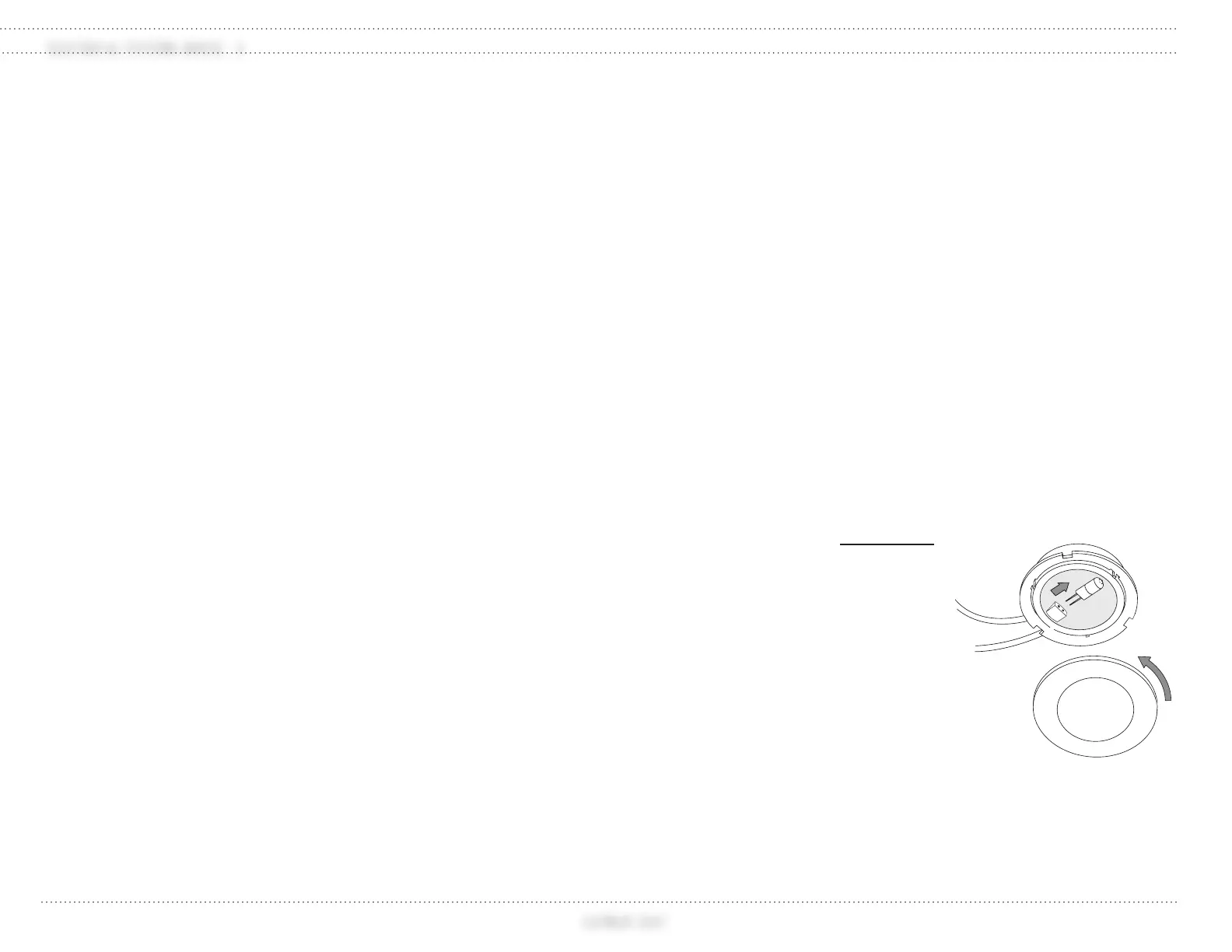
To Replace a Bulb:
1. Rotate the outer trim ring
counterclockwise and remove.
2. Carefully grasp bulb and pull from
socket.
3. Use a clean cloth or piece of tissue to
grasp new bulb. DO NOT touch bulb
directly as this can cause a “hot spot”
and result in immediate bulb failure.
4. Align contacts of bulb with terminals in
xture base. Insert bulb until contacts
are rmly seated.
5. Align tabs in trim ring with slots in
xture base. Rotate lens clockwise
until trim ring locks into place.
CAUTION:
DO NOT
touch
halogen
lighting
while on.
They can
cause a burn.
DO NOT touch
replacement bulbs.
Oil in the hands can
cause a “hot-spot”
to occur. If the bulb is
touched, allow it to cool and clean the
bulb with alcohol.
060200c



 To Next Page