DRIVING & SAFETY - 2
CAY M A N 2 0 0 7
17
On back roads and single divided roads,
tree branches and shrubbery can protrude
into the roadway. Watch for low hanging
branches, especially during inclement
weather as rain and snow will cause
branches to hang lower than usual.
Keep in consideration that posted
speed signs are usually passenger
automobile rated. Be extra aware
of driving conditions and use the
appropriate speed for a motorhome
when necessary, especially on corners
and mountain roads.
Downgrade speed should be at least
5 mph less than upgrade speed, or
downgrade speed should be attainable
within three seconds of a brake
application.
Use a four second rule when following
other vehicles at speeds under 40 mph.
Use a ve second rule when following at
speeds over 40 mph.
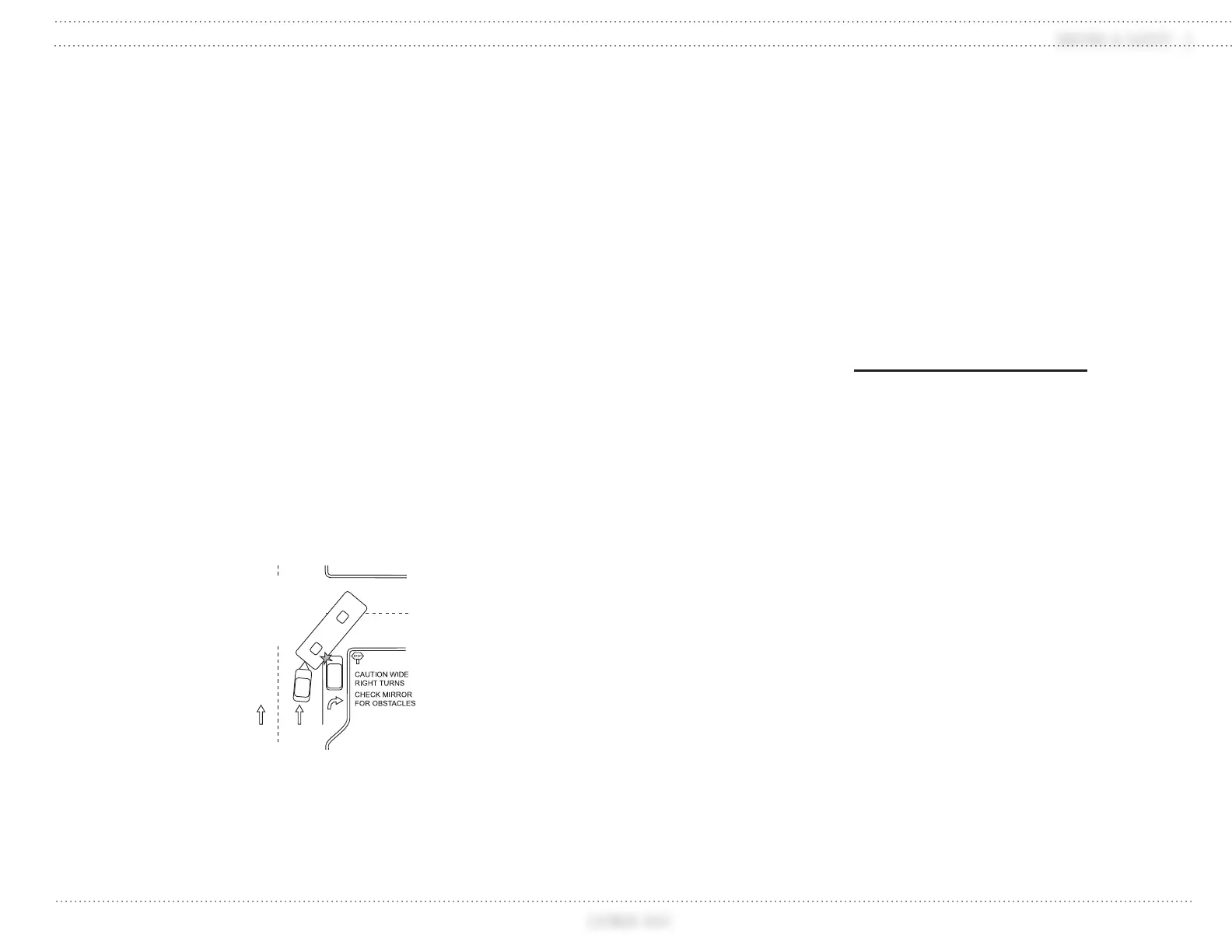
Right Turns:
Negotiating a
right hand turn in a
motorhome can be
dif cult. Many drivers
fear they cannot make
the turn without entering
into the other lane or
jumping the curb. Here
are a few tips to make a right hand turn easier:
As the turn approaches, look into the
mirror to ensure the lane to the left is
clear, then move wide over to the left.
When making the right turn, the left
rear wheel should touch the center line
of the road and the driver’s hips should
be parallel to the roadside curb of the
corner being turned to aid in avoiding a
premature turn.
Make the turn slowly.
Check mirrors frequently. Stay aware
of necessary clearance and space
management of the motorhome while
negotiating the turn.
Left Turns:
DO NOT start the turn until the center
of the intersection is reached with your
hips. If there are two lanes available,
take the right hand lane. A car or driver
on the left hand side is easier seen.
Ascending a Grade:
When approaching an uphill grade, assess the
grade and length before beginning the climb.
Prepare early for long climbs. Unlike gasoline
engines, diesels do not necessarily produce more
power by pressing further on the accelerator.
A gasoline engine will operate at full throttle
(at least for a short period of time), but a diesel
usually just wastes fuel at full throttle. The
power output from a diesel engine is dependent
upon the following:
RPM - Every engine has a range of RPM
that produces power most ef ciently.
Fuel/Air mixture - At a given RPM,
the engine, even with the help of
a turbo-charger, can only “pump”
a given volume of air into the
combustion chamber. This volume of
air can ef ciently combine with only
so much fuel; so it follows logically
that feeding more fuel to the re will
simply waste fuel.
Determine ranges where the motorhome works
best by driving long grades when temperatures
remain stable for the duration of the climb.
IMPORTANT SAFETY TIP:
Turn on the four way flashers if road
speed degrades to the point where the
motorhome is moving significantly
under the posted speed. Use pullouts if
traffic is building. Once in a pullout, if
there is sufficient clearance for safety,
idle the engine for a while to allow the
exhaust and the turbo to cool. While
these are cooling, the transmission will
also cool. Monitor the gauges while
waiting.
Descending a Grade:
Prepare to descend a grade at the crest of the
hill. Observe any signs indicating grade angle
and duration. The sign may suggest maximum
downhill speed according to Gross Combined
Weight (the combined weight of the motorhome
and a trailer/tow car). At the crest of the hill,
manually shift the transmission into a lower
gear. DO NOT allow the motorhome to gain
momentum before slowing down.
050250d



 To Next Page