198 Maintenance
corresponds to a level of performance which all passenger car
tires must meet under the Federal Motor Vehicle Safety Standard
No. 139. Grades B and A represent higher levels of performance
on the laboratory test wheel than the minimum required by law.
The temperature grade established for the MV-1 tire is for a tire
that is properly inflated and not overinflated. Excessive speed,
underinflation, or excessive loading, either separately or in com-
bination, can cause heat buildup and possible tire failure.
TIRE AND WHEEL ALIGNMENT
A bad jolt from hitting a curb or pothole can cause the front end
of your vehicle to become misaligned or cause damage to your
tires. If your vehicle seems to pull to one side when you are driv-
ing, the wheels may be out of alignment. Wheel misalignment in
the front or rear can cause uneven and rapid treadwear of your
tires and should be corrected by an authorized service center.
The tires should also be balanced periodically. An unbalanced
tire and wheel assembly may result in irregular tire wear.
Tire Rotation
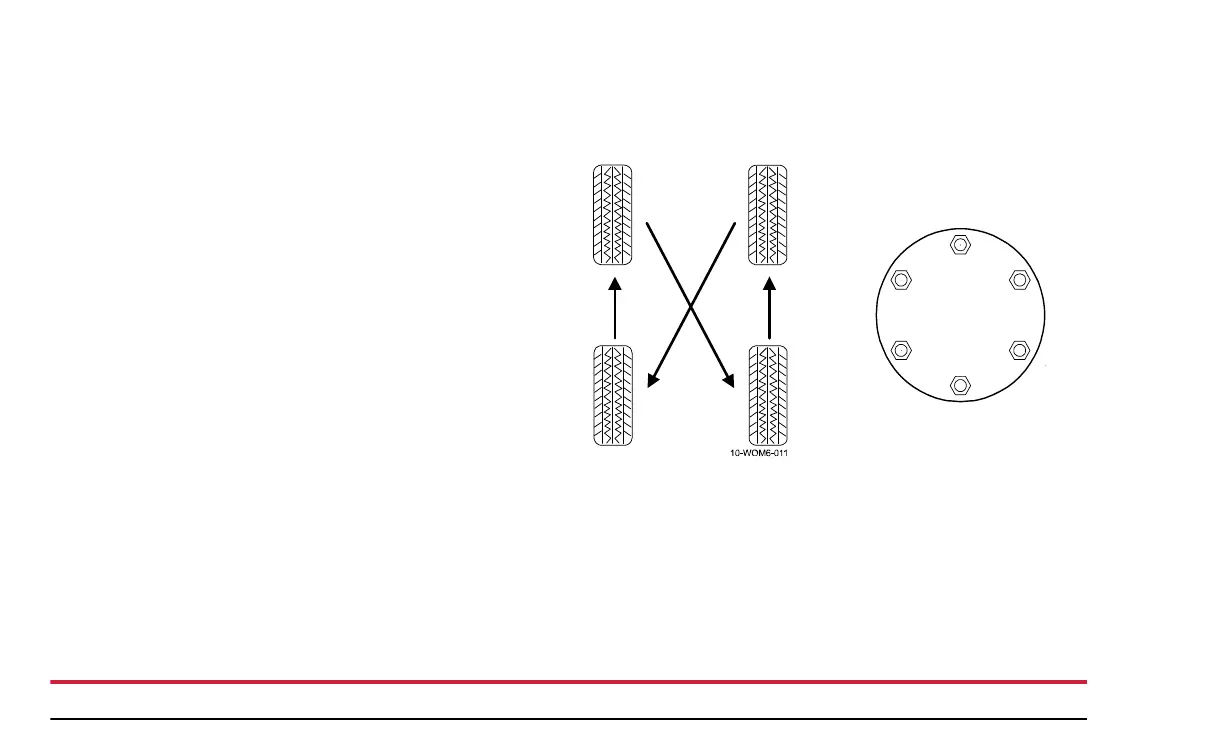
Regular tire rotation will help your tires wear more evenly, pro-
viding better performance and longer tire life. You should rotate
your tires every 7,500 miles (12,000 km) for normal use or
every 5,000 miles (8,000 km) for commercial fleet use. The
illustration below shows the recommended tire rotation for your
rear-wheel drive MV-1. Tighten the wheel lug nuts to 96 lb-ft
(130 Nm) in order shown on the right and check the torque peri-
odically thereafter.
Sometimes irregular tire wear can be corrected by rotating the tires.
NOTE:
If your tires show uneven wear, ask an authorized
service center to check for and correct any wheel
misalignment, tire imbalance or mechanical problem
involved before tire rotation.
NOTE: After having your tires rotated, check tire pressure
and adjust to the recommended inflation pressure.
Front of Vehicle
Lug Nut
Tightening Order


 To Next Page