Determining The Oil Pattern
61-900040-000 Rev. Date: 01/22 6-7
visually inspect the lane for more or less oil than desired and use the finger smear
technique to gauge more or less oil. Refer to Section 6.4.1 - Finger Smear Technique.
Oiled Area
Two adjustments can be made to change the amount of oil applied to the lane:
Adding or removing a second oiling or buffing pass
Using higher or lower flow wicking foams
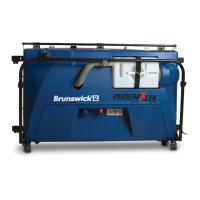
The second pass option runs the Phoenix LT4 down the lane a second time. During this
transit, more oiling and buffing will occur. The second pass settings are independent of the
first pass settings. Instructions for adding a second pass can be found in Section 3.2.2 –
Editing Program Specifications.
Changing wicking foams allows for the application of more or less oil to the lane without
making major changes to the programs or the machine. For information about the wicking
foam oil outputs, refer to Section 6.5 - Creating Oil Output Patterns or Section 4.4.3 –
Replacing the Wicking Foams.
Buffed Area
Buffing can provide more oil down the length of the lane without adding more oil in the head
area. As mentioned previously, the buffing distance must be at least equal to the oiling
distance but it can be greater. Additionally, buffing can take place without adding oil to the
lane.
The amount of oil in the buffed area is controlled by several factors which include:
The buffing distance
The oiling distance
The amount of oil applied in the oiled area
The number of buffing passes
Oil viscosity
The amount of oil at the end of the oiled area can be increased or decreased by
lengthening or shortening the oiling distance. A longer buff-only area will create an area
where the amount of oil on the lane gradually decreases (the ball will gradually start to hook
past the transition). By eliminating or using a very short buff only zone, a sharp edge can
be created (the ball will "snap" or start hooking immediately at the transition). It is important
to note that neither the gradual hook nor the "snap" at the transition zone are the "right"
answer. The transition zone is a part of the game just like the oil pattern. Instructions for
changing the buffing distance can be found in Section 3.2.2 – Editing Program
Specifications.
If changing the buffing distance does not result in the amount of oil desired in the buffed
area, consider changing the oiling distance. A shorter oiling distance will result in less total
oil being applied to the buffed area; a longer oiling distance will result in more oil total being


 To Next Page