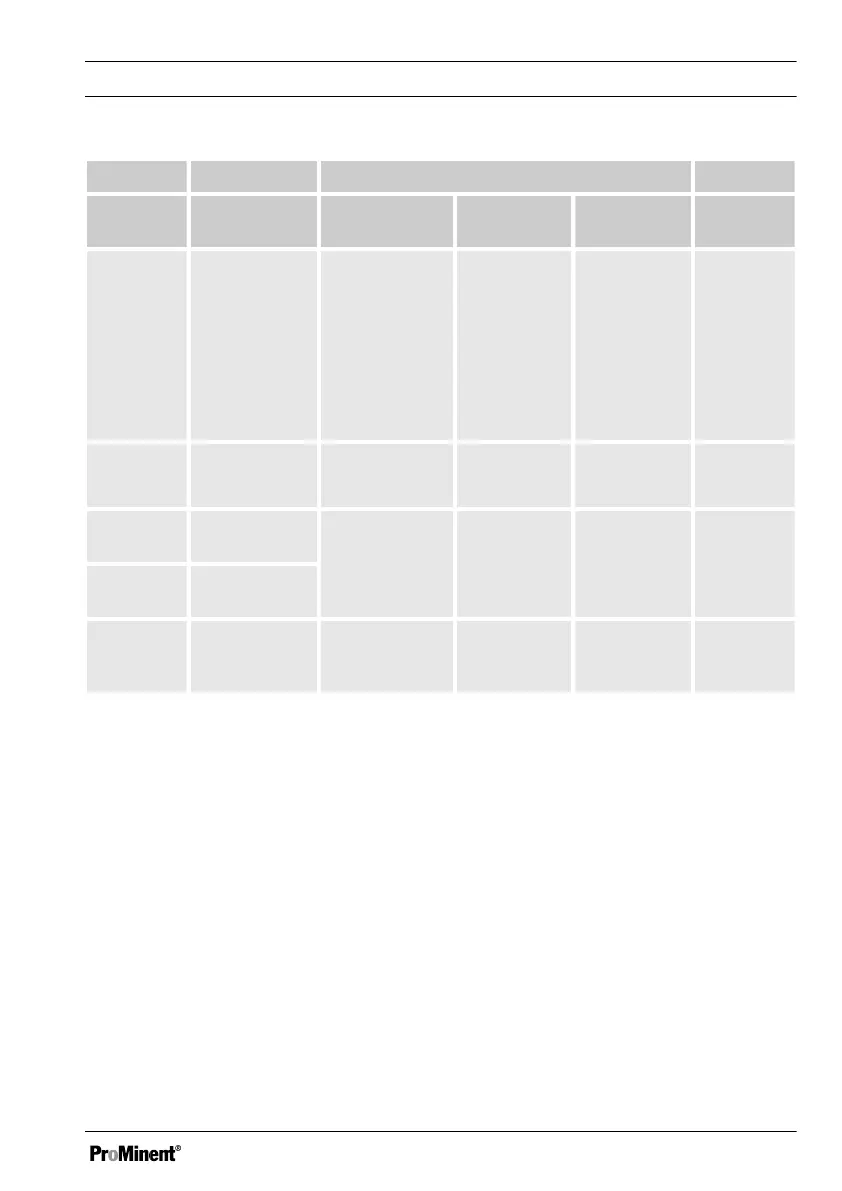
Possible values
Factory set‐
ting
Increment Lower value Upper value Remarks
Checkout
time limits
∆t on
Off 1 s 1 s 9999 s Results in
message
and alarm,
Off = 0 s,
function
switched
off No
message,
no alarm
Control On On
Off
Limit value
1 (GW1)
Active closed Active closed /
Active open
Acts as N/
O
Limit value
2 (GW2)
Active closed
Switch-on
delay ∆t
on
0 s 1 s 0 s 9999 s 0 s = off
If the limit is exceeded for longer than the "Checkout time limits (∆t on)", then a fault mes‐
sage will be triggered that has to be acknowledged and the alarm relay is deactivated. If
the "controller" is also set to "Off" then the control process is stopped.
"Lower limit" means that the limit criterion has been undercut.
"Upper limit" means that the limit criterion has been exceeded.
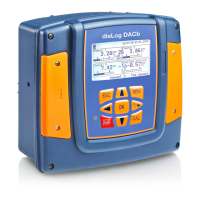
The DULCOMETER
®
D1Cb / D1Cc has an option for defining "Hysteresis limits".
The "hysteresis" works towards rectifying the limit transgression, i.e. if the "limit 1 upper"
of, for example, pH 7.5 has been exceeded at a set hysteresis limit of, for example, pH
0.20, then the criterion for limit transgression is redundant when the value drops below
the lower limit of pH 7.3. The hysteresis behaviour for a "lower limit" functions in a similar
way (the hysteresis value is added to the limit). In this way it is possible to forego an
external relay in self-retaining mode.
If the limit is exceeded for longer than the "Delay period limits
∆t on", then an acknowl‐
edgeable fault message will be triggered and the alarm relay is deactivated. If the "con‐
troller" is also set to "Off" then the control process is stopped.
Operating Menus Independent of Measured Variables
123





 To Next Page