Reference Manual
00809-0100-4360, Rev BA
August 2008
4-7
Rosemount 1151
The last trim/input values used will be displayed briefly. The engineering units
shown match those selected under configuration or in transmitter
characterization.
In selecting the pressure input values, the low and high values should be
equal to or outside the 4 and 20 mA points. Do not attempt to obtain reverse
output by reversing the high and low points.
Compensating for High
Static Pressure
Systematic Error Correction
One feature of sensor trim is the ability to use it to improve the Rosemount
1151 Smart DP or HP performance by correcting for systematic error because
of static pressure.
NOTE
Corrections can only be made in linear mode. Switch from square-root mode
to linear mode if necessary.
To better understand the effect of static pressure on the Rosemount
1151DP/HP transmitter, below is a technical description.
Static pressure affects the -cell in two independent ways. First, with zero
input differential, the effects on the high and low side of the cell tend to cancel
each other, but this cancellation may not be complete at higher static
pressures. The slight remaining difference in output is called the Static
Pressure Effect On Zero. While the magnitude of the zero effect is
predictable, its direction is not. The effect is repeatable, however, and can be
eliminated by simply rezeroing the transmitter at line pressure.
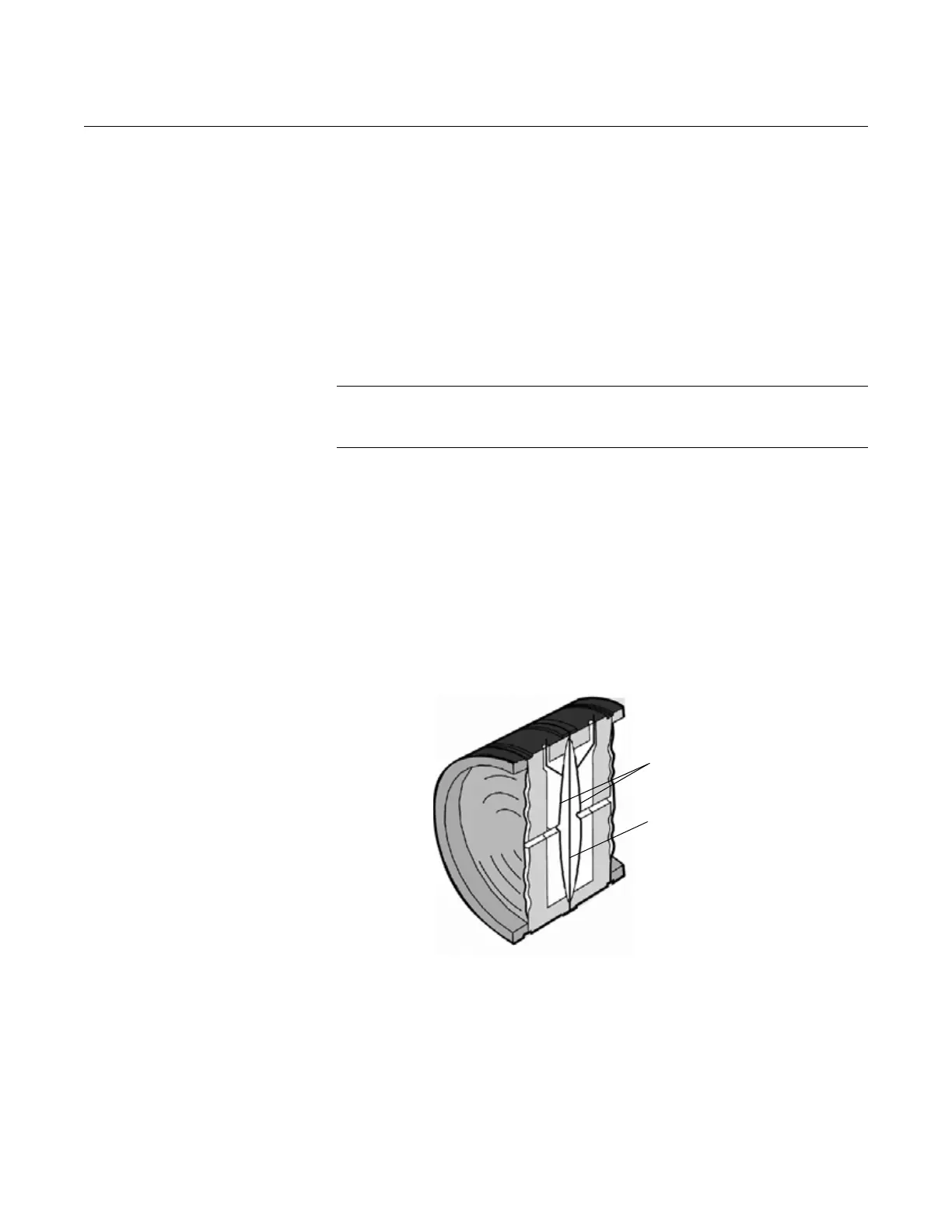
Figure 4-4. -Cell
™
Construction.
.
Second, transmitter span is also affected by static pressure. To understand
this effect, it is necessary to understand the inner workings of the -cell
sensor.
The -cell sensor is a variable capacitance device. Differential pressure is
sensed as a capacitance that varies with the position of a movable plate, or
sensing diaphragm, between two fixed plates. See Figure 4-4.
In the actual cell design, the sensing diaphragm is stretched between the
fixed plates and welded to the cylindrical body of the cell.
Capacitor
Plates
Sensing
Diaphragm





 To Next Page