Reference Manual
00809-0100-4360, Rev BA
August 2008
Rosemount 1151
4-8
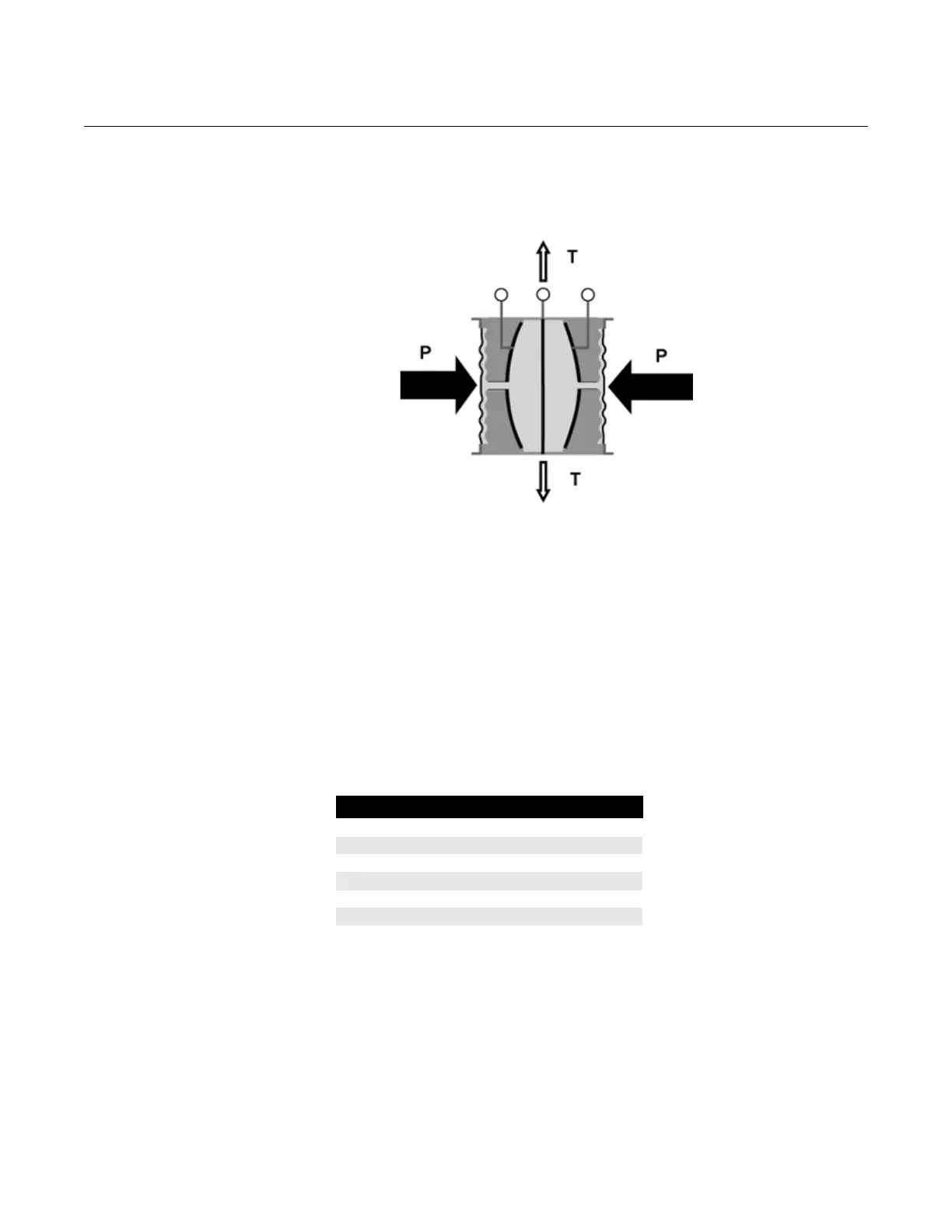
When high pressure is applied to both sides of the cell, a slight deformation
takes place, increasing tension in the sensing diaphragm. See Figure 4-5.
Figure 4-5. Static Pressure
Effect on the -Cell Sensor.
This increase in tension causes a reduction in transmitter output; as static
pressure increases, output for any given differential decreases. In other
words, as static pressure increases, a slightly higher differential pressure is
required to move the sensing diaphragm a given amount. This static pressure
effect is repeatable and linear, because it is within the realm governed by
Hooke's Law, which states that a body acted upon by an external force will
deform linearly, proportional to the stress, so long as a certain limit is not
exceeded.
High static pressure causes a systematic span shift in the transmitter.
Because static pressure always acts to reduce span and is linear, it is easy to
correct the effect during calibration by performing a sensor trim. Table 4-2
shows the amount of systematic span shift for Range Codes 3 through 8.
Table 4-2. Systematic Span
Shift
Correction for systematic error is made by simply calculating a correction
factor for the high trim and low trim and inputting this correction into the
transmitter.
To correct for systematic error due to static line pressure, use the following
formulas to determine a corrected value for Low Trim and High Trim.
Range Code 316L SST Alloy C-276
3 –1.75% –1.0%
4 –0.90%
(1)
(1) Applies also to Rosemount 1151HP.
–0.60%
5–0.80%
(1)
–0.70%
6 –1.50%
(1)
–1.45%
7–1.00%
(1)
–1.05%
8 –0.65% –0.65%





 To Next Page