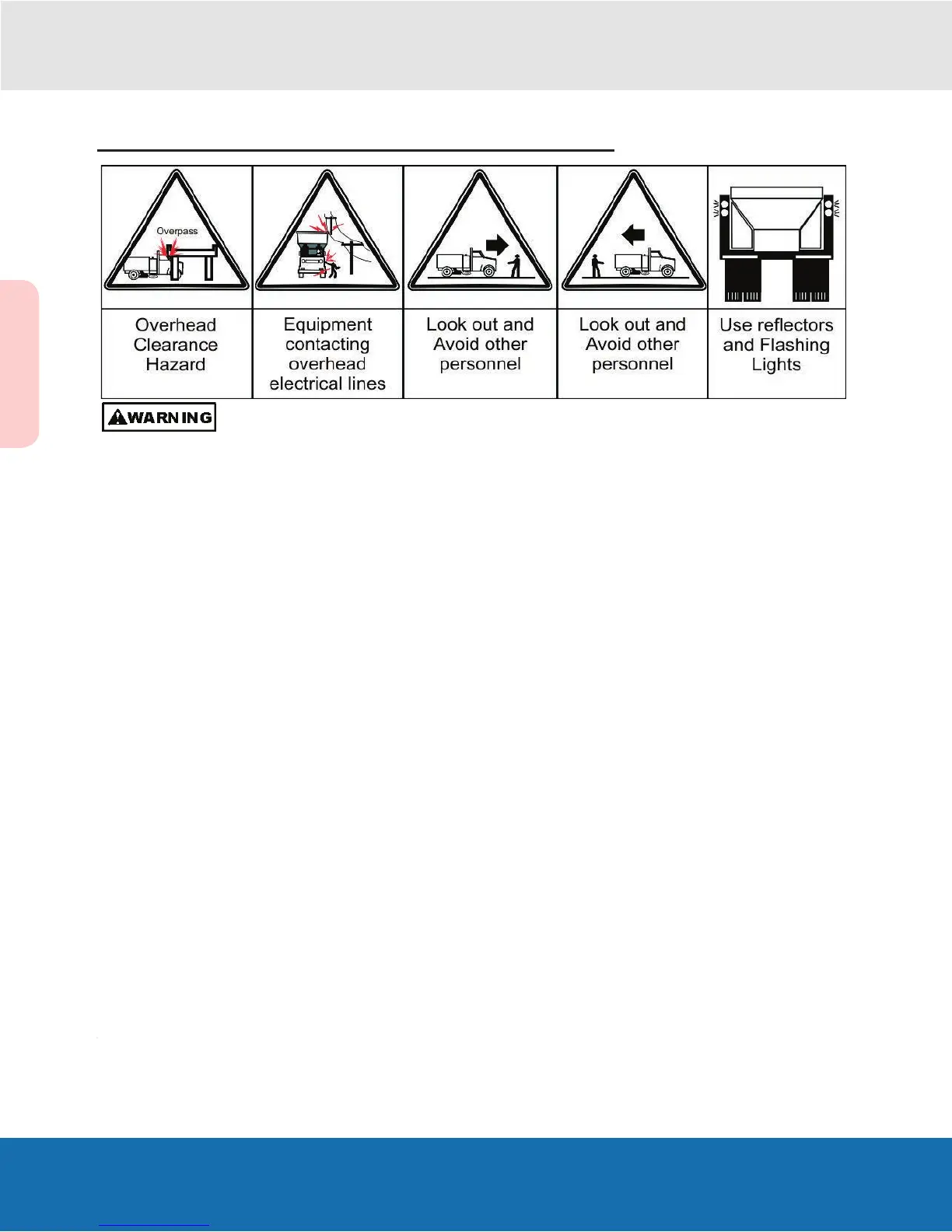
TO AVOID SERIOUS INJURY AND DEATH WHEN OPERATING OR TRANSPORTING EQUIPMENT:
• REDUCE SPEED on inclines, on turns and in poor towing conditions.
•
DO NOT TOW with trucks or other vehicles.
• FOLLOW all local traffic regulations.
BEFORE TRANSPORTING OR TOWING IMPLEMENT:
TRUCK INSPECTION:
•
CHECK steering and braking for proper operation and in good condition.
• CHECK reflectors and warning lights for proper operation and visibility behind unit.
•
ROUTINELY inspect the equipment’s headlights, brake lights, backup lights, and turn signal lights for
operational condition.
• Always turn on all safety lights and flashers when you operate the implement.
•
CHECK that your driving vision is not impaired by cab while seated in truck seat.
•
ADJUST your operating position, mirrors, and implement transport for clear vision for traveling and traffic
conditions.
DETERMINE STOPPING CHARACTERISTICS OF TRUCK AND IMPLEMENT FOR TRANSPORTING OR
OPERATING:
BRAKING TESTS:
• Stopping distance with loaded debris body will be greater than empty truck.
• Reduce travel speed on wet or icy roads; stopping distances increase.
DETERMINE MAXIMUM TURING SPEED BEFORE OPERATING ON ROADS OR UNEVEN GROUND:
•
TEST equipment in slowly increasing speed in turns to determine it can be operated at higher speeds.
•
USE REDUCED turning speeds in sharp turns to avoid equipment turning over.
WHEN OPERATING OR TRANSPORTING EQUIPMENT:
• Do Not Move truck unless hopper body is fully lowered in the horizontal storage position.
• Always WEAR SEAT BELT when driving truck.
• FOLLOW all local traffic regulations.
• USE low speeds to avoid overturn tip over when Hopper body is filled.
• USE low speeds and gradual steering on curves, hills, rough or uneven surfaces and on wet roads.
• TURN ON truck FLASHING WARNING LIGHTS when driving slower than traffic.
• Only transport the truck at the speeds determined as safe and which allow for proper control of the
machine while driving and stopping during an emergency.
• DO NOT leave piled material on roadway, material can be a hazard to other motorist.
TO AVOID SERIOUS INJURY OR DEATH FROM ELECTRICAL CONTACT WHEN WORKING AROUND
ELECTRICAL POWER LINES AND UTILITY LINES:
•
INSPECT area for overhead power lines, obstructions, cables and Utility lines, Municipal, or other type
structure.
•
KEEP sweeper dump body 10 feet or greater distance from all power lines and overhead obstructions.
• DO NOT allow dump body to contact with any Utility, Municipal, or type of structures and obstructions.
THSP-01


 To Next Page