EasyManua.ls Logo

Solartron 1260 - 1260 Analyzer Test Modules Overview

Solartron 1260
295 pages
Print Icon
To Next Page IconTo Next Page
To Previous Page IconTo Previous Page
Loading...
INTRODUCTION
1
Connections
to
the
item
under
test
are
made
from
BNC
sockets
on
the
instrument
front
nanel
The
GENERATOR
output is
connected
to
the
input
oi
the
item
under
test,
and
three
input
channels,
VOLTAGE
1,
VOLTAGE 2,
and
CURRENT,
are
available
for
measuring
the
test
response.
Connections
can
be
made
directly
to
the
front
panel
connectors,
using
suitably
terminated
screened
leads.
Or,
for
impedance
measurements,
connections
can be
made
via
a
test
module
which
fits
over the
connectors.
2
THE
TEST
MODULES
Two
types
of
impedance
test
module
are
available:
the
12601
module,
for
testing
loose
components,
and
the
12603
module,
for
measuring
coi
®^
ircult
B
°
th
are
available
as
options.
A
FIXTURE
facility
(in
the
ANALYZER
menu)
allows
the
analyzer
Voltage
1
inputs
to be
set
for use
with
either
test
module,
with
one
contro
setting
(see
page
5.9).
2.1
12601
COMPONENT
TEST
MODULE
The
12601
component
test
module
makes
it
easy
to
connect
loose
components
to
the
instrument
front
panel
terminals.
2.1.1
Component
Clamps
Two
types
of
component
damps
are
supplied
with the
module.
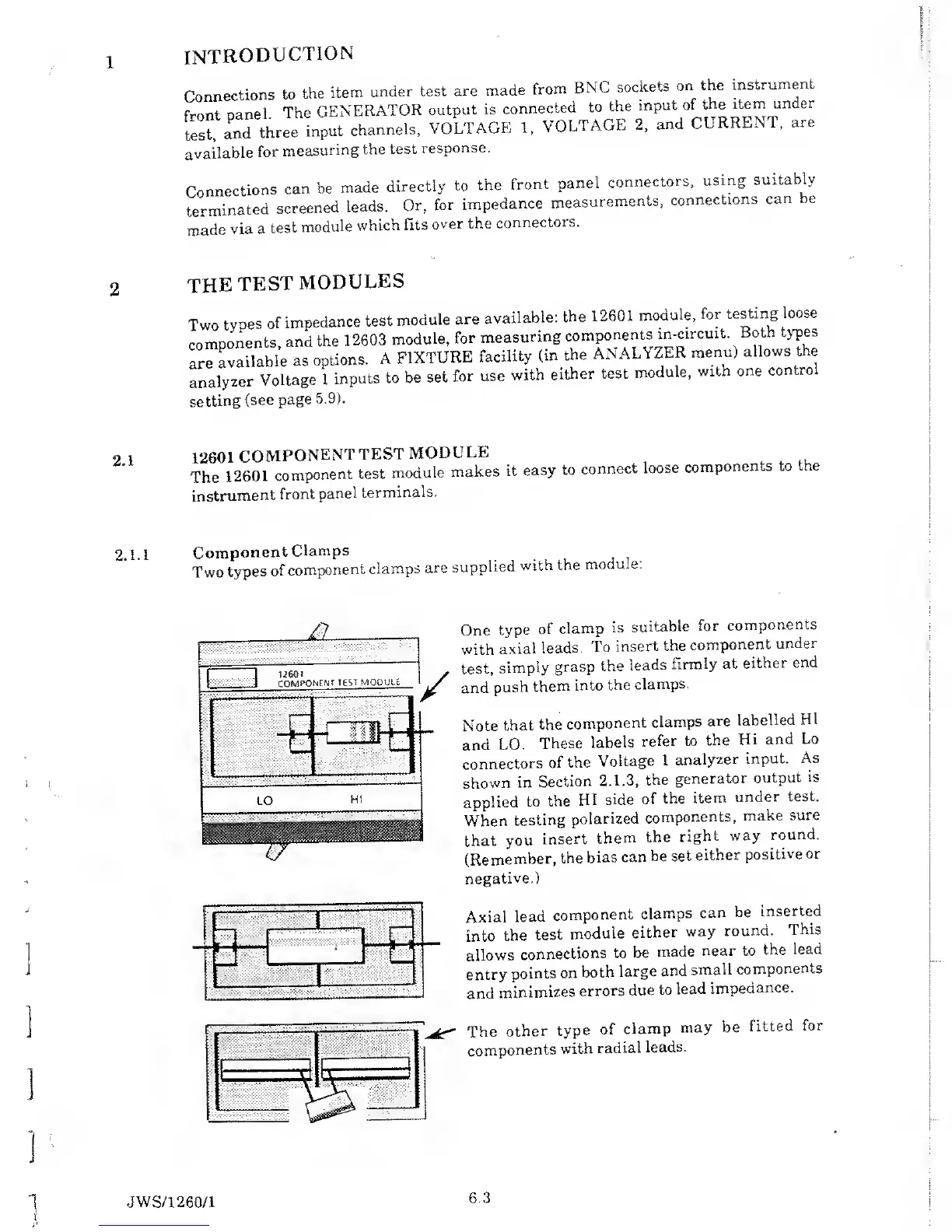
One
type
of
clamp
is
suitable
for
components
with
axial
leads.
To
insert
the
component
under
test,
simply
grasp
the
leads
firmly
at
either
end
and
push
them
into
the
clamps.
Note
that
the
component
clamps
are
labelled
HI
and LO.
These
labels
refer
to
the
Hi
and
Lo
connectors
of the
Voltage
1
analyzer
input.
As
shown
in
Section
2.1.3,
the
generator
output
is
applied
to
the
HI
side
of
the
item
under
test.
When
testing
polarized
components,
make
sure
that
you
insert
them
the
right
way
round.
(Remember,
the
bias
can
be
set
either
positive
or
negative.)
Axial
lead
component
clamps
can be
inserted
into
the
test
module
either
way
round.
This
allows
connections
to
be
made
near to
the
lead
entry
points
on
both
large
and
small
components
and
minimizes
errors
due
to
lead
impedance.
The
other
type
of
clamp
may be
fitted
for
components
with
radial
leads.
JWS/1 260/1
6.3

Table of Contents

Related product manuals