EasyManua.ls Logo

Solartron 1260 - Floating Point Format; All Data)

Solartron 1260
295 pages
Print Icon
To Next Page IconTo Next Page
To Previous Page IconTo Previous Page
Loading...
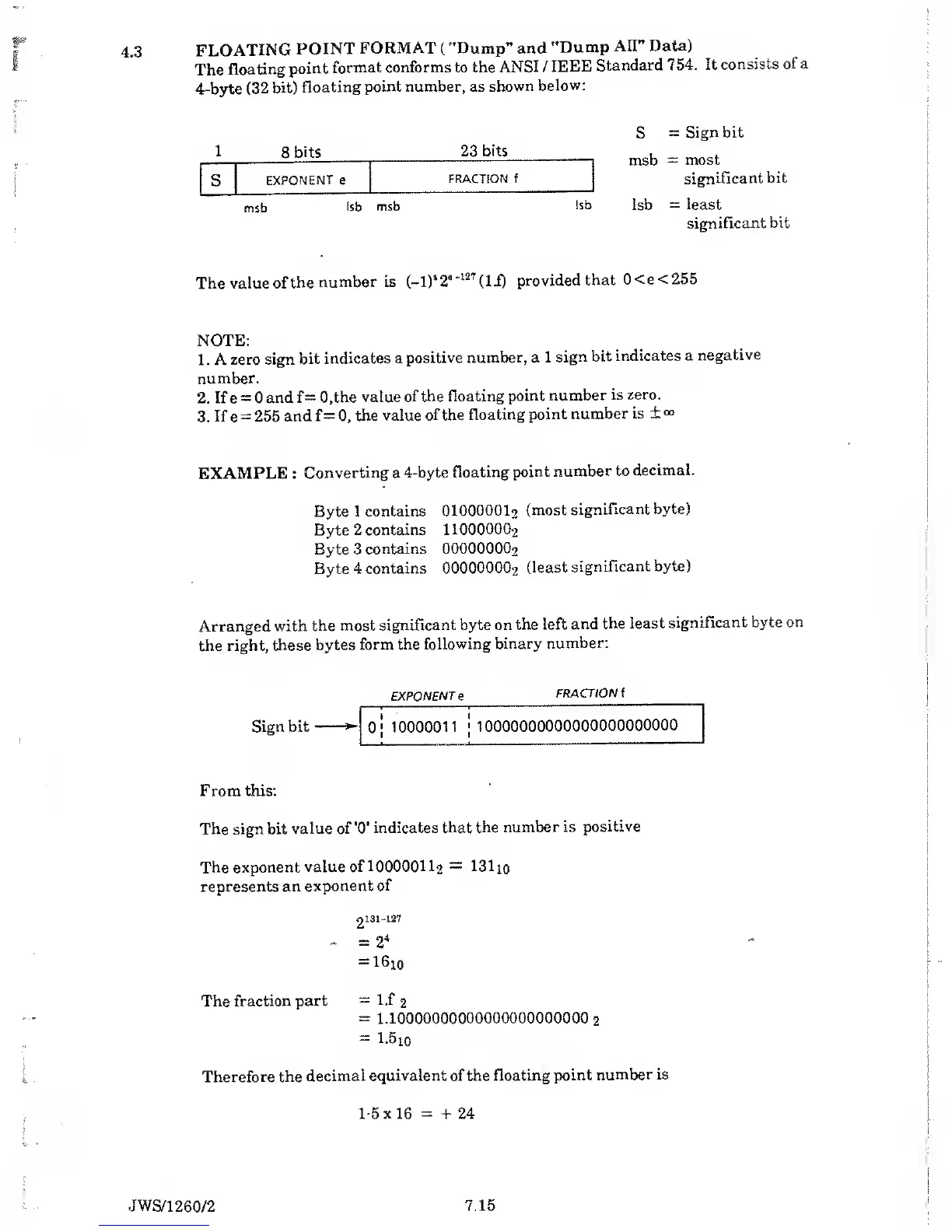
4.3
FLOATING
POINT
FORMAT
(
"Dump”
and
"Dump
All” Data)
The
floating
point
format conforms to the
ANSI /
IEEE
Standard
754.
It
consists
of
a
4-byte (32
bit)
floating
point number, as
shown
below:
1
8
bits
23 bits
s
msb
=
Sign
bit
=
most
significant bit
s
EXPONENT
e
FRACTION
f
msb
Isb msb
Isb
Isb
=
least
significant bit
The value
of the
number is (-l)
s
2
e
'
127
(l.f)
provided
that
0<e<
255
NOTE:
1. A zero
sign
bit indicates
a
positive
number,
a
1 sign
bit
indicates a
negative
number.
2.
If
e
=
0 and
f= 0,the
value
of the floating
point
number
is zero.
3.
If
e
=
255 and
f
=
0,
the value
of
the
floating
point
number
is ±
EXAMPLE :
Converting a
4-byte
floating
point
number to
decimal.
Byte
1 contains
Byte
2 contains
Byte 3
contains
Byte
4 contains
OIOOOOOI
2
(most
significant byte)
IIOOOOOO
2
OOOOOOOO
2
OOOOOOOO
2
(least
significant
byte)
Arranged
with the
most significant byte
on the
left
and the
least
significant
byte
on
the
right, these
bytes
form the
following binary
number:
Sign bit
EXPONENT
e
FRACTION
f
0
;
10000011
;
10000000000000000000000
From
this:
The sign bit
value of
*0*
indicates that
the
number is
positive
The exponent
value
of 100000 I I
2
=
131
10
represents an
exponent
of
2131-127
-
=
2
4
=
16io
The
fraction part
=
l.f
2
=
1.10000000000000000000000
2
=
1.5io
Therefore the
decimal
equivalent of the floating
point
number is
1-5x16
=
+
24
JWS/1
260/2
7,15

Table of Contents

Related product manuals