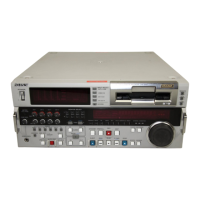
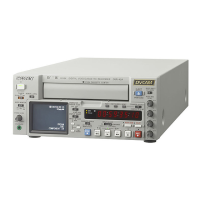
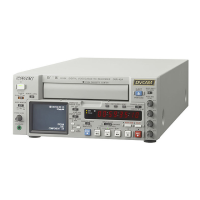
1-1. DSR-2000
Appendixes
146
Appendixes
S VIDEO OUT DIN 4-pin ×1
Y: 1.0 Vp-p, 75 Ω, sync negative
C: 0.286 Vp-p (DSR-2000) or
0.3 Vp-p (DSR-2000P), 75 Ω
(burst level)
COMPONENT VIDEO OUT Y/R
–Y/B–Y
BNC type ×3, component video
Y: 1.0 Vp-p, 75 Ω, sync negative
R–Y: 0.7 Vp-p, 75 Ω (75% for
DSR-2000 or 100% for DSR-
2000P)
B–Y: 0.7Vp-p, 75 Ω (75% for
DSR-2000 or 100% for DSR-
2000P)
Analog audio output
AUDIO OUT XLR 3-pin (male) ×4, +4/0/–6 dBu
(selectable by menu setting),
600 Ω loaded, low impedance,
balanced
MONITOR AUDIO
Phono jack ×1, –11 dBu, 47 kΩ
load, unbalanced
Digital audio output
DIGITAL AUDIO (AES/EBU) OUT CH-1/2, CH-3/4
BNC×2, complying with AES-3id-
1995
Headphone output
HEADPHONES Stereo phone jack ×1, –∞ to
–13 dBu, 8 Ω, unbalanced
Timecode output
TIME CODE OUT
BNC type ×1, SMPTE (DSR-
2000)/EBU (DSR-2000P)
2.2 Vp-p±3.0 dB, 600 Ω,
unbalanced, (when 75 Ω
terminated)
Control connectors
VIDEO CONTROL
D-sub 15-pin, male, for connection
of optional UVR-60/60P or BVR-
50/50P
CONTROL PANEL
D-sub 15-pin, female, for
connection of optional DSBK-200
REMOTE-IN D-sub 9-pin, female, for connection
of another DSR-2000/2000P unit or
other editing controller, complying
with RS-422A
REMOTE-OUT D-sub 9-pin, female, for loop-
through output of signals from the
REMOTE-IN connector
Accessories supplied
AC power cord (1)
Operating Instructions (1)
RCC-5G 9-pin remote control cable (1)
Accessories not supplied
DSBK-210 SDTI-CP Output Board
DSBK-190 i. LINK/DV Input/Output Board
RCC-5G 9-pin Remote Control Cable, 5 m (16 ft) long
DSBK-200 Control Panel
RMM-130 Rack Mount Kit
PDV-64ME/94ME/124ME/184ME Digital Video
Cassette (standard size)
PDVM-12ME/22ME/32ME/40ME Digital Video
Cassette (mini-size)
DV12CL Cleaning Cassette (standard size)
DVM12CL Cleaning Cassette (mini-size)
Design and specifications are subject to change
without notice.
Specifications
Appendixes
Appendixes
147
ClipLink
TM
Guide
What Is ClipLink?
The ClipLink
TM
function greatly improves the
efficiency of the video production process as a whole
by recording various editing-related data on tape when
shooting. As such, ClipLink is a revolutionary
function that transcends the conventional separation of
shooting and editing.
How ClipLink Changes Video Production
Techniques
The following describes various ways in which
ClipLink
1)
video production differs from conventional
video production.
Recording of ClipLink log data lightens the
shooting workload
When you start shooting a scene, ClipLink log data
such as the scene number and time code data are
automatically recorded into the cassette memory. This
eliminates the need for a conventional
“shot list”
compiled by someone using a stopwatch, clipboard
and pencil. You can also designate unwanted scenes
as “NG” (no good) and automatically skip all
“NG”
scenes when editing.
Recorded Index Pictures drastically cut
editing time
The ClipLink function also features Index
Pictures a time-saving tool for rough editing. Each
Index Picture is a compressed image taken from the
start of each scene, which is recorded onto the tape as
a still picture. When editing, begin by transferring
only the Index Pictures and the ClipLink log data to
the EditStation’s hard disk. You can also transfer OK
scenes only (“NG” scenes are skipped).
Next, begin rough editing by viewing the Index
Pictures on the EditStation
’s GUI display and
rearranging them as you wish. This eliminates the
difficult work of matching up a handwritten shot list
with recorded scenes. After you have completed this
rough editing, you can then transfer only the
recordings needed for your video program.
High-speed transfer of recordings
It is also possible to transfer the editing material itself
between the DSR-85/85P and ES-7 at four times
normal speed. In other words, the transfer can be
carried out in one fourth of the real time duration. It is
of course possible to carry out a transfer at four times
normal speed when backing up video and audio data
recorded on the disk drive to the DSR-85/85P, or in the
opposite direction when loading data backed up on the
DSR-85/85P to the disk drive. Thus the time required
is much shorter than with conventional equipment (for
which, for example, transferring a 40-minute segment
of video takes 40 minutes).
Note
To transfer digital signals (video, audio and time code)
recorded on a tape on this unit from the DSR-85/85P
to the ES-7 at four times normal speed requires a
continuous recorded section of about 40 seconds
before the IN point on the recorded tape.
...............................................................................................................................
...........................................................................
1) The ClipLink system is a video production system which
uses the cassette memory function.



 To Next Page