20
Step 4: Connecting the Audio Cords
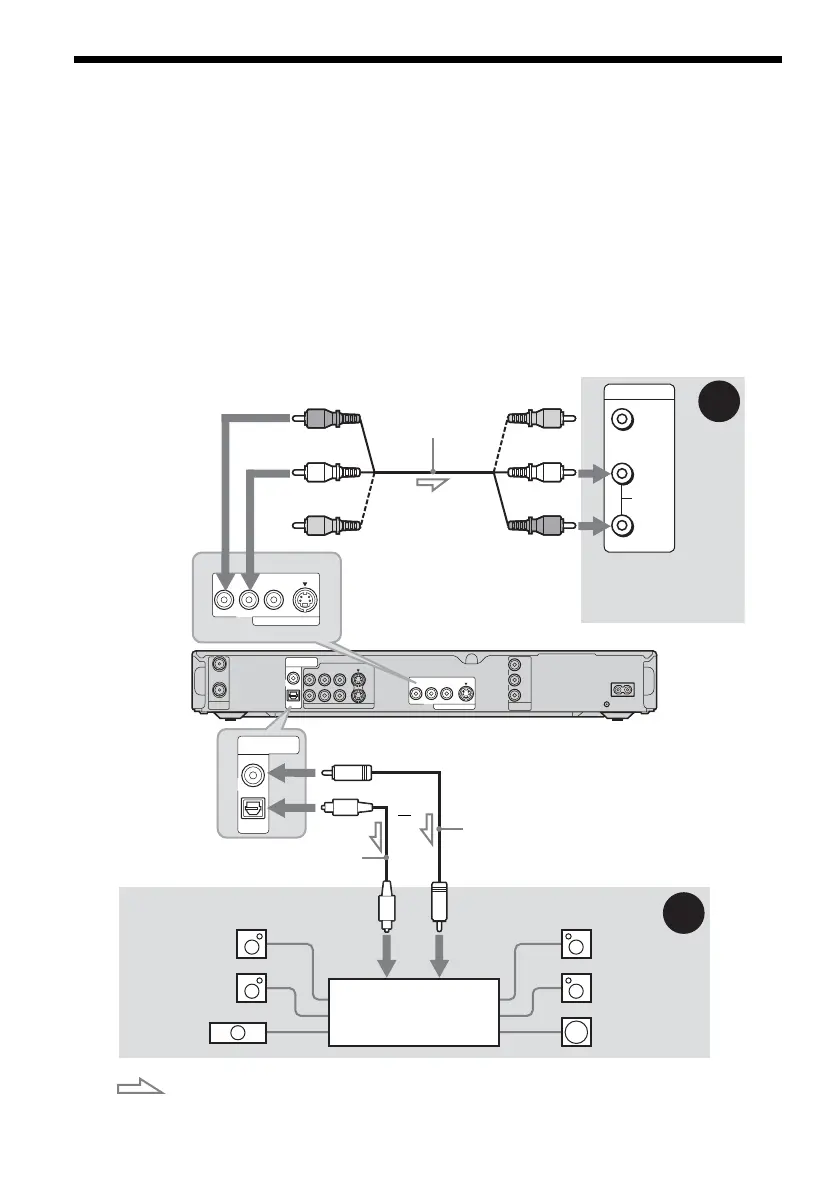
Select one of the following patterns A or B, according to the input jack on your TV monitor, projector,
or AV (audiovisual) amplifier (receiver). This will enable you to listen to sound.
A Connecting to audio L/R (left/right) input jacks
This connection will use your TV’s or stereo amplifier’s (receiver’s) two speakers for sound. You can
enjoy the following surround effects (page 57).
• TV: Dynamic, Wide, Night
• Stereo amplifier (receiver): Standard, Night
B Connecting to a digital audio input jack
If your AV (audiovisual) amplifier (receiver) has a Dolby
*1
Digital or DTS
*2
decoder and a digital input
jack, use this connection. You can enjoy Dolby Digital (5.1ch) and DTS (5.1ch) surround effects.
* The yellow plug is used for video signals (page 18).
VIDEO
AUDIO
INPUT
L
R
COAXIAL
DIGITAL OUT
OPTICAL
PCM/DTS/DOLBY DIGITAL
VHF/UHF
IN
LINE IN
COMPONENT
VIDEO OUT
LINE OUT
VIDEO
S VIDEO
R-AUDIO-L
PB
Y
P
R
~ AC IN
OUT
1
3
VIDEO
S VIDEO
R-AUDIO-L
B
A
3
LINE OUT
VIDEO
S VIDEO
R-AUDIO-L
COAXIAL
DIGITAL OUT
OPTICAL
PCM/DTS/DOLBY DIGITAL
AV (audiovisual)
amplifier (receiver)
with a decoder
(red)
TV, projector, or AV
(audiovisual) amplifier
(receiver)
Audio/video cord
(supplied)
: Signal flow
Coaxial digital cord (not supplied)
to DIGITAL OUT (digital out) (COAXIAL (coaxial) or OPTICAL (optical))
to LINE OUT (line out) (R-AUDIO-L
(right-audio-left))
Optical digital cord (not supplied)
Rear (L (left))
DVD (digital video disc) recorder
(white)
(yellow)*
(yellow)
(white)
(red)
[Speakers]
Front (L (left))
[Speakers]
to coaxial digital
input
Rear (R (right))
Front (R (right))
SubwooferCenter
to optical digital
input
or



 To Next Page