4.12.1 ASK communication
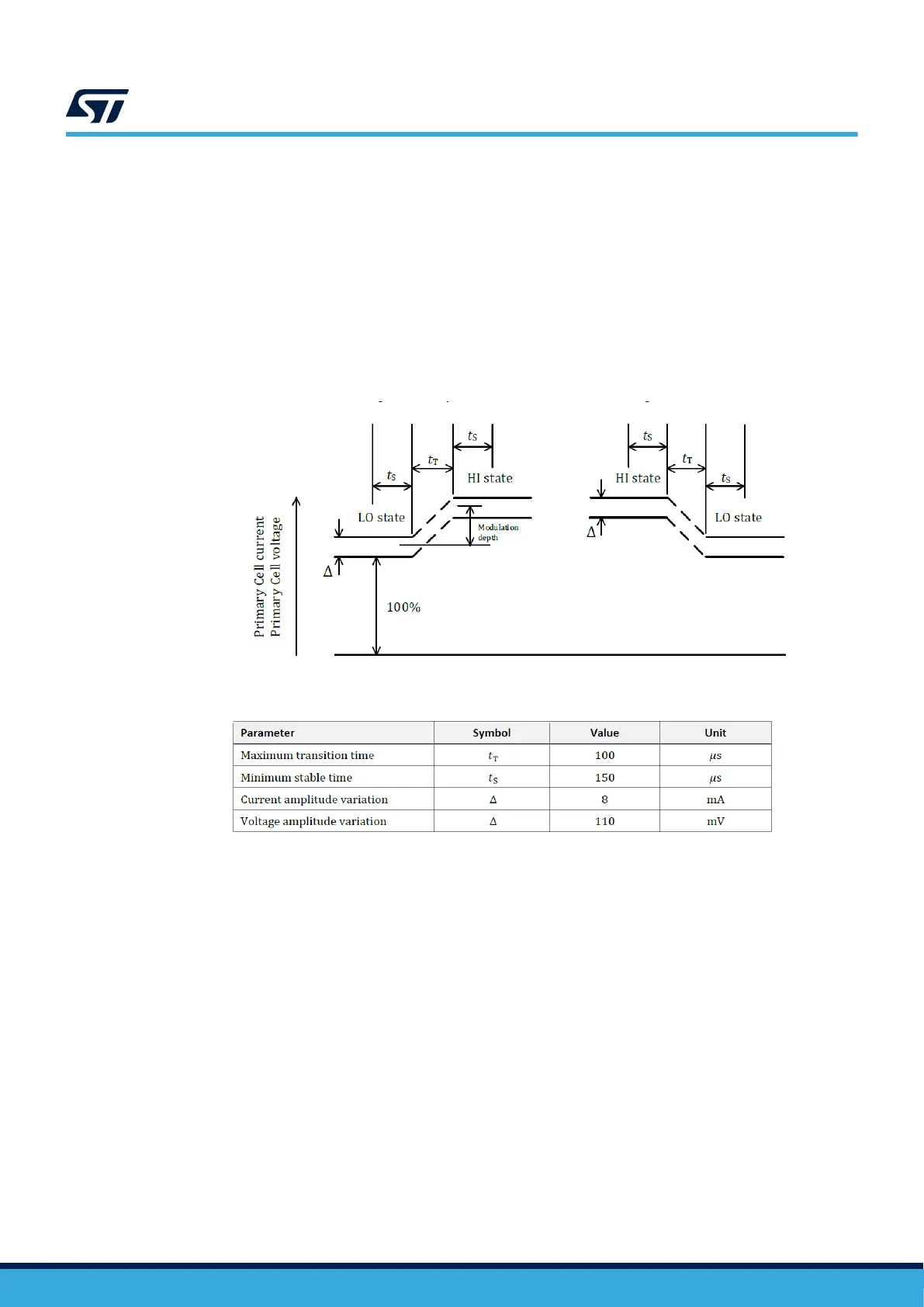
A state (either high or low) is characterized by the amplitude being constant (with a certain variation Δ) for at least
150 ms.
If the power receiver and the power transmitter coils are properly aligned, then for all appropriate loads at least
one of the following three conditions apply.
• The difference of the amplitude of the transmitter coil current in the high and low state is at least 15 mA
• The difference of the amplitude of the transmitter coil voltage in the high and low state is at least 200 mV
• The difference of the transmitter coil current in the high and low state is at least 15 mA. The transmitter coil
current is measured at instants in time that correspond to one quarter of the cycle of the control signal
driving the half-bridge inverter
Figure 44. Amplitude modulation of the Power Signal
Note: For more details refer to: The Qi Wireless Power Transfer System Power Class 0 Specification,
Parts 1 and 2: Interface Definitions, Version 1.2.4 February 2018.
The power receiver uses a differential bi-phase encoding scheme to modulate the data bits onto the power signal.
The power signal is then demodulated by the power transmitter’s external demodulation circuit and the
demodulated signal is fed into the VS pin of STWBC86 for processing.
The communication itself is carried out via packets. Each packet consists of 4 parts and each of those parts
consists of several bits/bytes.
Each communication bit is synchronized to the power receiver’s internal 2 kHz clock signal period. A ONE bit is
encoded as two transitions of the power signal, while a ZERO bit is encoded as a single transition.
UM3161
Bidirectional communication
UM3161 - Rev 1
page 35/78


 To Next Page