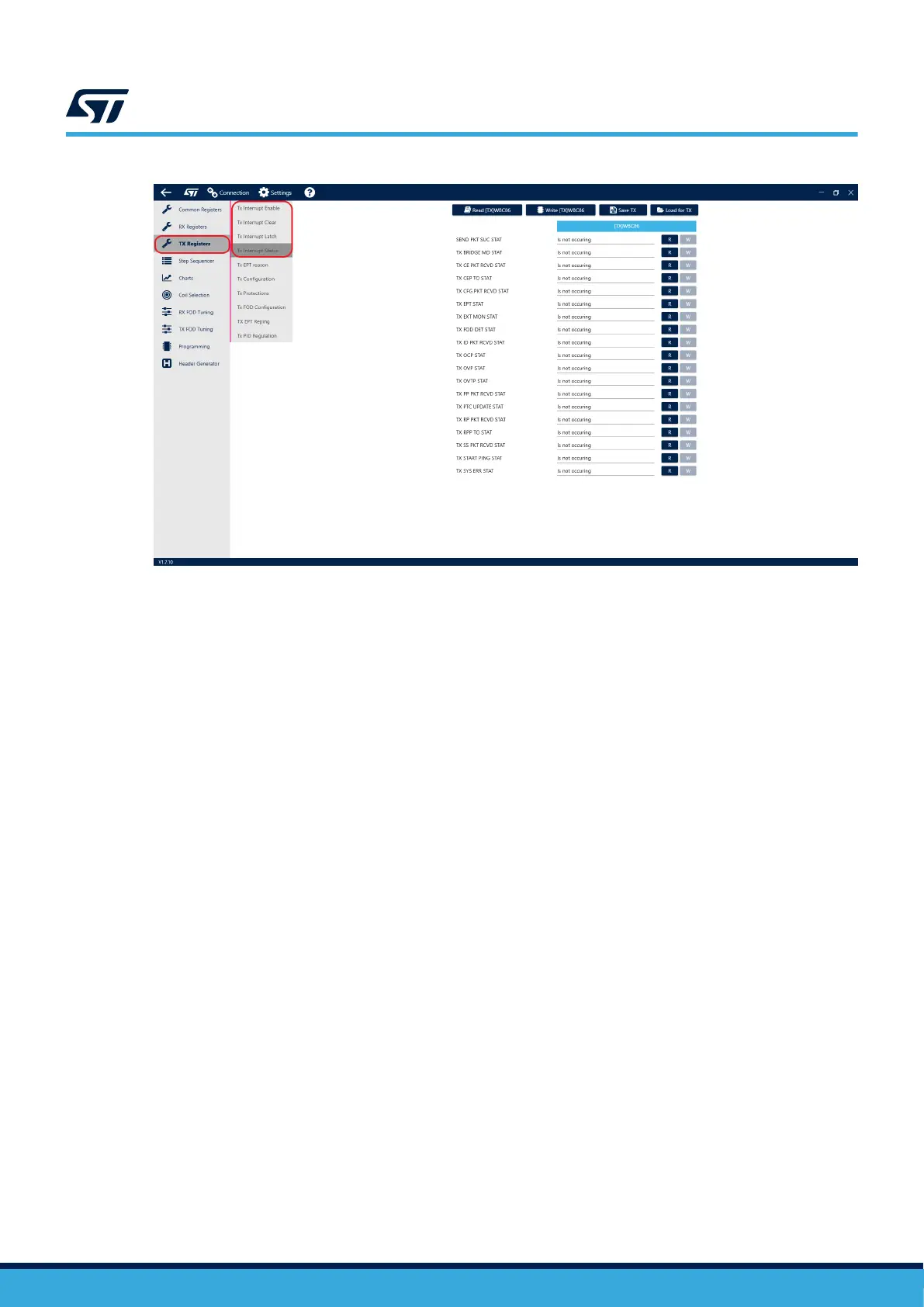
Figure 55. Interrupt registers
4.16 Frequency hopping (fhop)
One of the most common causes of ASK demodulation failure is noise produced by the adapter supplying power
to the transmitter. The noise interferes with the communication, which may cause the decoding to fail, as the
principal components of the noise are often close to the 2 kHz ASK communication frequency.
The STWBC86 features a frequency hopping (fhop) function that tries to improve the communication conditions
by shifting the operating frequency by a set step whenever CE timeout occurs, as the new operating point may be
less affected by the interference.
The fhop feature can be enabled and configured in the Tx Configuration section of the Tx Registers tab:
• TX CE TO MAX defines the number of CEP timeouts that the device must register before terminating the
power transfer. When set to 1, the device terminates the power transfer immediately after registering a
CEP timeout. This register must never be set to 0. This should be considered especially when the device is
programmed by a host MCU! If the hopping feature is enabled, the device performs a frequency hop
whenever CEP timeout occurs. The maximum number of hops should be set conservatively. A high value
enables the transmitter to keep transmitting power for quite some time even after the receiver is removed.
• TX CE TO FHOP enables the hopping feature. However, the device always waits for the number of CE
timeouts set in the TX CE TO MAX register even when hopping disabled!
• TX FHOP defines the hop size in Hz. A positive value specifies a hop to a higher frequency, while a
negative value means a hop to a lower frequency. However, the frequency cannot be shifted beyond the
set minimum and maximum frequency (frequency range). Therefore, when a CEP timeout occurs, the
firmware first checks if the frequency hopping would shift the operating frequency outside of the range. If it
determines that a shift beyond the boundary would occur, the firmware starts frequency hopping in the
opposite direction instead. No other checks are performed, however.
It is recommended to set the TX FHOP*TX CE TO MAX product to be at most half of the frequency range. This
ensures that the target frequency always remains within the set boundaries.
Note: Operating frequency does not move beyond the boundary even if the target exceeds it.
UM3161
Frequency hopping (fhop)
UM3161 - Rev 1
page 42/78


 To Next Page