There is also an additional type of message that can be sent from the transmitter to the receiver – a response to a
receiver’s message. A response consists of 8 bits, so the receiver can use quite a simple logic to decode it. The
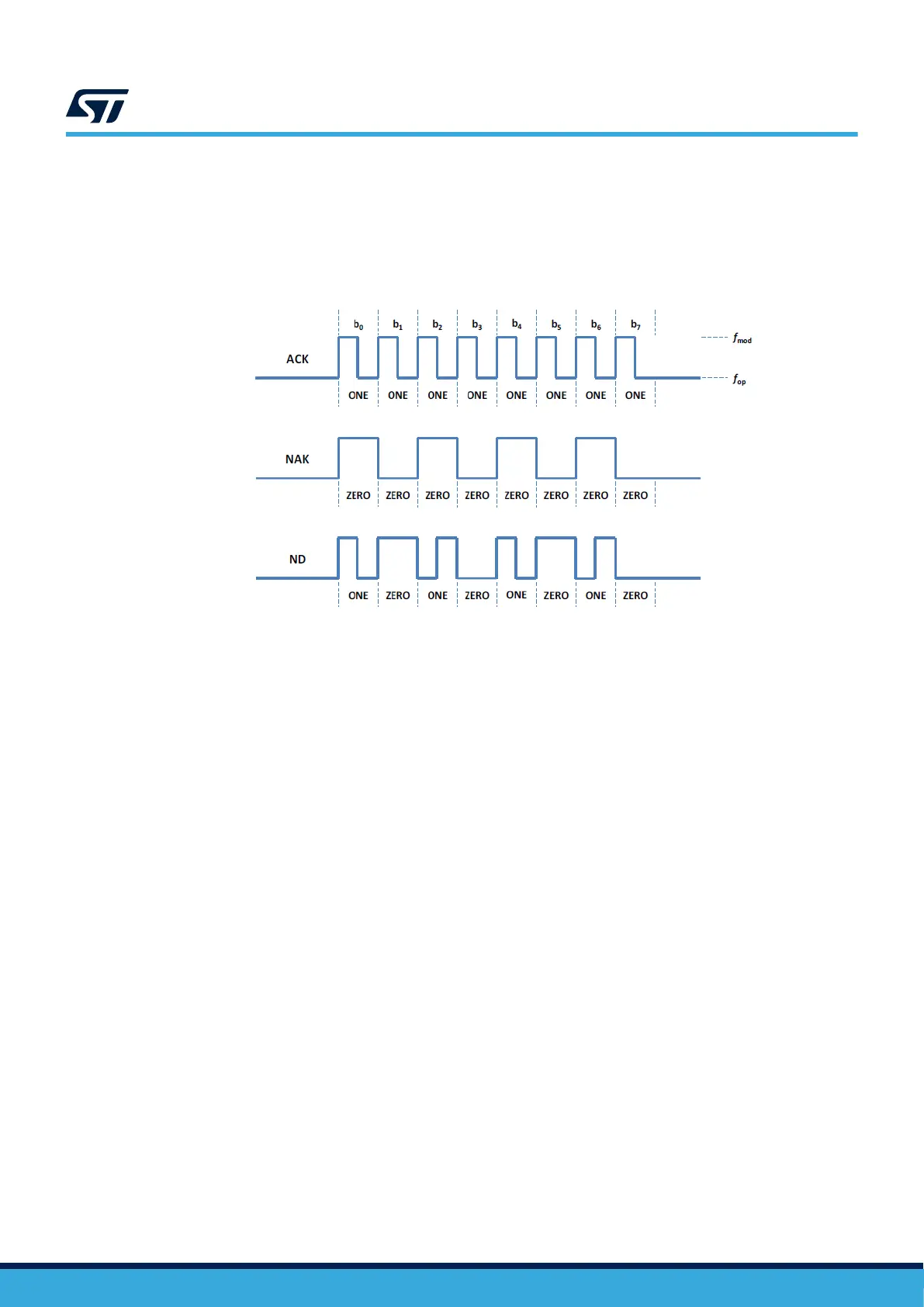
response can be either Acknowledge (ACK), Not-Acknowledge (NACK) or Not-Defined (ND). ACK is encoded as
a series of 8 ONE bits, NACK is encoded as 8 zero bits and ND is encoded as a series of 8 bits of alternating
ZERO and ONE bits (‘01010101’).
Figure 50. Format of the three defined responses
For a more detailed explanation please refer to the Qi Specification, section Power Transmitter to Power Receiver
communications interface.
4.12.3 Most common Qi communication packets
• Control error packet (CEP) provides feedback from the power receiver to the power transmitter about the
amount of power required by the load. CEP is a two’s complement signed integer; its maximum range is
-128 to +127. Its value is calculated by the receiver as a portion of the currently transmitted power, by
which the current power level should be increased/decreased. A negative CEP indicates less power is
required, while a positive CEP indicates more power is required. CEP equal to zero indicates no changes
of the operation point are required.
• Received power packet (RPP) value is calculated by the power receiver as a portion of the maximum
power value contained in the configuration packet and is used to inform the transmitter about the amount of
power received by the receiver. This information is mainly used for foreign object detection.
• Signal strength packet (SS) indicates the degree of coupling between the transmitting and receiving coils.
Its value is an unsigned integer, and it is calculated from the current power/voltage level as a portion of the
maximum expected power/voltage.
• End power transfer (EPT) packet is generated by the receiver, and its purpose is to signal to the
transmitter that power transfer shall be terminated. This request may have several causes, but the most
common ones are:
– The battery is fully charged,
– A protection was triggered (overvoltage, overtemperature, etc.),
– An internal fault in the receiver occurred,
– No/insufficient response to control error packets is detected.
• Proprietary packet (PP) enables sending custom messages between the transmitter and the receiver. Qi
standard defines different proprietary packet types, which can range in length from 1 to 20 bytes.
• Charge status packet (CSP) contains an unsigned integer which states the current charge status of the
battery in the receiving device. CSP equal to 100 means the battery is fully charged, while CSP equal to 0
means the battery is completely discharged. If the receiving device does not contain a battery or it cannot
provide charge status information, the CSP value should be set to 0xFF.
UM3161
Bidirectional communication
UM3161 - Rev 1
page 38/78


 To Next Page