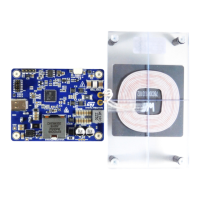
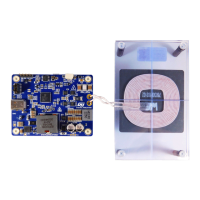
6 Designing a 5 W wireless power transmitter based on the STEVAL-
WBC86TX evaluation board
The design should begin with external component selection, as those components have a significant impact on
the board performance. Modifications of the external components are also harder to implement after the board is
manufactured and assembled.
6.1 External component design
The STWBC86 requires only a few external components to work properly. The design should begin with coil and
series resonant capacitor selection, as those are the crucial parts of the design and affect most of the device’s
functions.
6.1.1 Coil selection
Coil selection is a complex problem, as there are several factors that influence the resulting performance. When
selecting the coil, the designer should consider the coil’s inductance, DCR, ACR, current rating, dimensions,
maximum z-distance, and layout.
DCR, ACR (DC and AC resistance) should be kept as low as possible to minimize power loss caused by the
current flowing through the coil.
Dimensions, maximum z-distance, and coil layout have to be considered to achieve the best coupling possible, as
better coupling results in higher efficiency. Similar sized coils might offer a higher coupling factor, on the other
hand a different sized RX/TX coil might offer greater freedom of positioning.
Using the default coil combination found in STMicroelectronics’s EVKs should be a good starting point. For more
information regarding coil selection, please refer to AN5961 or the Wireless Power Consortium’s documentation,
which describes coils used in the Qi certified topologies.
6.1.2 Series resonant capacitor selection
Selection of the series capacitors is greatly influenced by the transmitting coil design. The value should be
selected so that the resulting circuit has its resonant peak located at, or very close to, 100 kHz. The following
formula can be used to calculate the series capacitance value:
f =
1
2
⋅ π ⋅ L ⋅ C
C =
1
L ⋅
2 ⋅ π ⋅ f
2
Voltage rating of the capacitors should consider that during operation, voltage generated across the capacitors is
usually much higher than the input/output voltage of the system. Therefore, the minimum recommended voltage
rating of the series resonant capacitors is 50 V.
Using C0G dielectric capacitors for the resonant circuit design is recommended to minimize temperature and
biasing voltage influence on the capacitance value as much as possible.
For more information regarding capacitor value selection, please refer to Wireless Power Consortium’s
documentation, which describes capacitors used in the Qi certified topologies.
6.1.3 Vin and Vinv capacitors selection
Selection of the VIN and VINV capacitor’s value is mostly a trade-off between load transition response time and
capacitor cost and/or size. Capacitance of 30 uF for each of the nodes should be a good starting point. The
voltage rating should respect the maximum input voltage. Ceramic X5R or X7R (preferred) dielectric capacitors
are recommended.
Capacitor derating caused by temperature and DC bias should also be considered, as the capacitance decrease
caused by those effects may be quite significant. Please refer to the capacitor datasheet for more information.
6.1.4 Hardware input protections
Hardware input overvoltage and overcurrent protections are recommended to avoid potential damage to the
device caused by unusual conditions or wrong operation of the board.
A TVS diode is a good choice for overvoltage protection. Its breakdown voltage should be higher than the input
voltage but should keep the input voltage safely below 27 V (absolute maximum rating of the input pins).
A fuse can be used as a cheap and simple overcurrent protection. The maximum input current should be limited
to 2 A.
UM3161
Designing a 5 W wireless power transmitter based on the STEVAL-WBC86TX evaluation board
UM3161 - Rev 1
page 50/78


 To Next Page