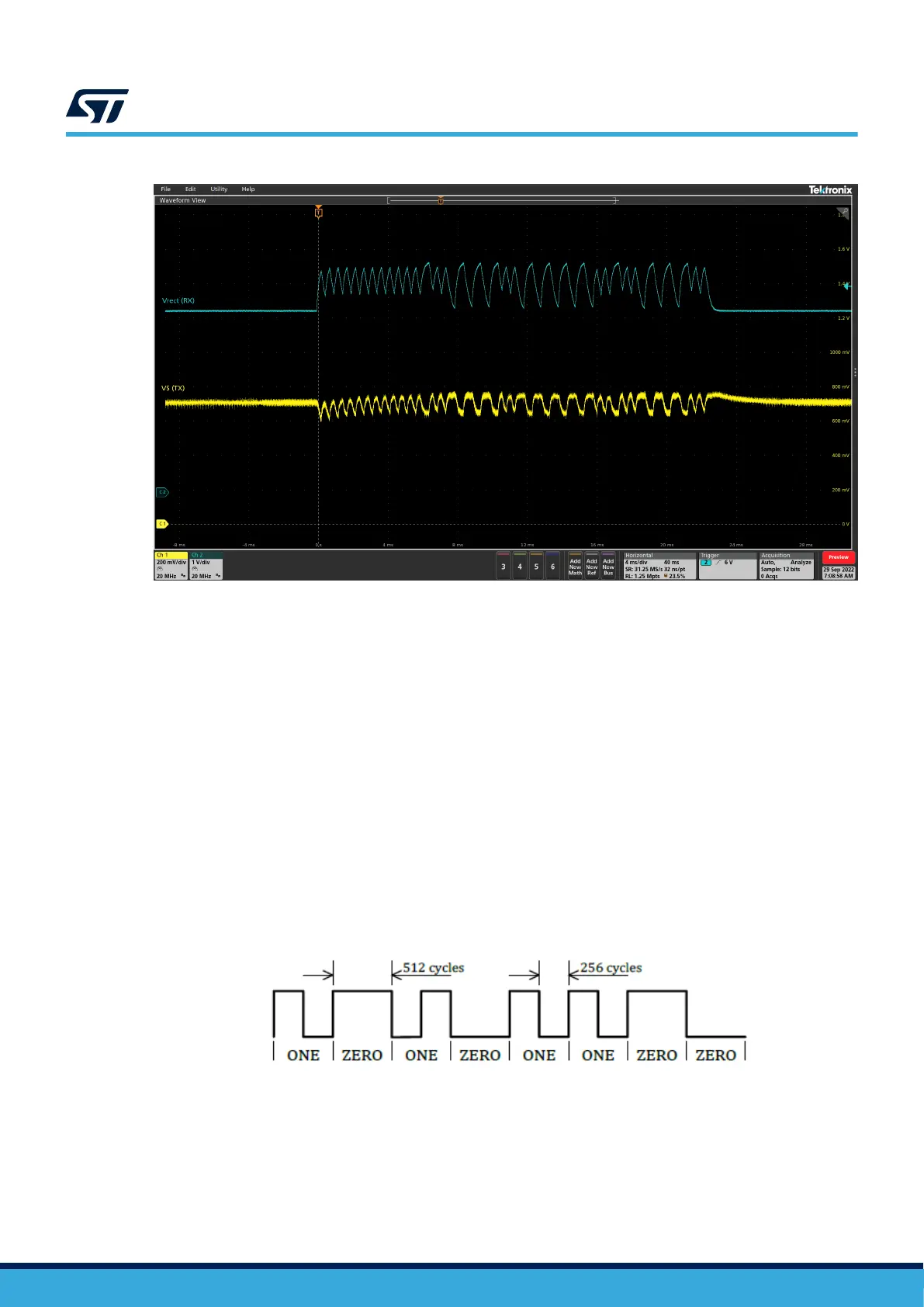
Figure 48. ASK communication - no load
4.12.2 FSK communication
The power transmitter modulates the power signal by switching between its normal operating frequency f
op
and its
modulated frequency f
mod
. The difference between f
op
and f
mod
can be described by two parameters: polarity
and depth.
Polarity is given by the difference between f
mod
and f
op
– a positive polarity corresponds to a positive difference,
while a negative polarity corresponds to a negative difference.
Depth describes the magnitude of difference between f
op
and f
mod
. Please note that a negative polarity results in
a higher induced voltage on the power receiver coil and should therefore be used with care.
The FSK communication is executed via packets. Each packet consists of 3 parts – a header, a message, and a
checksum. The header is a single byte that indicates the packet type, while also implicitly providing the size of the
message part. The message size can range from 1 up to 27 bytes. The checksum is a single byte which provides
a way to check for transmission errors. It is calculated as an exclusive-OR of the header bytes and the message
bytes.
Each FSK bit is aligned to 512 periods of the power signal. A ONE bit is represented by two transitions over the
512-period slot - the frequency change occurs at the very start of the slot and after 256 power signal periods
pass. A ZERO bit is represented by a single transition (at the start of the 512-period slot).
Figure 49. Example of differential bi-phase encoding
Each data byte is transferred as a sequence of 11-bits. The sequence consists of a start bit (ZERO), the data
byte itself, a parity bit, and a stop bit (ONE). The parity used for byte encoding is even – the parity bit set to a
ONE if the data byte contains an odd number of ONE bits. If the data byte contains an even number of ONE bits,
the parity bit is set to a ZERO instead. This encoding scheme is used for all 3 parts of the FSK packet - the
header, message, and checksum.
UM3161
Bidirectional communication
UM3161 - Rev 1
page 37/78


 To Next Page