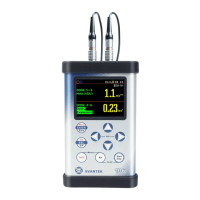
SVAN 973 User Manual – Appendixes
60-minutes running Leq is the rolling (sliding)
Leq window for the last 60 minutes of
measurement (3600 seconds) moving with 1
second step
( )
( )
=
−
T
3600T
2
0
dtptr
s3600
1
log1060LR
Note: If the current time period of the measurement T is less then 60 minutes then LR60 result is
undefined.
D.5 STATISTICAL LEVELS – LN DEFINITION
The noise level L(t) is the continuous random variable. The
probability that the temporary noise level L(t) belongs to the
interval
is called the class density and it can be
expressed by the equation:
( )
PtLLtLLP
n
1i
ikkk
=
=+
- time intervals, in which the noise
level
- so-called class interval or
distribution class of the series,
- total observation period.
In case when the class interval approaches infinity, the probability of L(t) tends to the probability of
value is strictly determined, and it depends mainly on the dynamics of the measurements
performed in the instrument. There are 120 classes in the instrument and the width of each class is equal to
1 dB. The histogram is the set of the class density values calculated for all classes.
The statistical distribution function, which determines the
probability (expressed in %) of the noise occurrence on the level
equal or less than
is given by the formulae:
The cumulative density function expressed by the equation:
is directly used to determine so-called statistical levels Ln or
position parameters of the distribution.
( )
( )
jj
LtLP1LtLP −=
The Ln is the certain boundary level surpassed by the temporary noise level values in not more than nn of
the observation period.


 To Next Page