Aligna
®
4D User Manual
21 / 84
4.4 Beam Sampling
The sampling of the beam used for 4D measurement of the main beam is a fundamental issue,
and very often, it is the limitation of the final precision. The beam will be stabilized related to
the 4D detector. If the sampled beam does not exactly represent the main beam, the effective
precision at the target will decrease.
It is obvious that the detection of the beam movement has to be located BEHIND the actuators.
(Otherwise, a movement of the actuators cannot be observed by the detectors for pointing
correction in a closed servo loop.)
There are several methods creating the sampled beam from the main beam. All of them have
advantages and disadvantages. Therefore, we will discuss the main methods in the follow up.
(In the pictures mostly the "PSD4Dc" is displayed. Of course it can be translated to the
"PSD4De", "PSD4Di" and other variants as well.)
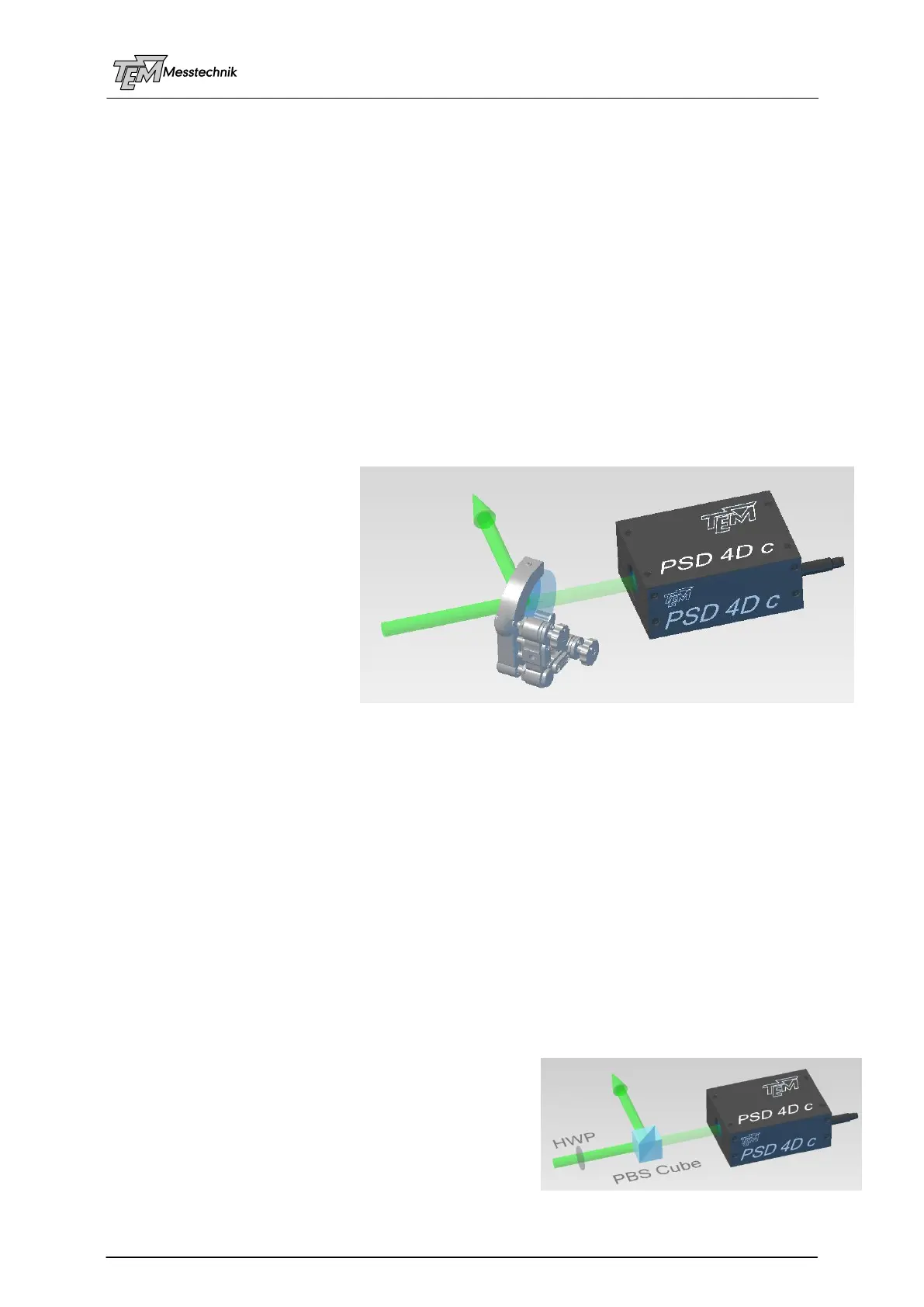
4.4.1 Leak of a HR Mirror
One of the simplest methods
is using the leak transmission
of a high reflecting mirror in
the beam path (preferably the
last mirror before the target).
One main advantage is that no
additional optical components
are inserted into the beam
path. Especially with high
power lasers or ultra-short-
pulse lasers, this is the main
reason to prefer this method.
One problem is that often it is rather difficult to get exact properties regarding the leak of a HR
coating. (The reflectivity may be specified as >99.7%, but the transmission may vary between
0.001% and 0.3% (which are 2.5 orders of magnitude!), depending on the complexity and the
homogeneity of the coating, of polarization properties, of air temperature and humidity.
The transmission of a HR coating may differ by a factor of 200 or more for p- and s-polarized
light. Thus if the laser is s-polarized, but p-light is transmitted 200-times stronger, the detector
will see more or less the "dirt" (caused by birefringence in optical components, or un-polarized
ASE), not the direct laser beam, which causes an incorrect stabilization result.
A half-wave plate may be used to vary the transmission by turning the polarization between s-
and p-light.
Other problems are interference effects, caused by Fresnel reflections of the back surface. So-
called ghost reflexes may interfere with the main transmitted sampled beam. A wandering
interference fringe, caused by small temperature changes of the mirror may be misinterpreted
as beam position drifts.
(NOTE: When using ultra-short-pulse lasers with a pulse length much smaller than a few mm,
interference is no longer a problem. Regarding prob-
lems of interference effects, see below.)
Alternatively, a Polarizing Beam Splitter (PBS) cube or
plate can be used for folding the beam, and for crea-
tion of the sampled beam (in reflection or in transmis-
sion). In this case a half wave plate selects the neces-
sary amount of sample intensity.



 To Next Page