Aligna
®
4D User Manual
22 / 84
4.4.2 Uncoated or AR Coated Sampler
Plates
A safer method in terms of predictable results and
defined conditions is using a sampler plate (for exam-
ple of fused silica, uncoated or AR coated).
However, one has to be very careful with interference
effects: front and back side surface reflections have
nearly exactly the same intensity, and are normally
extremely parallel. This leads to an interference con-
trast of nearly 100%. That means (with p-light at 45°,
e.g.) the reflected light may vary between 0.9% per
surface (at constructive interference) and 0 % (at
destructive interference). This leads to a strong varia-
tion of the out-coupled intensity, by more than an order
of magnitude!
Even more critical is that no parallel plate is absolute exactly parallel. There will be remaining
interference patterns. If temperature changes, these interference fringes will wander over the
beam diameter. Now the position detector cannot distinguish between a real (very small)
movement of the beam, or a moved interference fringe.
(Again, interference is no problem with ultra fast lasers with coherence lengths under a few
mm).
Often just a very small amount of the main laser beam is needed for measurement (1 mW
average power or so for cw and high repeating lasers, or 100 nJ for slowly repeating lasers.)
Using the Fresnel reflection of an uncoated fused silica or BK7 substrate at 45° gives 0.9% per
surface for p-light (close to Brewster's Angle), which is OK for lasers around 100 mW average
power. If power is much higher, filters can be used to reduce the sampled power. (ND 1 filter
for 1 W laser power, e.g.)
However, s-light would be reflected by 2 x 12% at 45°, which
normally is a no-go, one does not want to lose 24% for the
pointing measurement. (Only for very weak lasers in the
range of 100 µW to few mW this might be a fitting solution.)
Therefore, for using uncoated sampler plates the laser beam
has to be p-polarized.
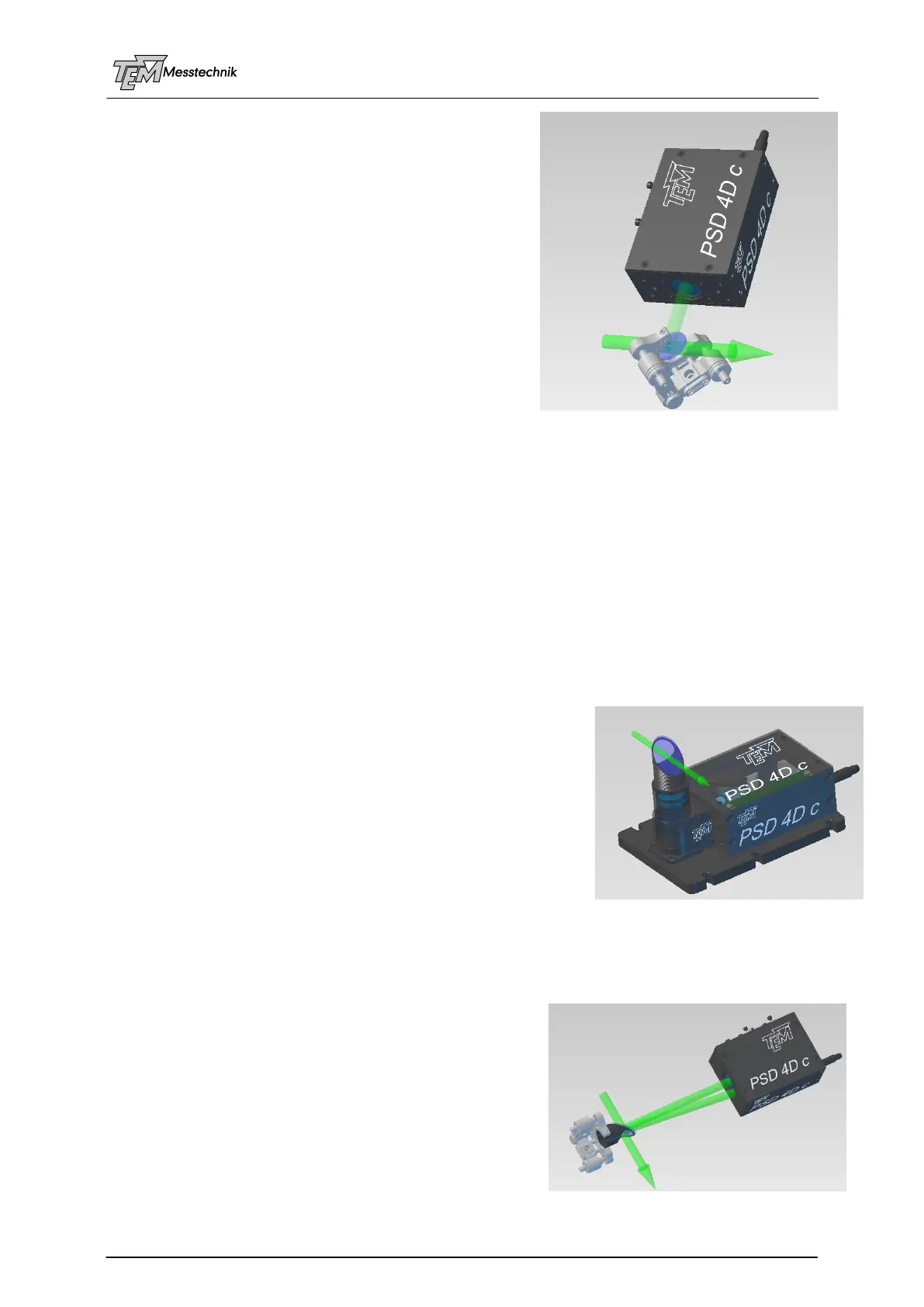
If the laser happens to be vertically polarized, the sampler
plate can be oriented in that way, that the sampled beam
goes vertically down, and it is folded again to a horizontal
detector.
4.4.3 Wedge Plates
To avoid interference effects and ghost reflexes the use
of a wedge plate (instead of a parallel plate) is strongly
recommended.
For the experiment, the wedge angle should be rather
small to avoid dispersion and to avoid an angle dis-
placement of the beam. In this case, the PSD has to be
located far enough from the sampler, so the part beams,
created by both surfaces are separated sufficiently.
One of the beams is skipped.



 To Next Page