Aligna
®
4D User Manual
24 / 84
lasers with rotating polarization, or lasers which have been combined via polarizing couplers..
In a variant for rather big beams, one folding mirror can be used as a concave focusing mirror.
This replaces the PSD lens for the "far field" or "angle" detector "A". Here again a wedged or
an un-wedged sampler plate may be used.
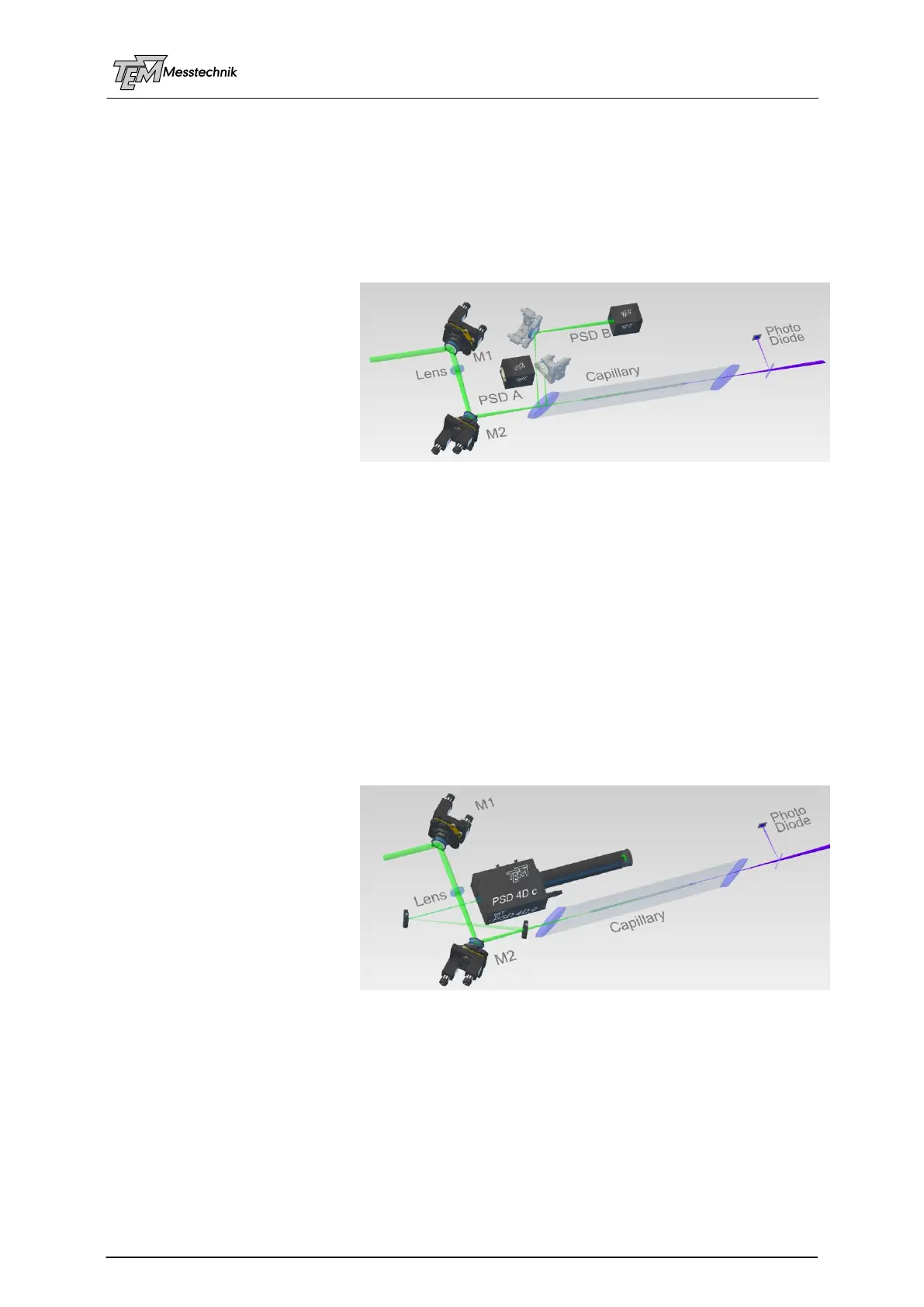
4.4.5 Focusing to a Capillary
One typical application for
Aligna systems is stabilizing a
beam, which is focused into a
hollow fiber or capillary, by
means of a lens with rather
long focal length (f = 0.3 m …
2 m)
In this case it is recommended
not to use the PSD-internal
lens, but placing the A detec-
tor in the focal plane of the main lens. The B detector is located more down streams, distinctly
behind the focus, when the beam diameter has expanded to a value, still smaller than the B
detector chip size.
In this case thermal effects of the main lens are also detected, and thus corrected.
If the reflections of the entrance window of the vacuum chamber are available, these are good
sampling surfaces. If these reflexes are not available, a separate Brewster's angled window, or
an AR window can be used.
In this particular case, also a parallel window works fine, because the beam is convergent at
the location of the beam sampling: in the near of the focus the two spots from both window
surfaces are well-separated. (In opposite, if the beam sampler is located in the collimated
beam, the two part beams from both surfaces cannot be separated by principle, if the surfaces
are exactly parallel, and the sampler plate is not much thicker than the beam diameter.)
Alternatively, instead of the
single 2D PSDs and external
mirror mounts also the back-
extended PSD4Dc can be
used, without an own lens,
using the main focusing lens
as well.
The photo diode behind the
fiber is used for automatic 4D
optimization. (This is de-
scribed in detail in another chapter.)



 To Next Page