E
H
1
M
3
M
2
M
1
H
2
LLZ 421
Installation Operation and Maintenance
ILS 420
2−34 Ed. 01.10SOAC
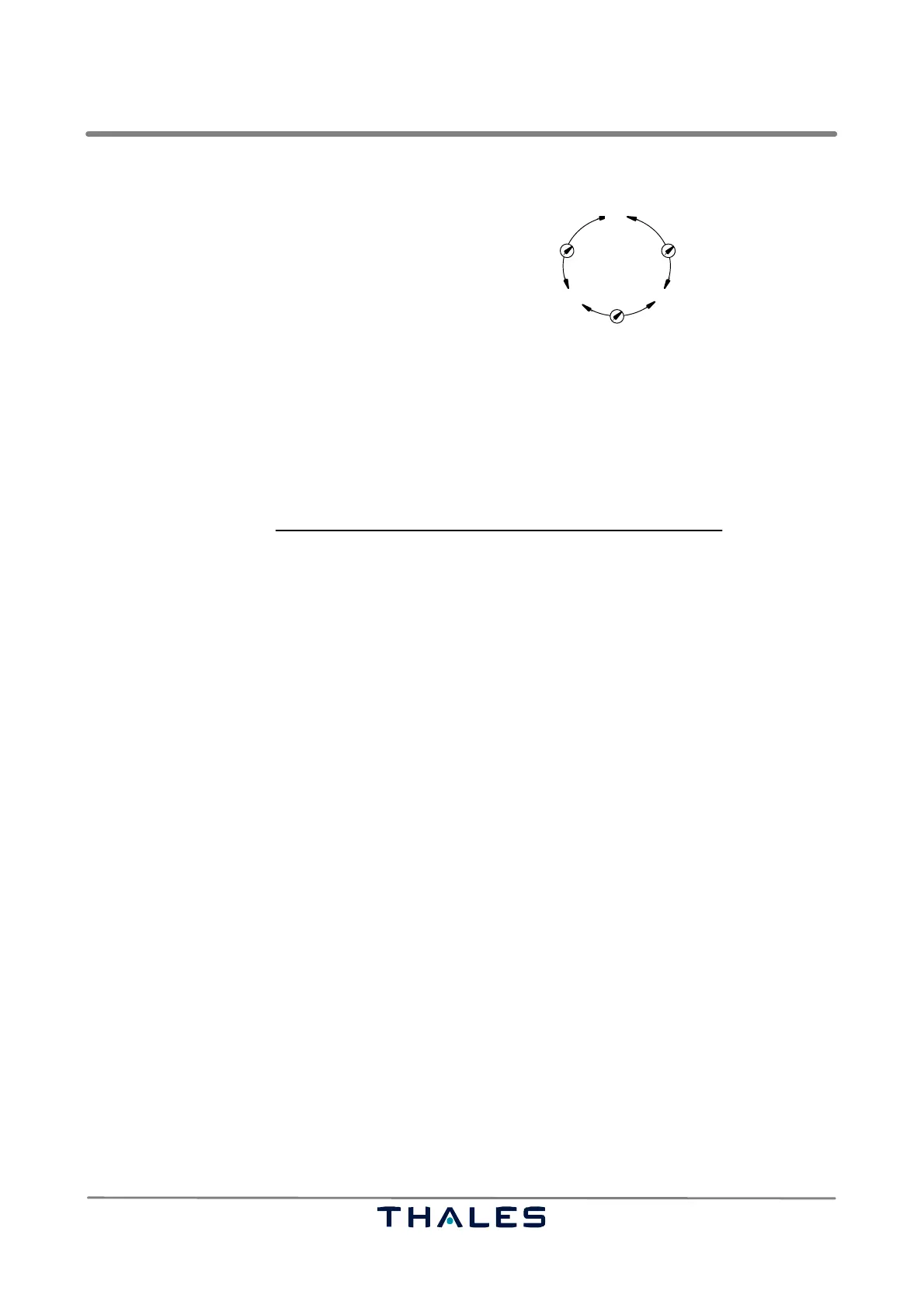
Measurements are performed as shown in the diagram below:
E = Installation ground
H
1 = Auxiliary ground 1
H
2 = Auxiliary ground 2
M
1 = Measured value 1
M
2 = Measured value 2
M
3 = Measured value 3
Measured value 1: Resistance between installation ground and auxiliary ground 1
Measured value 2: Resistance between auxiliary ground 1 and auxiliary ground 2
Measured value 3: Resistance between installation ground and auxiliary ground 2
When the three measurements have been performed the ground resistance is calculated as follows:
Corr. meas. value 1 + corr. meas. 3 − corr. meas value 2
Ground resistance =
2
The measurement is falsified by the resistance of the 2 test leads. The cross−sectional area of the
test leads should not be less than 1.5 mm@ in order to ensure an adequate breaking strength. With
this cross−sectional area and an assumed length of 2 x 25 m = 50 m, the falsifying resistance would
be 0.58 This resistance should therefore be measured and deducted from measured values 1, 2
and 3. The measured values corrected in this manner are entered into the above formula.
2.5.7 Earthing System LLZ or GP
The site dependent modifications of the arrangement have been taken from the project engineering
documentation.
The LLZ or GP grounding system consists of ground strips (usually made of aluminium, copper, gal-
vanized iron or stainless stee, round (10 mm ∅ ) or flat (30 x 3,5 mm) material. The grounding is laid
down in the earth to and along the LLZ antenna foundation or to the GP antenna foundation, and in
the form of a ring ground around the shelter foundation in the defined depth. The ring ground is
grounded at the corners with additional ground rods.



 To Next Page