APX 525/625 Generator Revision C Service Adjustments
©
2005 Del Medical Imaging Corporation
7/5/2005 Page 131
Connect a Dynalyzer™, equipped with a digital display unit, in-line with the anode
and cathode high voltage cables, between the high voltage transformer and the x -
ray tube.
If you do not have a digital display unit for the Dynalyzer™, all measurements must
be made with a storage oscilloscope, connected to the Dynalyzer™ as specified in
the calibration instructions. However, the storage oscilloscope is always required for
several portions of the calibration procedure, including the measurement of kV
waveforms for wave shape, quality, and anode to cathode voltage balance, as well
as the calibration of tube current and filament preheat accuracy.
Instructions for performing field calibration of the APX 525/625 generator when no
Dynalyzer™ is available may be found later in this section, in Alternate Calibration
Procedure.
If you do not have a digital display, you can make mAs measurements by inserting a
mAs meter in series with the mA+ feedback signal wire.
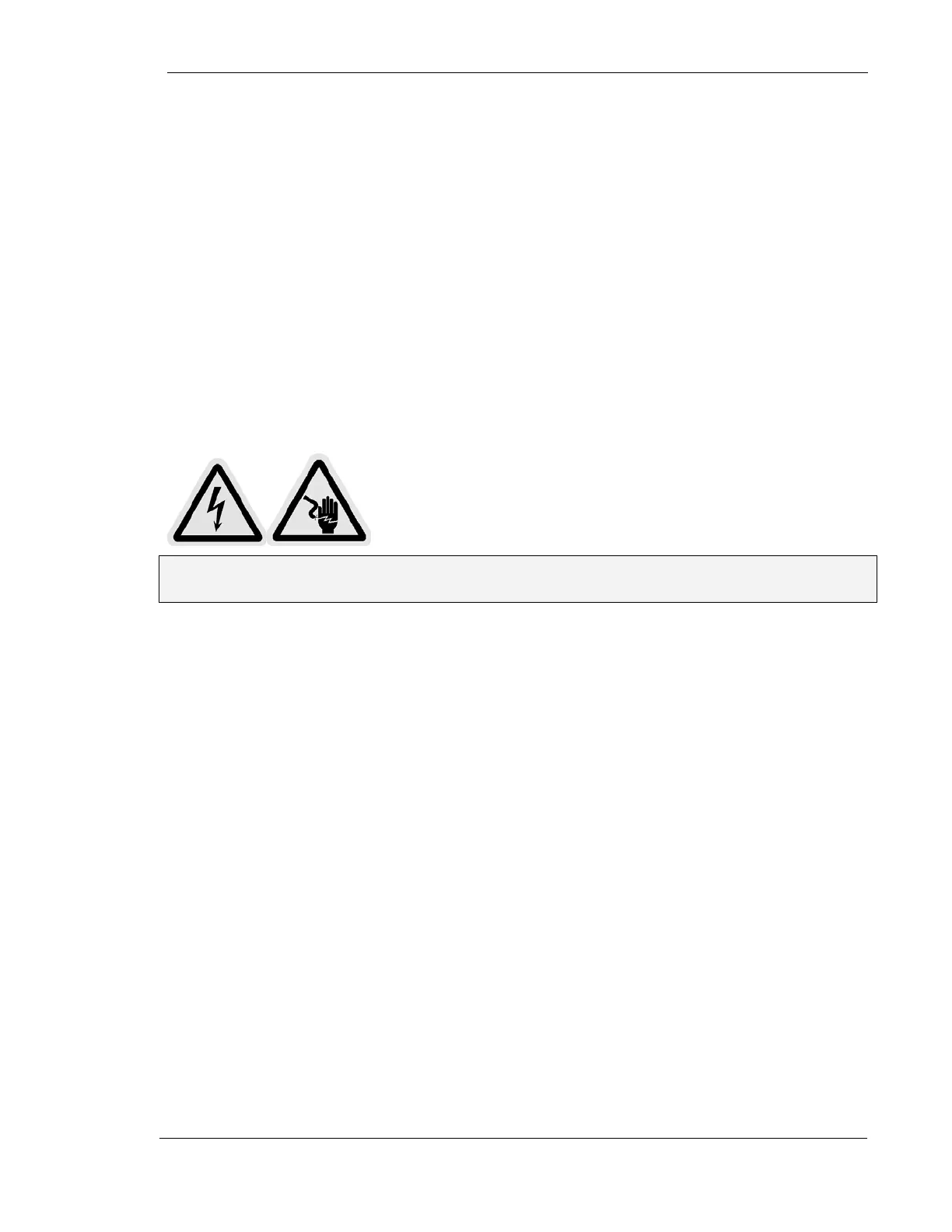
Warning: Do not touch any part of the mAs meter during exposures because
dangerously high voltages can be present if there are improper connections.
mAs measurements can also be made by using the storage oscilloscope. Calculate
mAs as a product of tube current and time, as measured using the mA waveform.
Del Medical Imaging Corporation tests all systems for mAs, kV, and mA accuracy,
using a Dynalyzer™ equipped with a digital display.
Oscilloscope connections to the Dynalyzer™ for mA waveform measurements
should be made at the BNC terminal marked “mA”. The mode switch on the
Dynalyzer™ should be set to “RAD”. The output of the Dynalyzer™ is scaled to 1
millivolt per mA, or 100mV per 100 mA, with the oscilloscope set to the 1X setting for
the scope probe input.
During normal exposures, the generator may induce irregular patterns of low voltage
noise spikes, which may be picked up in the coax between the scope and the
Dynalyzer™ and displayed as a component on the mA waveform. This is due to the
high sensitivity of the oscilloscope input at such a low voltage scale, and does not
necessarily indicate a performance problem in the generator.



 To Next Page