Vigilant MX1 Operator Manual Document: LT0344
Page 11-8 8 August 2017 Issue 2.4
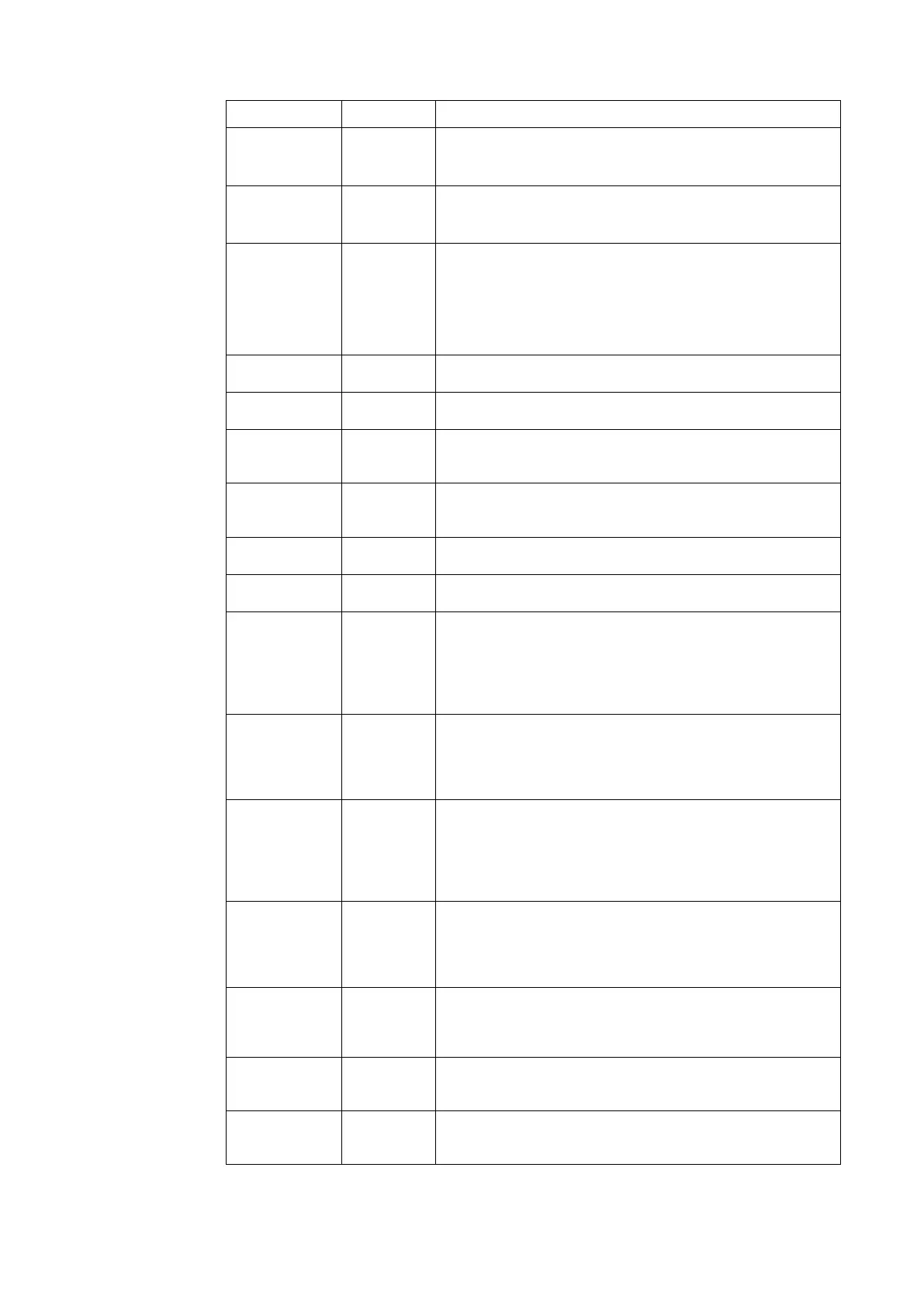
Ancillary
Disables,
Ancil Group 2
The disable status of this point may be used to control the
operation of site-specific ancillary functions.
Ancillary
Disables,
Ancil Group 3
The disable status of this point may be used to control the
operation of site-specific ancillary functions.
Provides status of the MX1 connection to the I-HUB. Fault
indicates that communication is not possible – usually because
the wrong serial port is used, the connection is broken, the
I-HUB is turned off, or a non I-HUB device is connected.
Refer to NETWORK CONNECTION STATUS below for
descriptions for the MAF Status text displayed.
Provides status of local PIB(s) that are directly connected to the
local I-HUB.
Provides status of remote PIB(s) reported by local PIB(s) that
are directly connected to the local I-HUB.
I-HUB - Ring
Channel 1
Break
Indicates fault when a ring break is present on I-HUB port 1.
I-HUB - Ring
Channel 2
Break
Indicates fault when a ring break is present on I-HUB port 2.
Indicates fault if the I-HUB has a hardware fault present
(EEPROM checksum fault in the I-HUB).
Indicates fault if the I-HUB has detected a PSU fault through its
PTT input.
I-HUB -
Neighbour I-
HUB Has No
SID
Indicates fault if the local I-HUB has a physically adjacent
neighbour I-HUB that has no programmed SID number of its
own and has been unable to borrow a SID number from a locally
connected MX1. This can happen if the neighbour I-HUB's MX1
has been turned off or there is no MX1 directly connected to the
neighbour I-HUB.
I-HUB - Multi-
Drop Port
Access
Has an active status if the local I-HUB has detected multiple
consecutive message collisions on a multi-drop port and is
hence unable to transmit. This can be caused by an overloaded
multi-drop network or by a wiring fault preventing the I-HUB from
receiving its own transmissions.
Indicates fault if the I-HUB has discarded a message after not
receiving confirmation of reception from the remote end despite
multiple retries. This can be caused by a fault or failure of the
device connected at the remote end, wiring faults, overloading,
or noise. The port number that the fault has occurred on is
indicated in a MX1 system event.
Indicates fault if the I-HUB has had a queue overflow and
message(s) have consequently been lost. This could be due to a
wiring fault, device failure, noise, or other network performance
problems. The port number that the fault has occurred on is
indicated in a MX1 system event.
Has an active status if the I-HUB has had a queue exceed the
configured queue warning level. This could be due to a wiring
fault, or other network performance problems. The port number
that the warning has occurred on is indicated in a system event.
Indicates fault if the I-HUB has a generic fault. This is for use
with future versions of the I-HUB firmware – connect to the I-
HUB’s diagnostic port for more information.
Has an active status if the I-HUB has a generic warning. This is
for use with future versions of the I-HUB firmware – connect to
the I-HUB’s diagnostic port for more information.


 To Next Page