Vigilant MX1 Operator Manual Document: LT0344
Page 1-10 8 August 2017 Issue 2.4
OK
This key is used to confirm operator initiated actions when prompted via
the LCD.
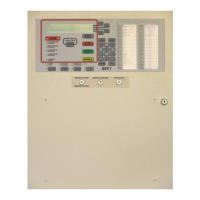
An NZ MX1 control panel has three keyswitches:
SILENCE ALARMS
This keyswitch requires a Bulgin key to operate. When this keyswitch is
operated:
all alarm devices are silenced,
new alarms will not re-sound the alarm devices,
the COMMON DEFECT and FAULTS indicators will be lit,
the key cannot be removed.
When the Silence Alarms keyswitch is restored to normal, all zones
currently in alarm will be automatically disabled. Refer to Section 6 for
instructions for resetting and enabling these zones.
SERVICES RESTORE
This keyswitch provides a means to restore selected building services in
a way controlled by the system configuration. For example it may enable
lift operation that has been disabled by the MX1 during an alarm.
EVACUATION
This keyswitch activates the alarm devices. It overrides the Silence
Alarms keyswitch.
In nearly all cases, the operator commands described in this manual
consist of a series of keypresses on the keyboard on the front of the MX1
panel.
Some of the keys have fixed labels and meanings, for example, the key
labelled “NEXT” immediately below the alphanumeric LCD. This key will
be referred to as the NEXT key. Similarly, other keys with fixed labels
will be referred to as RESET, MENU, OK, etc.
The four keys to the right of the LCD have meanings that change
depending on what is being displayed. The current meaning of each key
is displayed at the right hand end of the LCD, alongside each key.
For example, a common meaning for F2 and F3 is to step through a list,
when they are labelled “PREV” and “NEXT”. This will be referred to in the
command descriptions as PREVF2 and NEXTF3.
The degree to which you can view and control the MX1 depends on the
current operator Access Level (see Operator Access Levels, Section 1).


 To Next Page