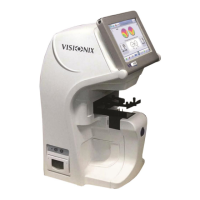
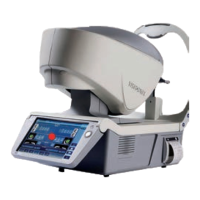
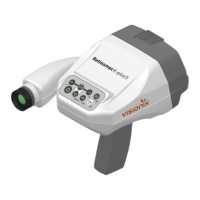
The VX65 is an automatic phoropter designed for subjective refraction analysis to determine a patient's eye correction and resulting prescription. It is a global system composed of an automatic phoropter head, an Android-based tablet for control, and an optional keyboard. The VX65 can be integrated into a complete refraction chain with additional accessories such as an auto refractometer, lensmeter, PC with patient data management software, and chart display. It can also control the VX22 chart display from the tablet. The device is intended for use by ophthalmologists, opticians, and optometrists.
Important Technical Specifications:
- Phoropter Head:
- Spherical Lenses: -29.00 to +26.75D (Regular); -19.00 to +16.75D (with cross cylinder, Prism or Manual mode).
- Spherical Step: 0.25 / 0.50 / 1.00 D.
- Cylindrical Lenses: 0-8.75D.
- Cylindrical Step: 0.25D.
- Axis: 0~180°.
- Axis Step: 1°/5°/10°.
- Prisms: 0~20 Δ.
- Prism Step: 0.50Δ.
- Dissociation Prisms: Right: 6 U Δ; Left: 10 I Δ.
- Pupillary Distance: 50-76mm.
- Pupillary Distance Step: 0.5mm.
- Rotating Cross Cylinder: ± 0.25 D / ± 0.50 D / DUAL ± 0.50 D (± 0.25 D with Manual mode).
- Fixed Cross Cylinder: -0.50 (+1.00) 90°.
- Polarized Filter: Linear polarization 45° / 135° and circular polarization.
- Red/Green Filter: Right eye: red; Left eye: green.
- Red Maddox: Right eye: horizontal; Left eye: vertical.
- Retinoscopy Lenses: +1.5 D.
- Pin Hole: 2mm.
- Occluder: Yes.
- Centering Reticle: Yes.
- Level Adjustment: Yes (adjusting knob and spirit level).
- Corneal Vertex Distance (VD): 10-16 mm.
- Near Vision Distance: 150-700 mm.
- Dimensions: 350 (width) x 280 (height) x 80 (depth) mm.
- Weight: 3.8kg.
- Power Supply: DC 24V 60W.
- Tablet:
- Wi-Fi: Yes.
- Operating System: Android 9.0.
- Bluetooth: Yes.
- Resolution: 1920 x 1200 pixel.
- Dimensions: 254.2 (width) x 155.3 (height) x 8.2 (depth) mm.
- Weight: 525g.
- Power Supply: DC 5V 2.0A, USB type C.
- Keyboard (optional):
- Dimensions: 23.5 mm (depth) x 19mm (width) x 14mm (height).
- Weight: 1kg.
- Power Supply: 12V, 2.08A, 25W.
Usage Features:
The VX65 offers both Manual and Automatic examination modes, configurable via the tablet's settings.
- Phoropter Head Controls (Operator's Side):
- Examination Window: Patient views lenses for refraction determination.
- Near Vision Illumination: Light activates during near vision tests.
- Corneal Aligning Windows: Allows observation of patient's cornea position.
- Forehead Rest Knob: Adjusts forehead position.
- Near Vision Rod Holder & Clamp Screw: Inserts and secures the near vision rod.
- Level & Leveling Knob: Indicates and adjusts instrument level.
- Phoropter Head Features (Patient's Side):
- Power Supply LED: Indicates power connection.
- Forehead Rest: Patient's forehead rests here; detachable for sterilization.
- Cornea Alignment Scale: Measures cornea vertex position.
- Forehead Rest Magnet: Secures the face shield.
- Tablet Interface:
- Virtual Buttons: Recent applications, Home, Back.
- Touch Screen: LCD interface for interaction.
- Power / Lock Button: Turns device on/off, locks/unlocks screen.
- Volume Button: Adjusts volume.
- Multipurpose Jack: USB type C for charging or data synchronization.
- Main Menu: Provides access to different interfaces and system shutdown.
- New Exam: Opens the designated new exam interface.
- Refraction: Opens the examination interface for subjective refractions.
- Previous Exam: Loads data from the previous exam (OBJ, LM, SUBJ).
- Settings: Manages app settings.
- Turn Off: Shuts down the tablet app.
- Examination Interface (Manual & Automatic Modes):
- Phoropter Head Control (Left Side): Adjusts sphere, cylinder, axis, addition, and prism values.
- Sphere: Rotate knob (0.25D steps) or tap areas (3D steps) to change value.
- Cylinder: Slide button (0.25D steps) to change value.
- Axis: Rotate knob or tap areas (1° or 5° steps) to change value.
- Addition: Slide from area (0.25D steps) to change value.
- Prism: Tap area to insert, rotate button for orientation (Up/Down/In/Out), slide button for value (0.5Δ steps).
- Cross Cylinder: Tap area to insert, tap to change "1"/"2" position, rotate to verify axis/cylinder.
- Pupillary Distance (PD): Slide knobs to adjust total, right, and left half PD.
- Occluder/Accessories: Tap to open/close eye or rotate to change accessory (Retinoscopic Lens, Polarizing Lens, Red Maddox, Cross Hair, Red/Green Filter, Pin Hole, Dissociating Prisms, Fixed Cross Cylinder).
- Chart Display Control (Right Side):
- Display on Chart Display: Shows what the patient sees, including visual acuity.
- Optotype Masks: Single letter, single line, column, three identical lines, three different lines.
- Change: Reorganizes optotype distribution.
- Red/Green: Switches to red/green background.
- Black/White: Reverses black/white colors, inverts right/left eye display for specific tests.
- Contrast: Adjusts contrast.
- Visual Acuity: Adjusts acuity (letters become larger/smaller).
- Sections of Tests: Accesses various test categories (Standard, Pictures, Special).
- Shortcuts of Tests: Calls tests directly.
- Red/Green Side Buttons: Displays feedback for red/green optotypes.
- Remote Mode Button: Uses full automatic interface.
- Program Mode Button: Uses pre-defined steps for exams.
- Program Mode: Manages chart display (character change, VA modification) with customizable programs and steps.
- Input Data Window: Loads or manually sets OBJ and LM data.
- Exam File Interface: Overview of all refractions for the current exam, allowing comparison, data erasure, loading, and copy/paste.
- Optional Keyboard:
- Change Refraction: Selects Sphere, Cylinder, Axis, Addition, Prism (horizontal/vertical) for modification.
- Open/Close Eyes: Alternating opening/closing of right/left eye, or open both eyes.
- Control Chart Display: Adjusts VA (up/down), contrast (up/down), redistributes optotypes, saves VA.
- Control Data: Calls SUBJ1, SUBJ2, Unaided, OBJ, LM refractions; loads last received data; erases current refraction.
- Control Cross Cylinder: Calls "1" or "2" position of XCyl, or inserts XCyl.
- Control Exam: Switches between Remote and Program mode, goes to next program step, ends exam.
Maintenance Features:
- Hard Reset: Performs an advanced reset of the phoropter head to realign wheels.
- Cleaning:
- Surfaces: Dampen a cloth with a commercial, non-abrasive cleaner.
- Forehead Rest: Clean regularly with a soft cloth and alcohol.
- Disinfection: Use ethanol (DAB 10) 80% vol. or isopropanol 70% vol. for parts in direct contact with the patient.
- Safety: Disconnect power before cleaning, do not spray liquids directly, avoid caustic/abrasive cleaners, ensure no moisture penetration, replace paper pads after each patient.
- General: Never disassemble or reassemble, do not modify, repairs by qualified personnel only, keep hands/body clear of moving parts.
- Electricity: Do not handle plugs with wet hands, ensure power cable is undamaged and fully inserted in a grounded outlet, use only manufacturer-provided power supply.
- Transport, Storage, Handling: Transport in designed case, pack firmly, avoid strong vibrations/shocks.
- Transport Conditions: -40°C to +70°C, 10-95% humidity, 500-1060 HPa air pressure.
- Storage Conditions: -10°C to +55°C, 10-95% humidity, 800-1060 HPa air pressure.
- Operating Conditions: +10°C to +35°C, 30-90% humidity, 800-1060 HPa air pressure.
- Precautions during use: Avoid direct sunlight, excessive dust/humidity, hot air currents. Keep tablet screen clean. Wait 5 seconds after turning off before restarting. Avoid stacking with other equipment. Use only specified accessories/cables. Maintain 30 cm (12 inches) distance from portable RF communications equipment.
- Corneal Aligning Device: Do not bring face close to the near vision rod to avoid injury.
- Medical Device: Class 1, compliant with Regulation EU 2017/745.
- Manufacturer: Luneau Technology Operations, France.
- Lifetime: 7 years.
- First CE Marking: 2020.
- WEEE Directive: Electronic components subject to Directive 2012/19/UE; dispose separately from domestic waste.

 Need help?
 General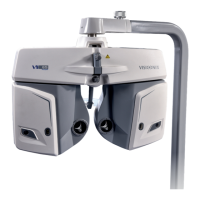

 To Next Page