3064298_201805 11
Informationontheheatpump
Otherequipmentfeatures
The appliance is equipped with sensors that monitor the heating circuit and the refrigerant circuit.
DHWcylinders
WOLF heat pumps require special DHW cylinders for heating the domestic hot water; these are
available from the WOLF range of accessories.
TheindirectcoilsurfaceareaintheDHWcylindersmustbeatleast0.25m²perkWofheating
output.
HeatingwaterqualityinWOLFheatpumps
VDI 2035 Part 1 lists recommendations for the prevention of scaling in heating systems. Part 2 deals
with corrosion on the water side.
When screed drying using the electric immersion heater particular care should be taken to ensure
that the permissible total hardness is complied with, otherwise there is a risk of scaling and immersion
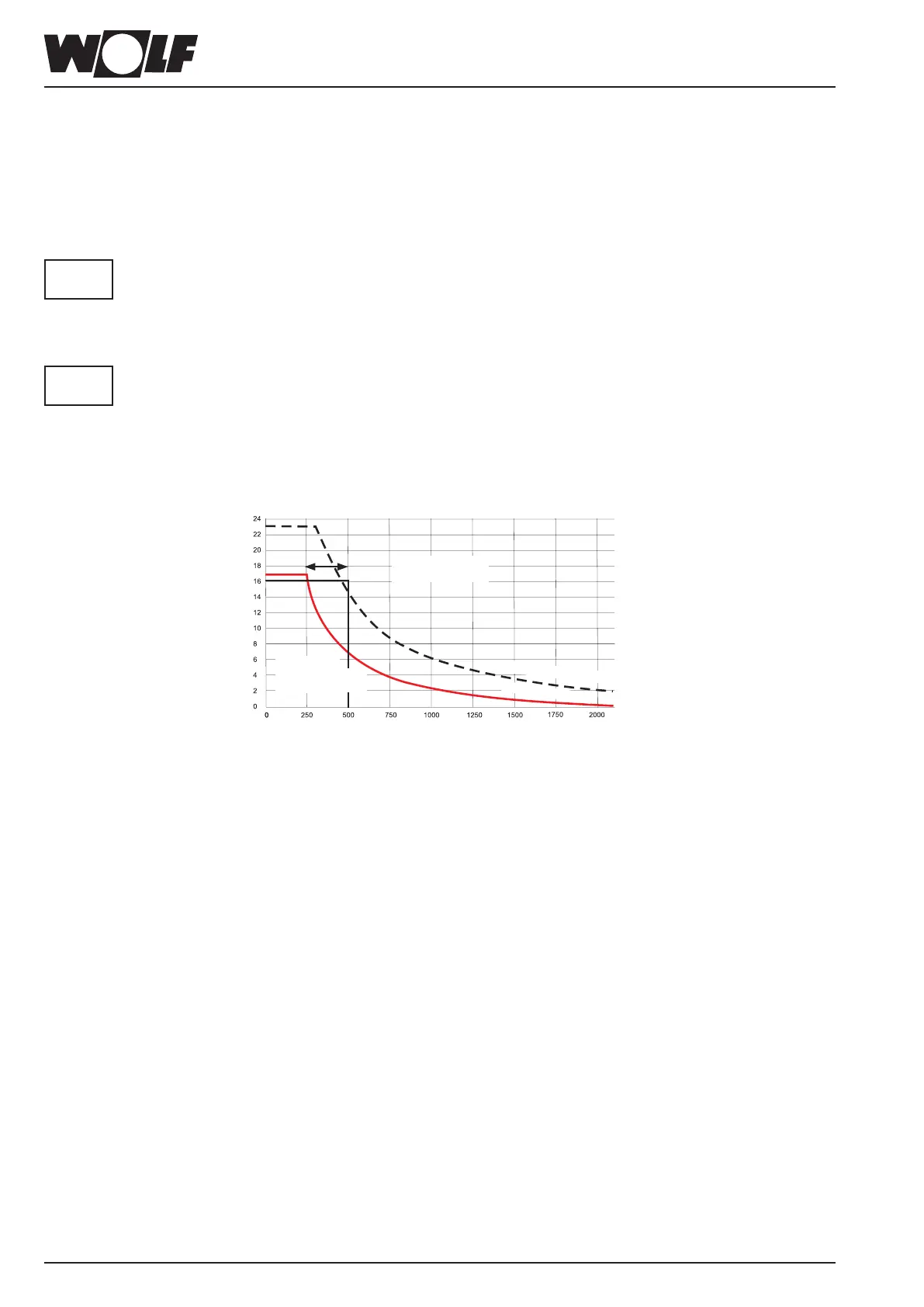
heater failure. The permissible water hardness is 16.8 °dH for system volumes of up to 250 litres
during operation with the electric immersion heater.
In the case of high volume systems or those where large top-up water volumes (e.g. due to water
losses) are required, the following values should be observed.
System volume in l
Permissible hardness in °dH
Water treatment
required
None
Water treatment
required
250 l
Operation without immersion heater
Operation with immersion heater
If the limit curve is exceeded, an appropriate portion of the system water must be treated.
Example: Total hardness of the domestic hot water: 16 °dH
System volume:500 l; i.e. at least 250 l must be treated.
Additionalheatingwaterqualityrequirements:
- pH value of between 6.5 and 9.0
- Electrical conductivity < 800 µS/cm; better < 100 µS/cm
Low salt operation (conductivity < 100 µS/cm to VDI 2035) is always preferable in order to minimise the risk of
corrosion.Waterparametersstabiliseorchangeduringaperiodofupto12weeksaftercommissioning(lling).
Inhibitorsarenotpermissible.
Alkalising additives may be used by a water treatment specialist to stabilise the pH value. For example, in order to
meet the requirements of VDI 2035 regarding pH value in mixed installations (8.2-9.0).
Potablewater
To protect against scaling, the DHW temperature must be set to max. 50 °C if the total water hardness is 15 °dH
(2.5 mol/m³) or above. If the total hardness is 16.8 °dH or above, we recommend using a water treatment facility
in the cold water supply line when heating DHW, in order to prolong the maintenance intervals. Even if the water
hardness is below 16.8 °dH, a higher risk of scaling may occur locally, necessitating suitable softening measures.
Failure to take such measures will result in premature scaling of the appliance and a reduction in the convenient
availability of domestic hot water. The contractor responsible should always check the local conditions.
The adjustable cylinder water temperature can exceed 60 °C. Short term operation at temperatures above 60 °C
must be monitored in order to prevent scalding. For permanent operation, appropriate precautions should be taken
to prevent draw-off temperatures above 60 °C, e.g. thermostatic valves.
Please
note
Please
note


 To Next Page