PK=aÉëÅêáéíáçå
fåëíêìÅíáçå=j~åì~ä=`êçëëÄÉ~ã=PQM=ÉåMOE`loF =QR=çÑ=N PQ
léíáçåë
3.4.8. Detectors
3.4.8.1. In-lens Duo detector
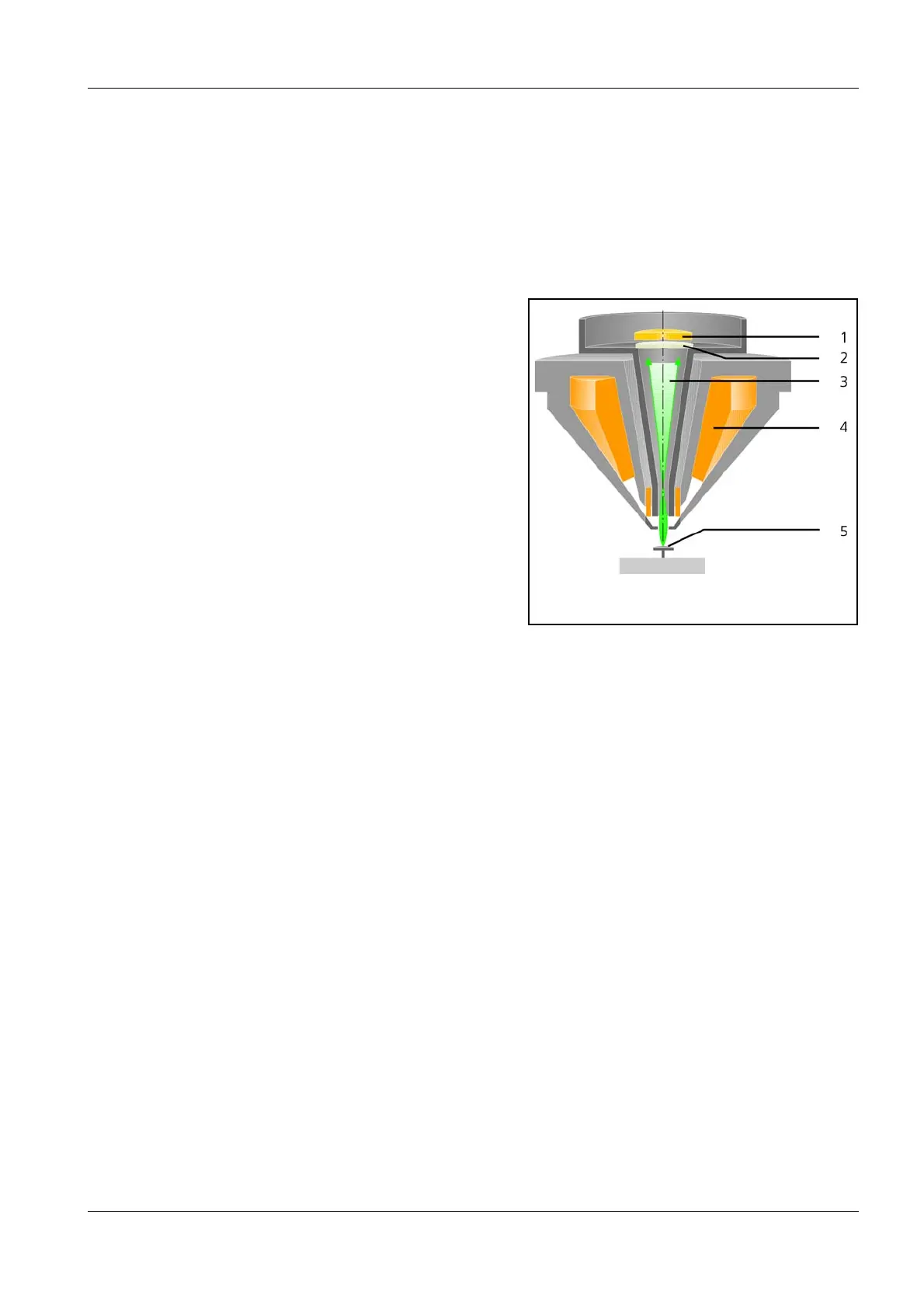
The In-lens Duo detector (1) allows imaging and mixing of a high contrast topography (SE) as well
as clear compositional contrast (BSE). It is an annular shaped in-column detector that is located
in place of the In-lens detector.
1 In-lens Duo detector
2 Filtering grid
3 Beam path
4 Objective lens
5 Specimen
The SEs and BSEs generated at the impact
point of the primary electron beam are inter-
cepted by the low electrical field of the GEMI-
NI
®
column. These electrons are accelerated
by the field of the electrostatic lens.
Filtering grid Without switching on the filtering grid voltage, the In-lens Duo detector has the same characteris-
tics as the In-lens SE detector, see section 3.3.4.1.
The In-lens Duo detector primarly detects secondary electrons (SEs). By switching on the filtering
grid (2) voltage, the SEs will be rejected and only backscattered electrons (BSEs) will be detected.
Below a landing energy of 1.5 kV the filtering grid has the additional function of selecting the de-
sired energy of the BSEs. The operator can select the threshold energy of inelastically scattered
BSEs to enhance contrast and resolution.
Fig. 3.13: Schematics of the In-lens Duo
detector


 To Next Page