UQ=çÑ=NPQ fåëíêìÅíáçå=j~åì~ä=`êçëëÄÉ~ã=PQM=ÉåMOE`lo F
SK=léÉê~íáçå
pÉííáåÖ=pbj=é~ê~ãÉíÉêë
6.6.1.2. Measuring the specimen current
The specimen current is the current flowing through the specimen. Depending on secondary and
backscattered electron emission, the specimen current is either part of or multiple of the incident
beam current. In case there is no other signal emission from the sample, the specimen current
equals the primary beam current that hits the sample. This beam current can be measured by
means of a Faraday cup. This cup consists of a strongly absorbing material with a cavity covered
by a small aperture. If the beam is focused in this cavity no secondary electrons and no backscat-
tered electrons leave the Faraday cup. The displayed current equals the incident beam current.
Procedure
1 Load the Faraday cup into the specimen chamber.
2 Pump the specimen chamber.
3 Switch on the electron beam.
4 Set a magnification that allows transmission of the complete electron beam into the cavity
through the aperture orifice.
5 Open the Panel Configuration Bar.
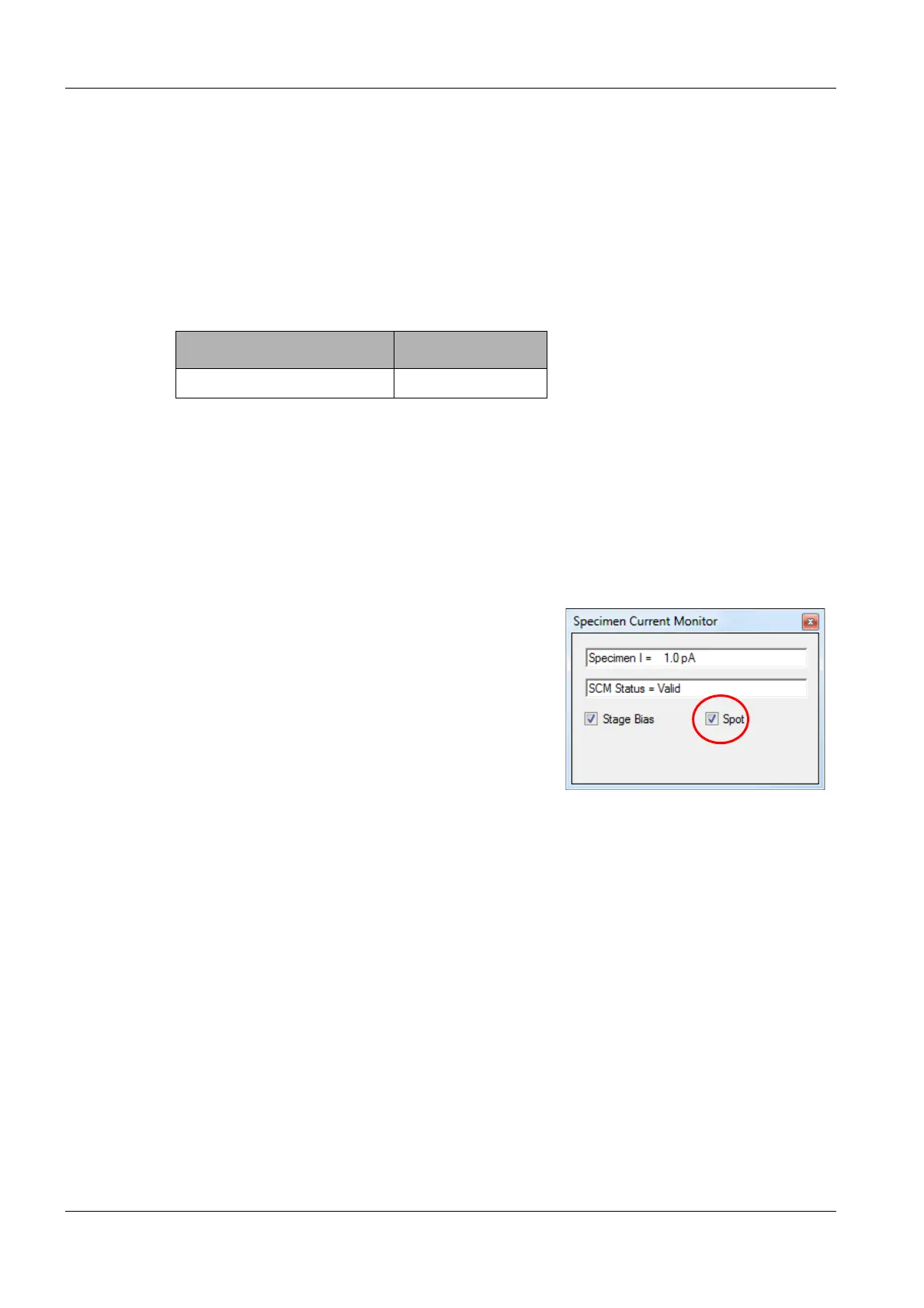
6 Double-click the Specimen Current Monitor.
7 Select the Stage Bias checkbox (default).
The touch alarm is activated to avoid collision
of the stage.
8 Select the Spot checkbox.
The specimen current is measured continu-
ously. The measured value is displayed in the
field Specimen I =.
Parts required Part no.
Faraday cup 348342-8055-000


 To Next Page