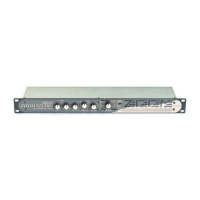
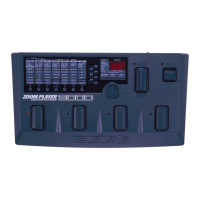
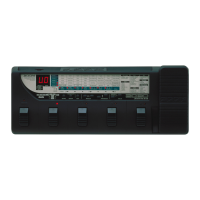
This section explains the Patch programming operations of
the
Edit
mode.
Patch
Structure
In order for you to best understand how to program the
effects
of
the
9030,
you should first have a
firm
grasp of the
structure of a Patch. The explanations that follow describe
the different kinds of effect modules and effect types of the
9030
and how
the
signals are processed.
Effect
Modules
The
9030
consists of the following effect modules:
COMP
(Compressor group)
EXT
(External effect)
DTST
(Distortion group)
EQ
(Equalizer group)
AMP
(Amp simulator group)
EFF
1
(Miscellaneous effects l)
EFF
2 (Miscellaneous effects 2)
SFX
(Special effects)
REV
(Reverb
&
echo group)
Helpful Hlnt:
The master level (set
in
the Play mode
)
and Patch name (set
in the Utility mode)
are
added
to
the settings of the effect
module,
and
all
are stored to memory
as
a
Patch.
The
SFX
and
EFF
1/2 modules above cannot
be
used simul-
taneously. For example, when the
SFX
module is selected,
EFF
1/2 modules are automatically turned off. Likewise,
selection of either
EFFl
or
EFF2
cancels the
SFX
module.
Effect
Types
The
following chart shows
the
effect
type
installed
to
each
effect module. Effects marked
with
an
asterisk
(*)
are
stereo
effects.
Structure
of
Effect
Modules
EXTERNAL
SENDJRETURN
T
SFX
L
DlST
P
INPUT-
REV
-
-
EQ
-
1
-
OUTPUT
R,
EFF2
COMP
-
EXT
-


 To Next Page