B
Effect
Module
9:
Reverb
(REV)
This effect module features six delay/keverb group effects.
This is an Hall
-
Type reverb effect, especially suited to
adding rich ambience to strings sounds.
[Page
11
(1) RvT (reverb time):
0.5
-
10 seconds
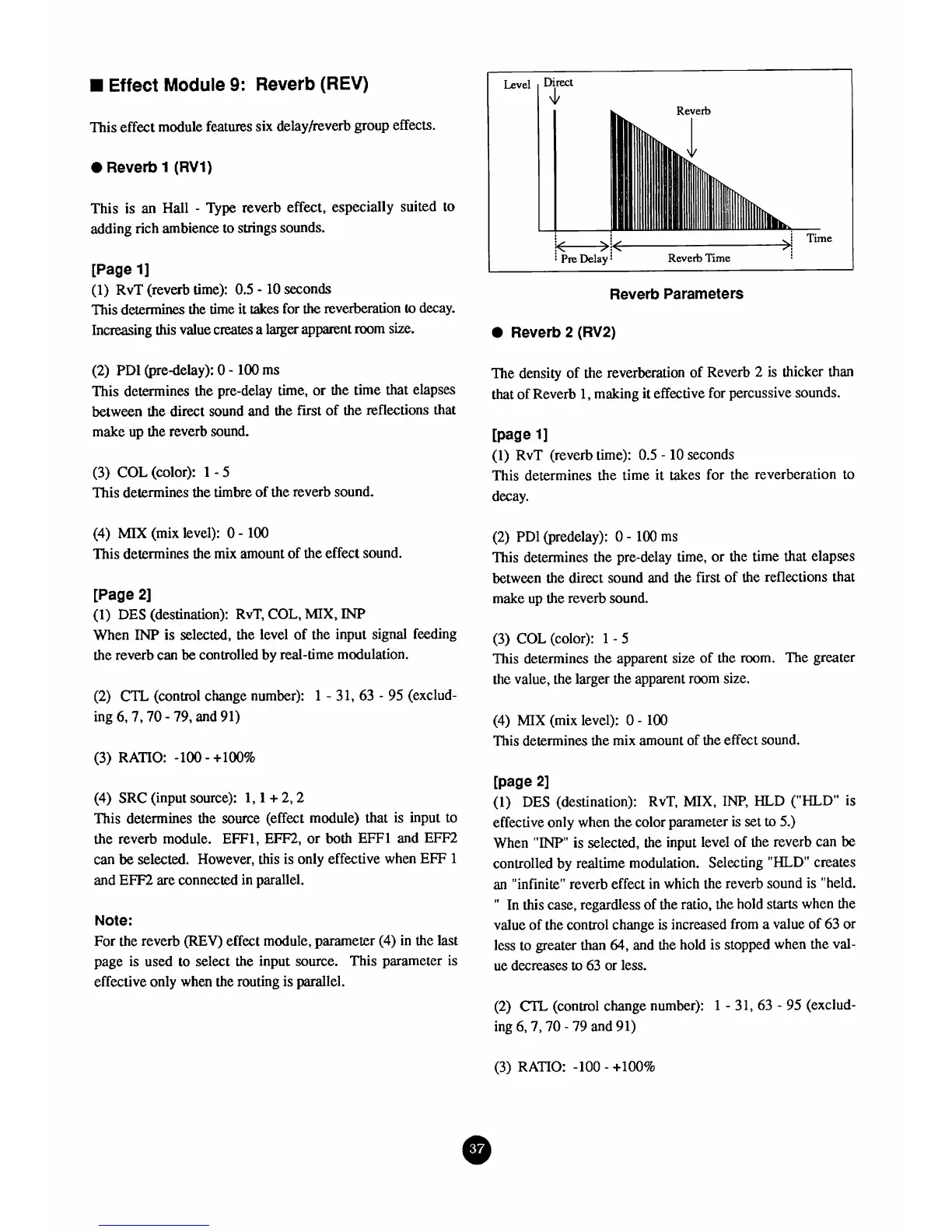
This determines the time it takes for
the
reverberation
to
decay.
Increasing
this
value creates a
larger
apparent room size.
(2)
PD1 (predelay):
0
-
100 ms
This determines the pre-delay time, or the time that elapses
between the direct sound and the first of the reflections that
make up the reverb sound.
(3)
COL
(color): 1
-
5
This determines the timbre of the reverb sound.
(4)
MIX
(mix level): 0
-
100
This determines the mix amount of the effect sound.
[Page
21
(1) DES (destination): RvT, COL,
MIX,
INP
When
MP
is selected, the level of the input signal feeding
the reverb can
be
controlled by real-time modulation.
(2)
CTL
(control change number): 1
-
31, 63
-
95
(exclud-
ing 6,7,70
-
79, and 91)
(3) RATIO:
-100
-
+
100%
(4) SRC (input source): 1, 1
+
2,2
This determines the
source
(effect module) that is input to
the reverb module. EFFl, Em, or both EFFl and
EFF2
can
be
selected. However, this is only effective when
EFF
1
and
EF'F2
are connected in parallel.
Note:
For the reverb
(REV)
effect module, parameter
(4)
in the last
page is used to select the input source. This parameter is
effective only when the routing is parallel.
Revert,
Time
Reverb Parameters
Reverb
2
(RV2)
The density of the reverberation of Reverb 2 is thicker than
that of Reverb 1, making it effective for percussive sounds.
[page
11
(1) RvT (reverb time): 0.5
-
10 seconds
This determines the time it takes for the reverberation to
decay.
(2)
PDl (predelay): 0
-
100 ms
This determines the pre-delay time, or the time that elapses
between the direct sound and the first of the reflections that
make up the reverb sound.
(3)
COL (color): 1
-
5
This determines the apparent size of the room. The greater
the value, the larger the apparent room size.
(4) MIX (mix level):
0
-
100
This determines the mix amount
of
the effect sound.
[page
21
(1)
DES (destination): RvT,
MIX,
INP,
HLD
("HLD"
is
effective only when the color parameter is set
to
5.)
When
"INP"
is selected, the input level of the reverb can
be
controlled by realtime modulation. Selecting
"HLD"
creates
an
"infinite" reverb effect in which the reverb sound is "held.
"
In
this case, regardless of the ratio, the hold starts when the
value of the control change
is
increased from a value of 63 or
less to greater than
64,
and the hold is stopped when the val-
ue decreases
to
63 or less.
(2)
CTL
(control change number): 1
-
31, 63
-
95
(exclud-
ing 6,7,70
-
79 and 91)
(3) RATIO: -100
-
+loo%


 To Next Page