Annex B Safety Knowledge
61
conductor is far away from other conductors, producing strong diverging electric field, so
local discharge will occur that the point. Usually accompanied by light-emitting and noise.
(GB/T 2900.5-2002)
B.6 Charge current test
a) Definition
The charge current means the Max. peak current obtained during voltage output process
of the analyzer. Set for the capacitive load in general to determine whether the load is open.
b) Purpose
During ACW/DCW, the user is often only interested in whether the lower limit of the
DUT is exceeded. If the DUT is not connected well with the test circuit, open circuit will
often cause false judgment. The steady test current of capacitive loads is relatively low, it is
difficult to determine via setting the upper limit for alarm. Charging current test can be
adopted to determine whether the DUT is connected in the circuit.
c) Principle
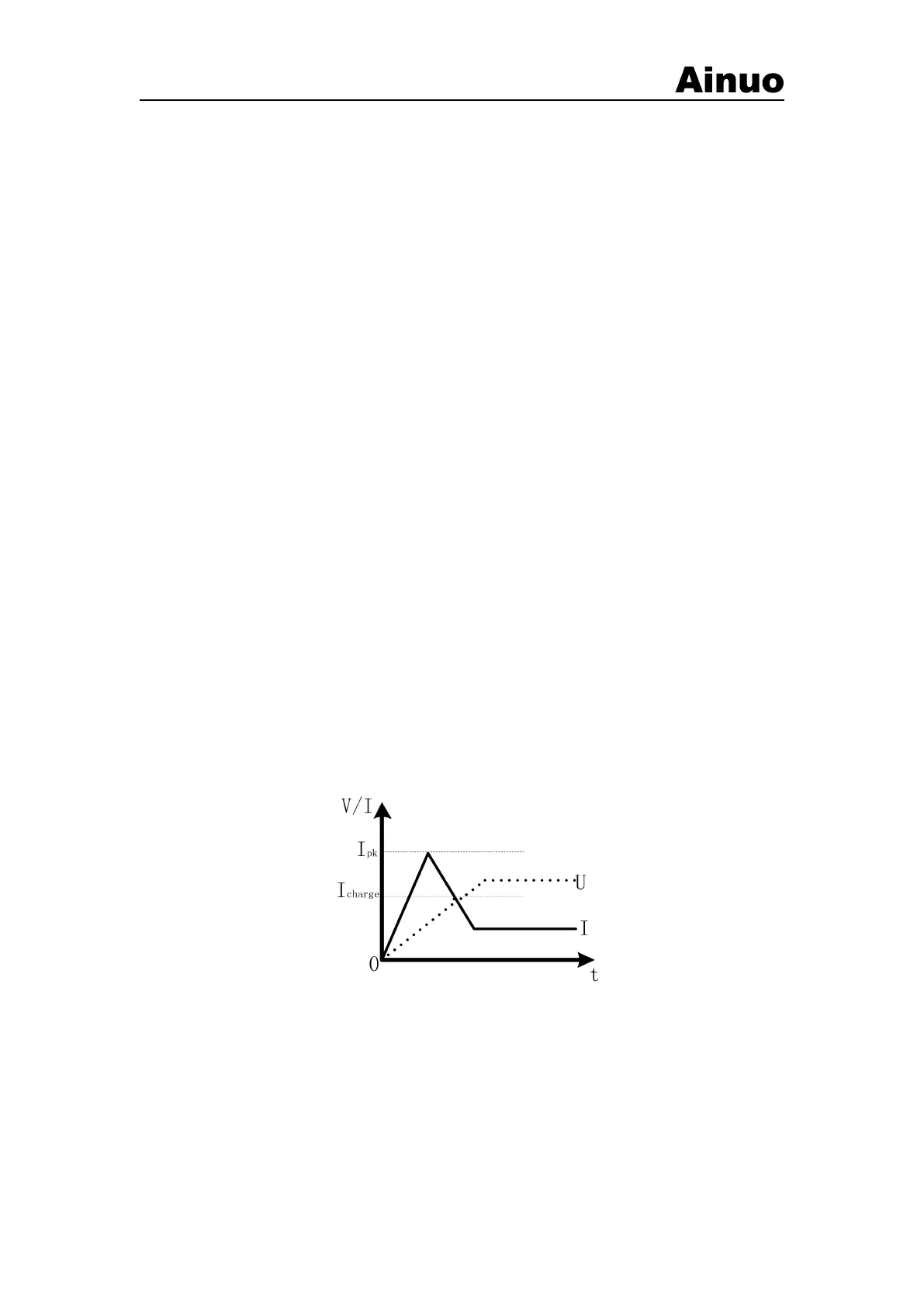
As hown in the following figure, during voltage ramp process, the current of DUT will
increase followingly. The analyzer will automatically record the peak current Ipk during ramp
process. At the end of ramp process, judge if the peak test current exceeds the set lower limit
of charge current Icharge. If Ipk>Icharge, the load is connected well, otherwise, it is open,
and the analyzer will give alarm.
The user can enter the lower limit of the charging current manually, or select the value
via the cursor and then press the "START" button to get the value automatically.
Figure B-6-1 Scheme of charge current test
B.7 LC
LC (Leakage Current Test) is a test item among many safety tests. General safety
implementation units, such as UL, CSA, IEC, BSI, VDE, TUV and JSI etc, will require this
test for certain products. The specifications of LC are different for different test products. For
different applications and functions of products, the specifications are also different. Current


 To Next Page