Master-Slave Operation
Page 146 7210 SAS-X, R6 OS Services Guide
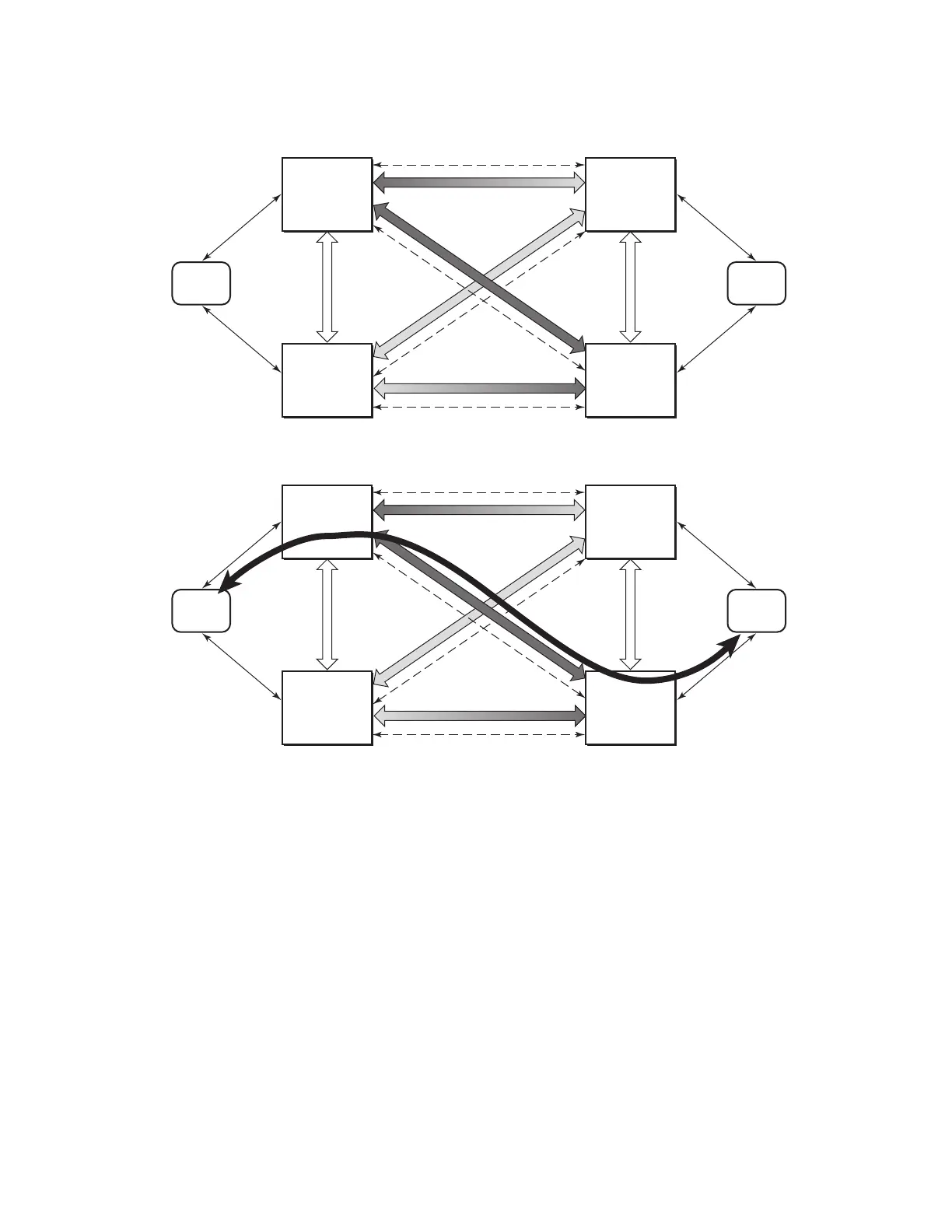
Figure 20: Access Node Resilience
In this application, a new pseudowire status bit of active or standby indicates the status of the SAP
in the MC-LAG instance in the 7210 SAS aggregation node. All spoke SDPs are of secondary type
and there is no use of a primary pseudowire type in this mode of operation. Node A is in the active
state according to its local MC-LAG instance and thus advertises active status notification
messages to both its peer pseudowire nodes, for example, nodes C and D. Node D performs the
same operation. Node B is in the standby state according to the status of the SAP in its local MC-
LAG instance and thus advertises standby status notification messages to both nodes C and D.
Node C performs the same operation.
7210 SAS node selects a pseudowire as the active path for forwarding packets when both the local
pseudowire status and the received remote pseudowire status indicate active status. However, a
OSSG116
Aggregation
node
A
Aggregation
node
C
MSANMSAN
Aggregation
node
B
Aggregation
node
D
Inter-chassis
PW for VLL
Active
Active
Active
Active
Standby
Standby
Standby
Standby
Standby
TLDP
Standby Active
Active
Inter-chassis
PW for VLL
Aggregation
node
A
Aggregation
node
C
MSANMSAN
Aggregation
node
B
Aggregation
node
D
Inter-chassis
PW for VLL
Active
Standby
Standby
TLDP
Active
Inter-chassis
PW for VLL




 To Next Page