VPRN Service Configuration Commands
Page 834 7210 SAS-X OS Services Guide
The router-id specified in this command must be associated with the virtual neighbor. The transit area
cannot be a stub area or a Not So Stubby Area (NSSA).
The no form of the command deletes the virtual link.
Default No virtual link is defined.
Parameters router-id — The router ID of the virtual neighbor in IP address dotted decimal notation.
transit-area area-id — The area-id specified identifies the transit area that links the backbone area
with the area that has no physical connection with the backbone.
The OSPF backbone area, area 0.0.0.0, must be contiguous and all other areas must be connected
to the backbone area. The backbone distributes routing information between areas. If it is not
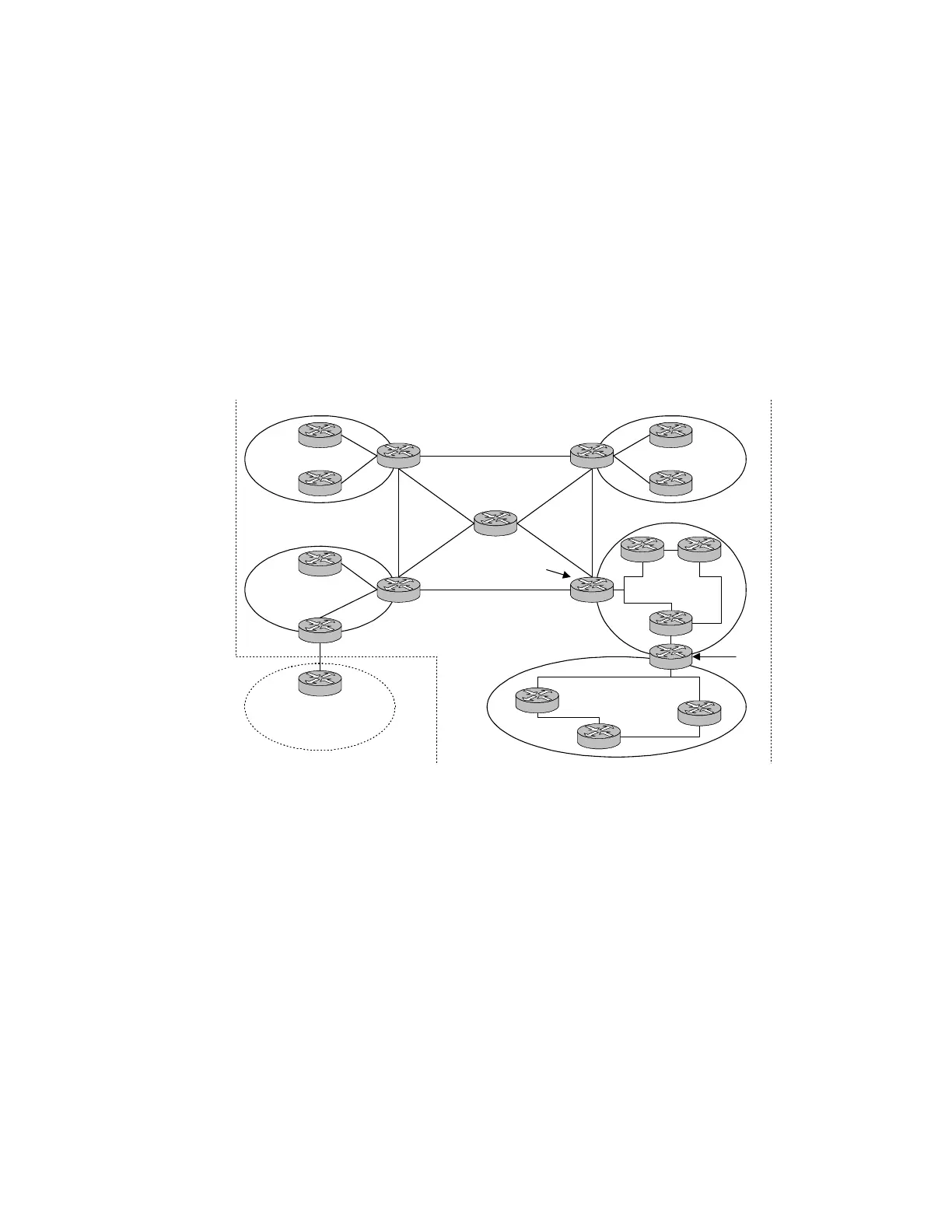
practical to connect an area to the backbone (see Area 0.0.0.5 in Figure 57) then the area border
routers (such as routers Y and Z) must be connected via a virtual link. The two area border
routers form a point-to-point-like adjacency across the transit area (see Area 0.0.0.4).
Figure 57: OSPF Areas
compatible-rfc1583
Syntax [no] compatible-rfc1583
Context config>service>vprn>ospf
Description This command enables OSPF summary and external route calculations in compliance with RFC1583
and earlier RFCs.
RFC1583 and earlier RFCs use a different method to calculate summary and external route costs. To
avoid routing loops, all routers in an OSPF domain should perform the same calculation method.
Area 0.0.0.5
Area 0.0.0.4
Area 0.0.0.2Area 0.0.0.1
Area 0.0.0.3
Area 0.0.0.0
Y
Z
RIP Domain
OSPF Domain



 To Next Page