Virtual Private LAN Services
7210 SAS-X, R6 OS Services Guide Page 287
Epipe Emulation using Dot1q VLAN range SAP in VPLS
with G8032
On the node where the service originates, in addition to the access dot1q range SAP, the service
needs to be configured with access-uplink SAPs on the two G.8032 ring ports. G.8032 mechanism
is used to for breaking the loop in the ring and VPLS service protection. The intermediate nodes
on the ring needs to use VPLS service with access-uplink SAPs on the ring ports and use the same
G.8032 instance for protection, as one is used for service protection on the originating node.
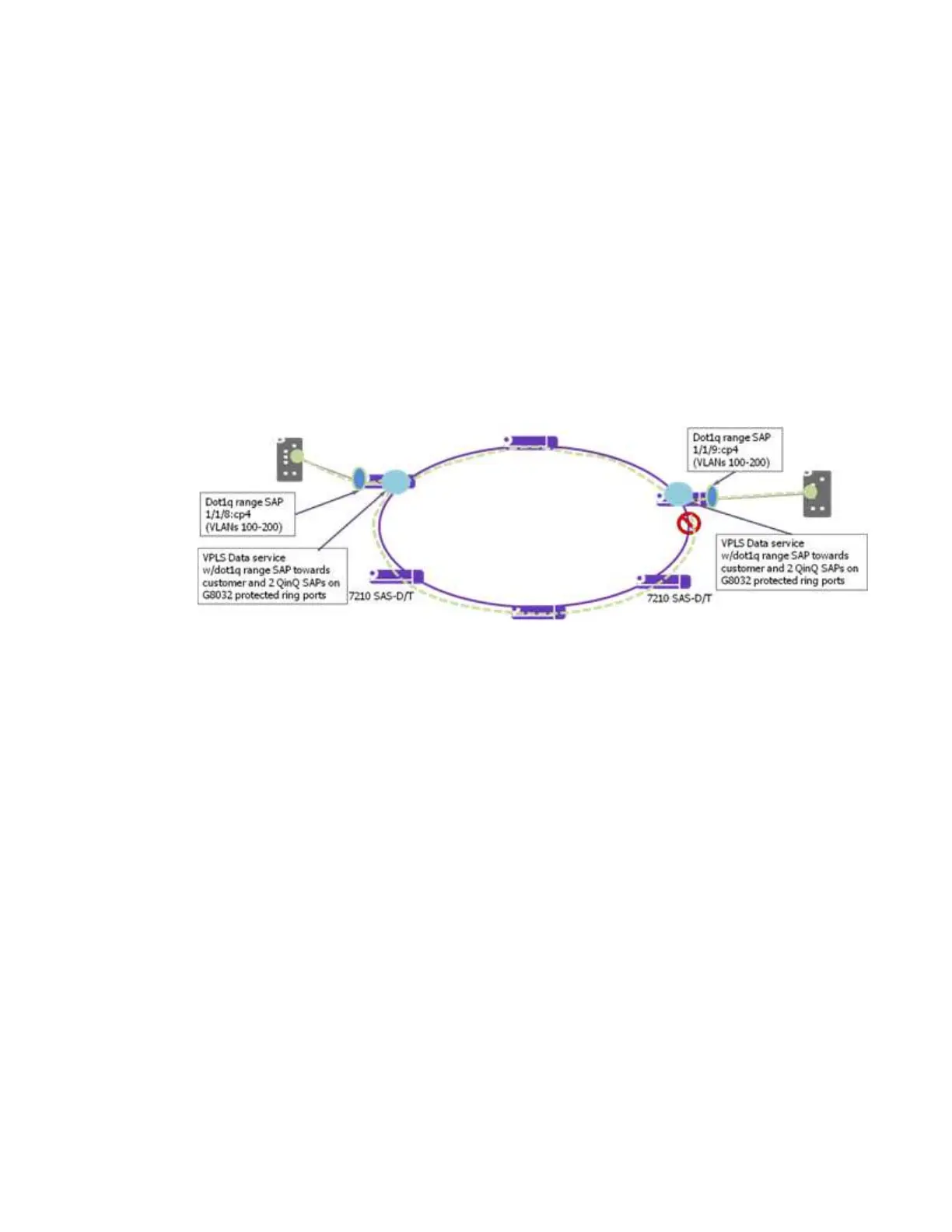
The Figure 39 shows how two business offices, served by an operator are connected in a ring
network deployment using Dot1q range SAPs and a VPLS service with G.8032 for protection.
Figure 39: Epipe Emulation in a ring using VPLS with G.8032
The following are the requirements to provide for an Epipe service connectivity between two
business sites:
• Transport all the VLANs used by the internal enterprise network of the businesses.
• Support high availability for the service between the business sites by protecting against
failure of the links or nodes in the ring.
To achieve connectivity between two business sites in access-uplink/L2 mode is to configure
SAPs for each of the individual VLANs used in the enterprise network in a VPLS service and use
G.8032 for protection. The number of VLANs that was supported is limited by the number of
SAPs supported on the platform.
The 7210 SAS platforms, currently support the use of Dot1q range SAPs with only Epipe services
in either network/MPLS mode or access-uplink/L2 mode. Dot1q range SAPs allows operators to
transport a range of VLANs by providing similar service treatment (service treatment refers to
forwarding decision along with encapsulation used, QoS and ACL processing, accounting, etc.) to
all the VLANs configured in the range. It simplifies service configuration and allows operators to



 To Next Page