VPLS Service Overview
Page 234 7210 SAS-X, R6 OS Services Guide
1. 7210-A (Figure 27)
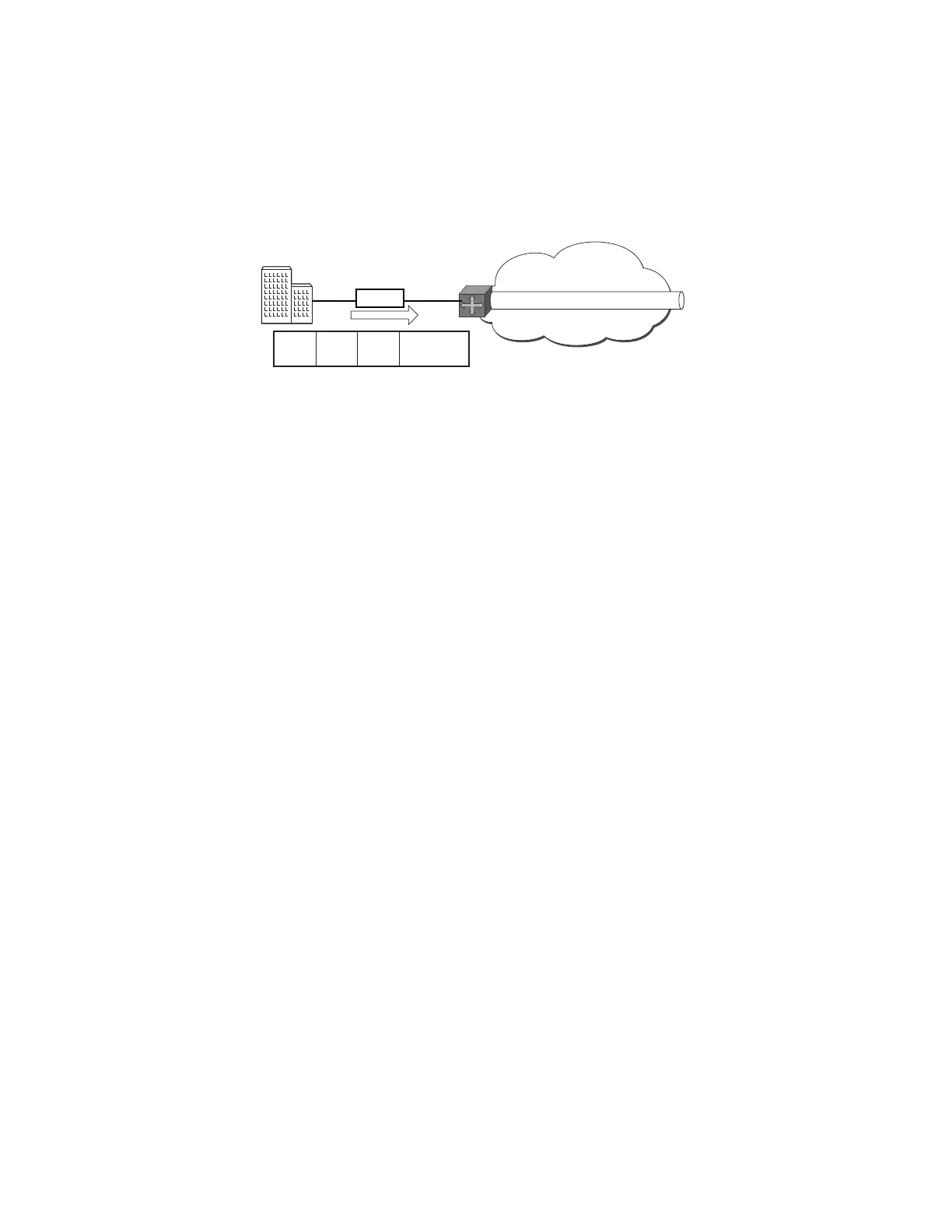
a. Service packets arriving at are associated with a VPLS service instance based on the com-
bination of the physical port and the IEEE 802.1Q tag (VLAN-ID) in the packet
Figure 27: Access Port Ingress Packet Format and Lookup
b. 7210-A learns the source MAC address in the packet and creates an entry in the FIB table
that associates the MAC address to the service access point (SAP) on which it was received.
c. The destination MAC address in the packet is looked up in the FIB table for the VPLS in-
stance. There are two possibilities: either the destination MAC address has already been
learned (known MAC address) or the destination MAC address is not yet learned (unknown
MAC address).
For a Known MAC Address (Figure 28):
d. ,If the destination MAC address has already been learned by 7210, an existing entry in the
FIB table identifies the far-end PE-Router and the service VC-label (inner label) to be used
before sending the packet to PE-Router-A.
e. The 7210 SAS chooses a transport LSP to send the customer packets to PE-Router-A. The
customer packet is sent on this LSP once the IEEE 802.1Q tag is stripped and the service
VC-label (inner label) and the transport label (outer label) are added to the packet.
For an Unknown MAC Address (Figure 28):
f. If the destination MAC address has not been learned, 7210 will flood the packet to spoke
SDPs that are participating in the service.
PE A
Customer
Location A
IP/MPLS Network
Dest
MAC
Src
MAC
VLAN
ID
Payload
Customer Payload
7210-A



 To Next Page