Need help?
Do you have a question about the Asco 8300 and is the answer not in the manual?
Explains the necessity of testing generators to ensure optimal performance under load and compliance.
Explains the basic principle of how load banks function using a simplified model for generator testing.
Details the Sigma 2 control system and various user interface options for controlling load banks.
Describes the range of user control interfaces available, from basic to sophisticated systems.
Discusses the importance and methodology of testing generators with non-unity power factors to simulate real-world loads.
Describes load banks designed for temporary installation and their specific design differences compared to fixed units.
Outlines various applications for load banks beyond generator testing, including UPS and site load correction.
Provides essential safety instructions for handling, operation, and maintenance of load banks to prevent injury.
Details safe procedures for lifting, transporting, and securing load banks, covering forklift and crane methods.
Covers key factors for selecting and installing a load bank safely and correctly, including location and airflow.
Guides the electrical installation process, including power sources, wiring, and connections for safe operation.
Details how to connect the main power supply (Supply-on-Test) to the load bank terminals for testing purposes.
Explains how to connect control devices like the Sigma Hand-held to the load bank for operation and monitoring.
Outlines a three-stage process for commissioning the load bank to ensure correct electrical operation and safety.
Lists prerequisites and checks required before operating the load bank according to manual instructions.
Reiterates crucial safety warnings for operating the load bank to prevent injury and equipment damage.
Explains how the load bank is controlled using Sigma 2 systems or alternative methods for testing.
Describes the layout and components within the load bank's control room console for operation and monitoring.
Details the switches, buttons, and indicators on the load bank's main control panel for direct operation.
Explains the meaning of various indicator lamps on the control panel for operational status feedback.
Details methods for quickly shutting down the load bank in an emergency, using buttons or isolators.
Provides steps for performing a brief load function test to confirm installation and operational readiness.
Explains how to control the load bank using the ID rotary switch when a Sigma controller is unavailable.
Introduces the Hand-held unit as a user interface for controlling Sigma load banks and monitoring generator performance.
Guides on how to update the firmware on the Sigma Hand-held unit via USB for optimal performance.
Explains how to connect the Hand-held unit to the load bank using a Sigma control cable for remote operation.
Describes the layout and function of the Hand-held's keypad and quadrant keys for control and navigation.
Provides a quick guide to performing a manual generator test using the Hand-held, covering settings and load application.
Explains how to use the Hand-held's settings pages to configure the unit for accurate load bank operation.
Guides on setting the Supply-on-Test details to ensure correct load application and generator protection during tests.
Details how to check and edit supply rating values against the generator's rating plate for accurate testing.
Allows checking load bank capacity and accessing options pages for operation adjustments and configuration.
Introduces the three option pages for adjusting load bank operation aspects like control, display, and loading parameters.
Explains direct, real-time control of the load bank using the Hand-held for precise load management.
Guides on applying selected load, recalculating corrections, and adjusting load while testing for optimal generator assessment.
Introduces automated test sequences for repeatable testing and fault finding, allowing pre-programmed load steps.
Step-by-step guide to programming test sequence stages for percentage load, power factor, and duration for automated tests.
Reiteration of safety warnings for maintenance personnel before performing any work on the load bank.
Outlines daily and monthly maintenance tasks to ensure optimal load bank performance and longevity.
Details annual and five-yearly maintenance requirements for optional air circuit breakers for safety and reliability.
Provides a chart of common faults, possible causes, and solutions for troubleshooting load bank issues.
Explains the status display on the Sigma 2 module and its normal operation codes for monitoring.
Lists warning codes and their associated causes and actions for troubleshooting abnormal conditions.
Lists error codes and their potential causes and required actions for troubleshooting critical faults and ensuring safe shutdown.
Introduces the System Monitor for diagnostics, control, and maintenance, providing an operator interface.
Describes the display tabs for viewing load bank operation, supply, and control parameters for monitoring performance.
Explains the Status screen's Overview and History tabs for viewing activity, errors, and warnings for system events.
Details the Load screen for operating load control and viewing settings, enabling manual adjustments.
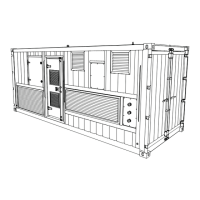
Provides diagrams for the 8300 model, showing dimensions, access points, and clearance requirements.
Provides diagrams for the 8400 model, showing dimensions, access points, and clearance requirements.
Displays the declaration of conformity for the load banks with relevant EU directives and harmonised standards.
Details the equipment's compliance with EMC directives regarding immunity to external interference and electromagnetic emissions.
Lists relevant formulas for calculating power, current, and de-rating from nominal voltage and frequency values.
 General
| Brand | Asco |
|---|---|
| Model | 8300 |
| Category | Portable Generator |
| Language | English |

 To Next Page