CB (E6.1) 07/2017 Page 121/145
21. Troubleshooting
Only qualified service personnel authorized by BINDER must perform repair.
Repaired chambers must comply with the BINDER quality standards.
21.1 General
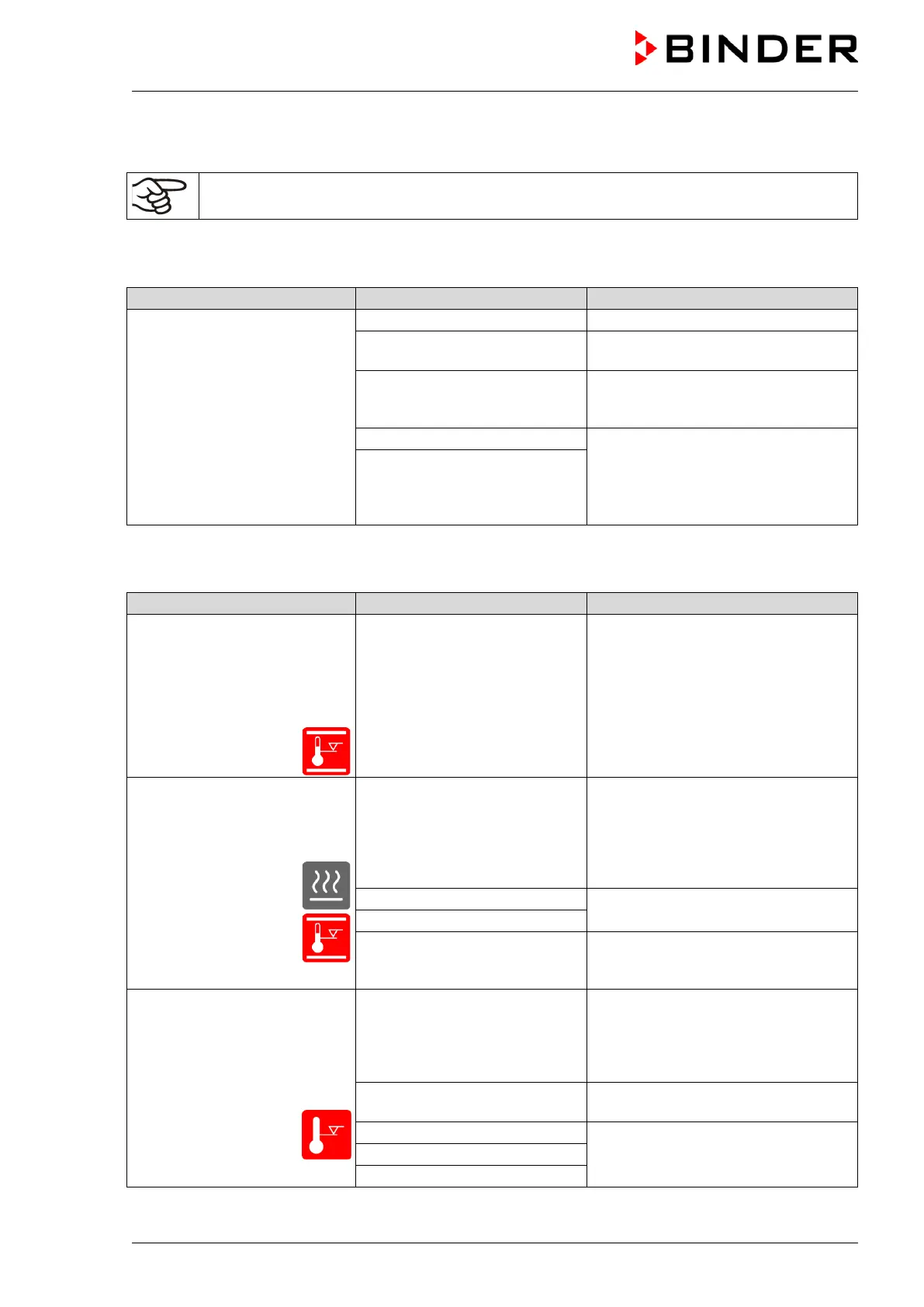
Fault description / indication
Chamber without function.
Check connection to power supply.
Wrong voltage.
Check power supply for voltage of
100-120V or 200-240V.
Chamber fuse has responded.
Check chamber fuse and replace it if
appropriate. If it responds again,
Contact BINDER service.
Nominal temperature exceeded
by 10° due to chamber failure.
Over temperature protective
device (class 1) responds.
21.2 Heating
Fault description / indication
Excess temperature. Having
reached the setpoint, the
temperature exceeds the
setpoint by more than the set
tolerance range value (more
Site of installation too warm.
Difference between the set
temperature and the ambient
temperature too low.
Confirm the alarm (chap. 11.4).
Difference between the set
temperature and the ambient
temperature must be at least 7 °C /
12.6 °F.
Alarm message
“Temp. range”
Chamber heating permanently,
Temporary disturbance of the
temperature control.
Confirm the alarm (chap. 11.4). Turn
off the chamber. Open the chamber
doors for approx.. 5 minutes and turn
on the chamber again. Confirm the
alarm (chap. 11.4). Upon renewed
alarm, contact BINDER service.
Notification
“Heating active”.
Alarm message
“Temp. range”
Confirm the alarm (chap. 11.4).
Contact BINDER service.
Semiconductor relay defective
Temperature controller not
adjusted.
Confirm the alarm (chap. 11.4).
Calibrate and adjust the temperature
Excess temperature.
Overtemperature safety
controller class 3.1 responds.
Safety controller setpoint value
exceeded.
Confirm the alarm (chap. 11.4).
Check setting of temperature setpoint
and of the safety controller class 3.1
setpoint. If appropriate, select
Alarm message
“Safety controller”
Too much external heat load.
Confirm the alarm (chap. 11.4).
Reduce heat load.
Confirm the alarm (chap. 11.4).
Contact BINDER service.
Semiconductor relay defective
Safety controller defective.



 To Next Page