Paragraphs 63-66
63.
SHUT-OFF CONTROL. Ib adjust the shut-off
control, pull shut-off knob fully outward. Then,
check to see that lever
(14—Fig.
59) contacts stop. If
not, acyust cable position as required. Push knob fuUy
inward and check to see that lever (14) contacts the
pump case. If not, loosen locknut under knob, back
off knob slightly and retighten locknut. Recheck to
see that shut-off lever
(14)
contacts stops when knob
is fully in run position or fully out in stop position.
iNJECTiON NOZZLES
WARNiNG: Fuei ieaves the injection nozzies with
sufficient force to penetrate the
skin.
When testing,
iceep your person ciear of the nozzle spray.
Aii Modeis
64.
TESTING AND LOCATING FAULTY NOZ-
ZLE. If engine does not run properly and a faulty in-
jection nozzle is suspected, or if one cylinder is mis-
firing, locate faulty nozzle as follows: With engine
running at low isle speed, loosen the high pressure
line fitting on each ir\jector in turn, thereby allow-
ing fuel to escape at the fitting rather than enter the
cylinder. As in checking spark plugs in a spark igni-
tion engine, the faulty nozzle is the one that when
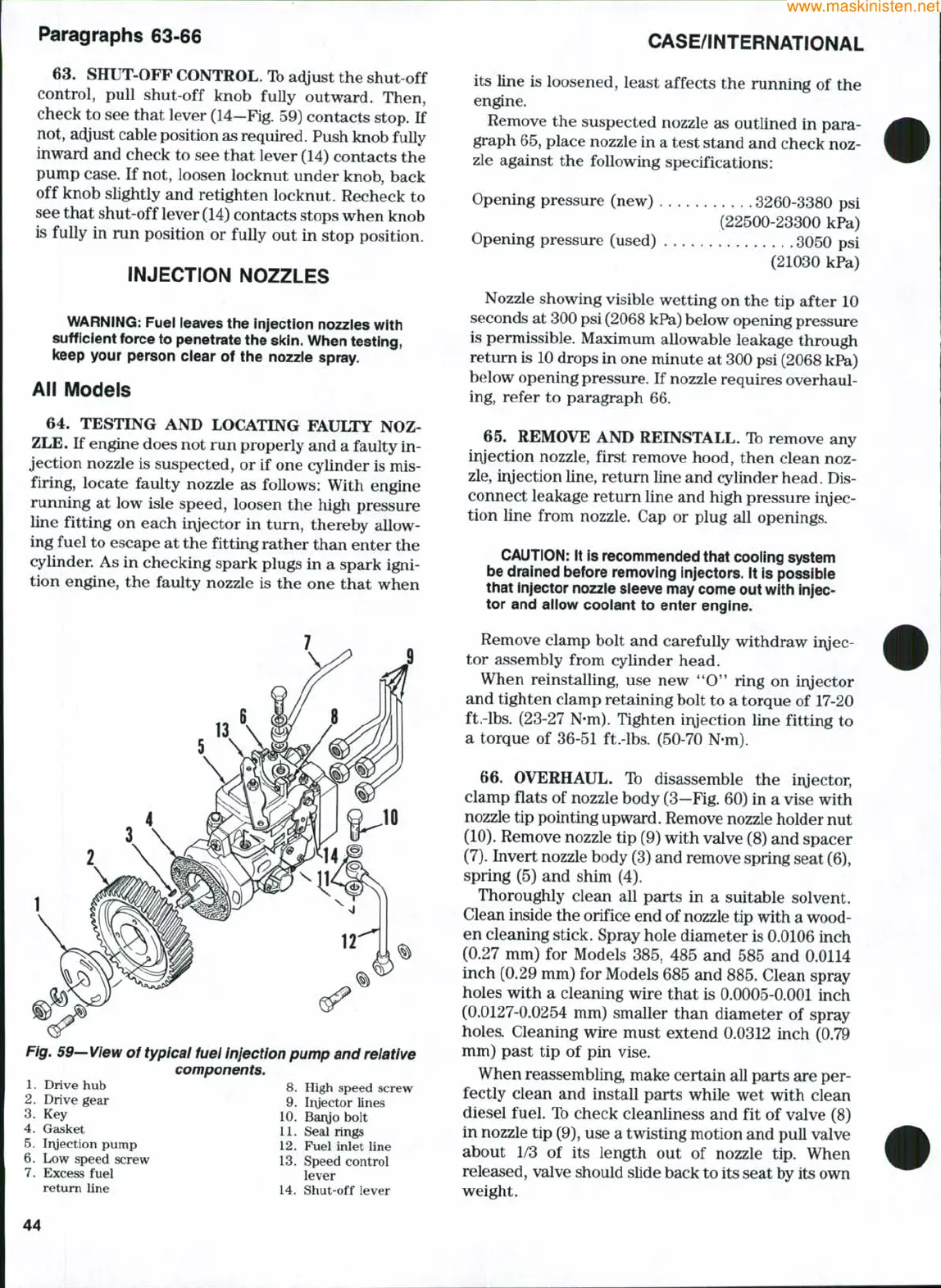
Fig.
59—View
of
typical
fuel
injection
pump and
relative
components.
1.
Drive hub
2.
Drive gear
3.
Key
4.
Gasket
5.
Ir\iection pump
6. Low speed screw
7.
Excess fuel
return line
44
8. High speed screw
9. Irxjector lines
10.
Bar\jo bolt
11.
Seal rings
12.
Fuel inlet line
13.
Speed control
lever
14.
Shut-off lever
CASE/iNTERNATiONAL
its line is loosened, least affects the running of the
engine.
Remove the suspected nozzle as outlined in para-
graph
65,
place nozzle in a test stand and check noz-
zle against the following specifications:
Opening pressure (new) 3260-3380 psi
(22500-23300 kPa)
Opening pressure (used) .. 3050 psi
(21030 kPa)
Nozzle showing visible wetting on the tip after 10
seconds at 300 psi (2068 kPa) below opening pressure
is permissible. Maximum allowable leakage through
retum is 10 drops in one minute at 300 psi (2068 kP^)
below opening pressure. If nozzle requires overhaul-
ing, refer to paragraph 66.
65.
REMOVE AND REINSTALL. Ib remove any
ir\jection nozzle, first remove hood, then clean noz-
zle,
iryection line, return line and cylinder head. Dis-
connect leakage retum line and high pressure iryec-
tion line from nozzle. Cap or plug all openings.
CAUTION:
It is recommended that cooling system
be drained before removing injectors. It is possibie
that injector nozzle sleeve may come out with injec-
tor and aiiow cooiant to enter engine.
Remove clamp bolt and carefully withdraw iryec-
tor assembly from cylinder head.
When reinstalling, use new **0" ring on ir\jector
and tighten clamp retaining bolt to a torque of 17-20
ft.-lbs.
(23-27 N-m). Tighten ir\jection line fitting to
a torque of 36-51 ft.-lbs. (50-70 N-m).
66.
OVERHAUL. To disassemble the iryector,
clamp flats of nozzle body (3—Fig. 60) in a vise with
nozzle tip pointing upward. Remove nozzle holder nut
(10).
Remove nozzle tip (9) with valve (8) and spacer
(7).
Invert nozzle body (3) and remove spring seat (6),
spring (5) and shim (4).
Thoroughly clean all parts in a suitable solvent.
Clean inside the orifice end of nozzle tip with a wood-
en cleaning stick. Spray hole diameter is 0.0106 inch
(0.27 mm) for Models 385, 485 and 585 and 0.0114
inch (0.29 mm) for Models 685 and 885. Clean spray
holes with a cleaning wire that is 0.0005-0.001 inch
(0.0127-0.0254 mm) smaller than diameter of spray
holes.
Cleaning wire must extend 0.0312 inch (0.79
mm) past tip of pin vise.
When reassembling, make certain all parts are per-
fectly clean and install parts while wet with clean
diesel fuel. Ib check cleanliness and fit of valve (8)
in nozzle tip
(9),
use a twisting motion and pull valve
about 1/3 of its length out of nozzle tip. When
released, valve should slide back to its seat by its own
weight.



 To Next Page