Group 22, Wheels and Tires
22-2-8 • Pneumatic Wheels and Tires SM 765, Nov ’06
Filling Tires with Air
Follow these procedures when putting air into tires. All
wheel and tire assemblies must be filled in a safety cage.
The hose must have an adapter that can be connected to
the valve stem.
1. Attach an air hose to valve stem.
2. Open the control valve which will let compressed air
into the tire.
3. At intervals, close the control valve and check the
pressure in the tire by reading the gauge. Do not put
too much presssure into the tire.
4. Continue to fill the tire to the correct air pressure
reading of
Drive tire GEX20/25/30: 800 kPa (116 psi).
Steer tire GEX20/25/30: 1000 kPa (145 psi)
IMP
RTANT
Put equal pressure in both tires of a dual
assembly. Do not put air into a tire that is flat
without first inspecting it and the wheel for
damage.
Filling Tires with Nitrogen
If your air supply does not have enough pressure to fill the
tire, you can use a pressurized cylinder of commercial
nitrogen gas to get the correct tire pressure. With the tire
in a safety cage, connect the nitrogen cylinder to the valve
stem with the use of an air chuck.
WARNING
!
Use nitrogen only. Do not use oxygen or any
other gas to fill tires. Make sure all items of
equipment used (nitrogen cylinder, regulator,
gauges, hoses) are UL approved and in good
condition. Use the correct regulator and hose
for the pressures that are necessary.
1. Be sure tank valve is closed to connect hose to valve
stem. Tank vlave is closed by turning handle on top
of tank clockwise to a stop.
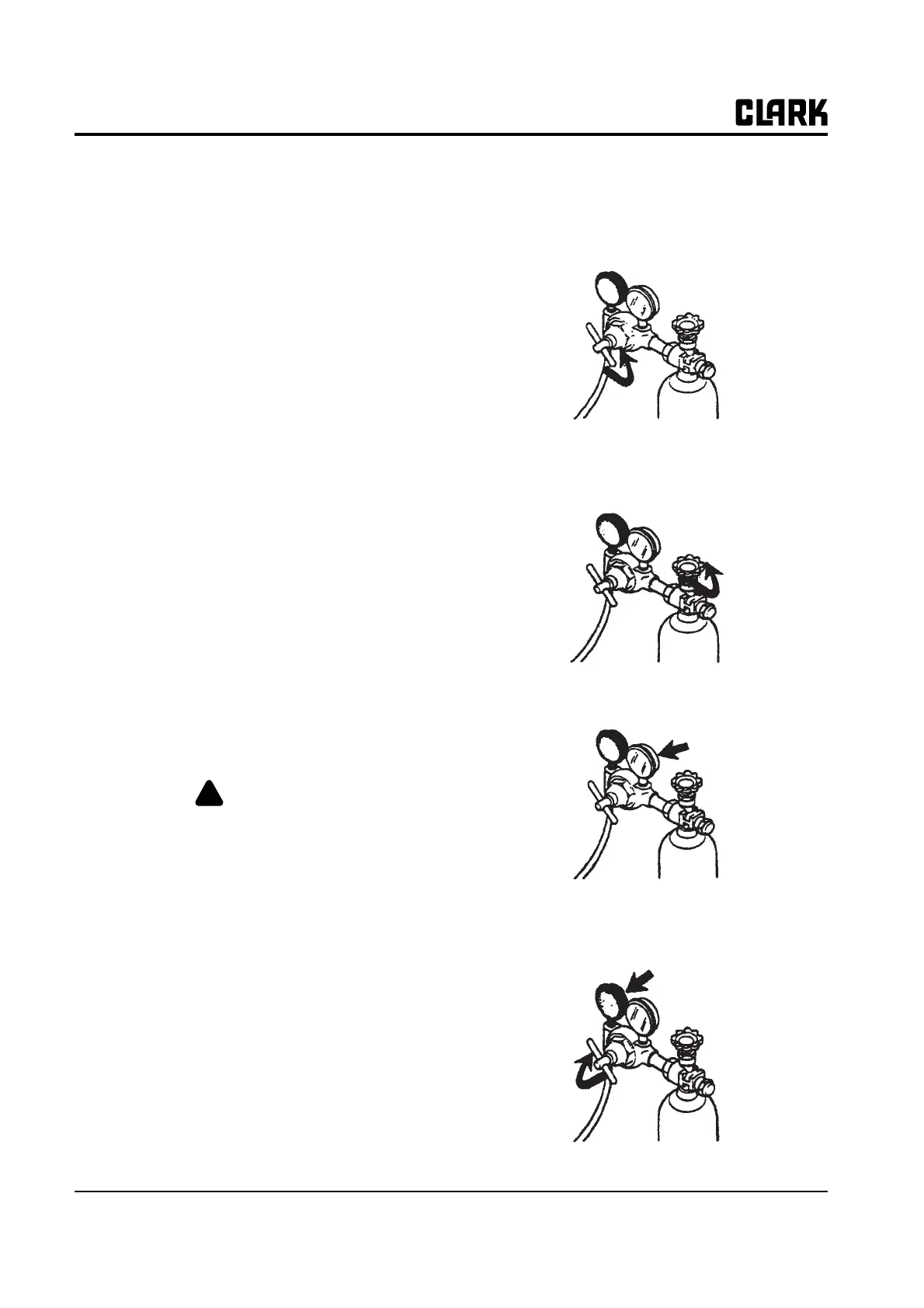
2. Turn the regulator valve counterclockwise (CCW)
until you can feel no resistance from the regulator.
This will adjust the regulator presssure to a low pres-
sure near zero.
3. Slowly turn the cylinder valve counterclockwise
(CCW) to open position.
4. The tank gauge will now show tank pressure.
5. Turn the regulator valve clockwise (CW) until the
regulator gauge reads the correct tire pressure. Fill
the tire with nitrogen.



 To Next Page