Group 34, Uprights
SM 765, Nov ’06
Carriage and Upright Roller Clearance Checks and Shim Adjustments
• 34-4-3
Roller Side Clearance Checks
The same basic procedure is used for checking all the lift
rollers. That general procedure is given in the subsection
directly below. Special instructions for specific rollers fol-
low that subsection. Follow those directions (in the sub-
section called “Directions for Checking Specific Rollers”)
and you will be directed to general and specific informa-
tion you need.
General Roller Side Clearance Checking
Procedure
For each roller set, you need to measure the gap between
the outside face of a roller and its adjacent nesting rail. In
general, the lift roller side clearance check procedure is as
follows:
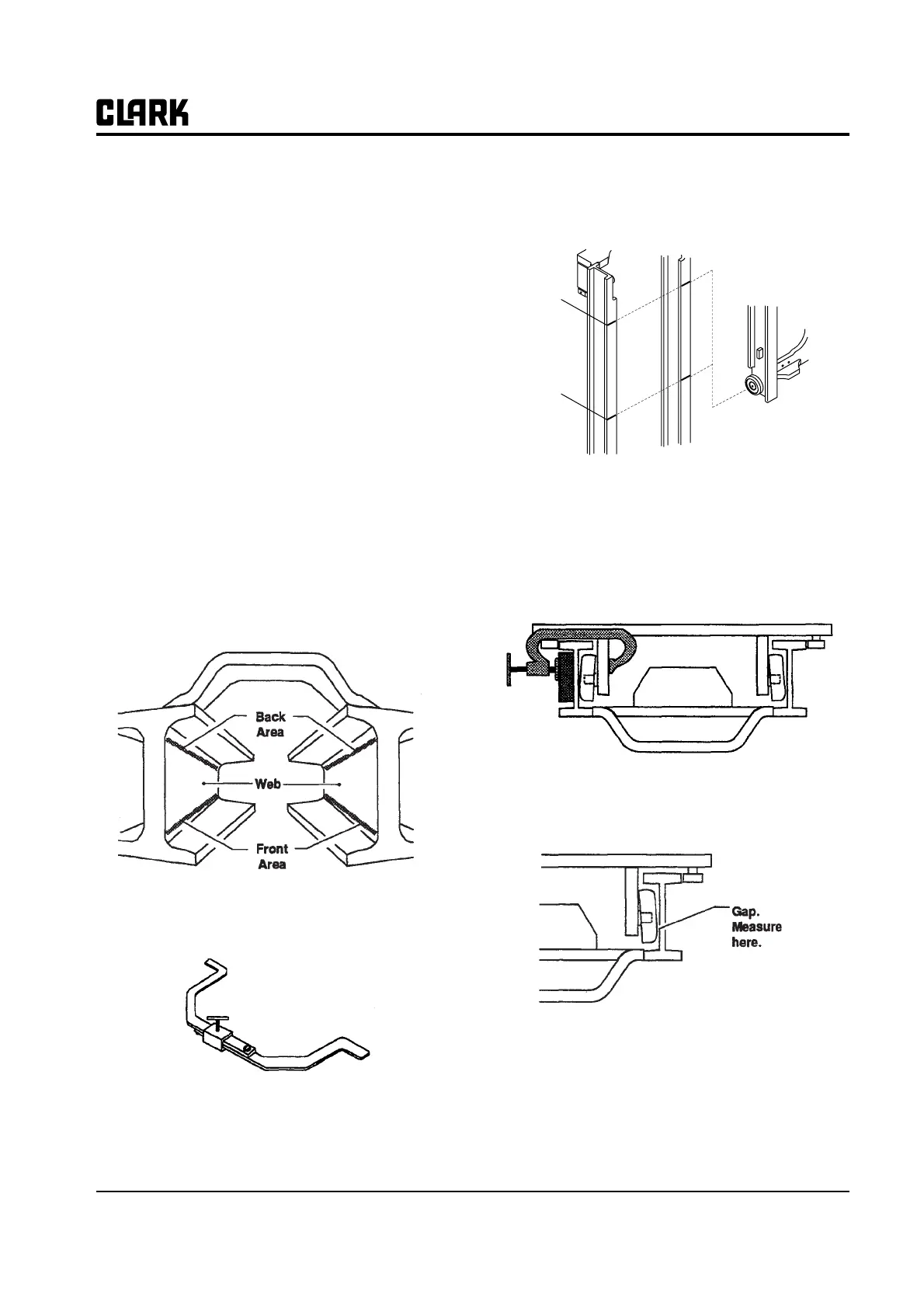
1. With the spanner tool, find and mark the narrowest
and widest spans in each rail set at the roller-contact
areas in the rail webs:
• Inner Rail Set-Mark narrowest and widest spans
for both the front and back web areas.
• Outer and Intermediate Rail Sets-Mark narrowest
and widest spans for the back web area only.
Web Areas on Typical Rail Set
Spanner Tool. Clark Part #180109
2. Position the carriage or rails so that the roller set you
want to check is at the mark for the narrowest span
on the adjacent nesting rail set.
Example of Aligning Roller Set with Widest and
Narrowest Spans Marked on Adjacent Rail Set.
Rail sets are shown separated for clarity.
3. Clamp the rails together opposite the roller you
intend to check. Use wooden shim blocks to protect
the rails. Place clamp as close to roller as possible.
Torque clamp to 25 N⋅m (20 ft-lb).
4. Measure the gap with a feeler gauge. Make sure
roller is tight against its shoulder. Write down the
result.
5. Repeats steps 2 through 4 for the widest span marked
on the rail set.
Widest
span
Narrowest
span



 To Next Page