Page 7
INPUTS Cont.
TAMPER/KEY-SWITCH - A 24Hr tamper circuit is available for monitoring tamper status of the control cabinet,
external satellite sirens, etc. The tamper circuit is programmable with 2 options (P601E5E) either normally closed
loop or 2k2 EOL supervision. The tamper circuit must be terminated with an end-of-line resistor if 2k2 EOL
supervision is selected. The activation events to outputs for this tamper circuit are fully programmable. The tamper
circuit can also double as a key-switch input. If the key-switch function is enabled for any of the Areas at addresses
P531E, P631E, P731E or P831E option 1. When the key-switch is enabled, the tamper input is wired as per Type 3
or Type 4 configurations as shown on page 7. The low key-switch uses the 4k7 resistor and if selected, the high
key-switch will use the 8k2 resistor.
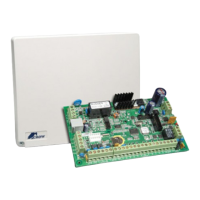
AC - Connect the two low voltage wires (no polarity) from the transformer to the terminals marked AC on the PW64
PCB. The PW64 cabinet includes a transformer rated at 1.4 amps at 17 volts AC and incorporates an inbuilt
thermal protection fuse.
EARTH - Connect the mains earth to the terminal marked with the earth symbol (beside the two AC terminals) on
the PW64 PCB.
BATTERY - Connect a sealed lead acid rechargeable 12V DC battery to the battery terminals via the red and black
battery leads supplied. Battery charge current at these terminals is limited to a maximum of 300ma.
LINE IN - This pair of terminals is used to connect the PW64 to the incoming telephone line from the street. The
Dialler uses this line for reporting alarm events.
LINE OUT - This pair of terminals is used to connect telephones and other communication equipment to the
incoming phone line via the PW64 controller. The telephone line is passed through the PW64 controller to ensure
that the line is available to the controller when it is required.
OUTPUTS
12 VOLT OUTPUTS - There are three 12V DC outputs available on the PW64 PCB. They are protected by a single
self resetting thermal fuse suitable for powering detectors, sirens and other external devices. These outputs are
marked 12v and 0v (or POS & NEG at the keypad buss). A maximum total load of 1 amp may be drawn from these
terminals.
OUTPUT 1 - This fully programmable output drives the on-board piezo siren fitted inside the main housing.
WARNIG: Do not touch the two pins labelled “Piezo” when output one is on as high voltages are present.
OUTPUT 2 - This fully programmable, high current, open drain (high-going-low) type FET output is capable of
switching up to 1.5A @ 12V DC.
OUTPUT 3 - This is a low current, open collector (high-going-low) type transistor output capable of switching no
more than 500ma. Like Outputs 1 & 2 it is fully programmable.
OUTPUT 4 - This output drives the on-board relay. The “common” terminal of the relay is connected to the three
way jumper situated in between the main row of terminal blocks. If the jumper is not connected, the “common”
terminal is “Clean” (has no voltage on the contact). If the jumper is on the centre and lower position the “common”
terminal is connected to the +12v supply. If the jumper is on the centre and upper position the “common” terminal is
connected to the 0v supply.
COMMUNICATION PORTS
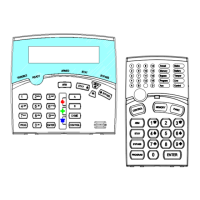
KBD Connector - The LCD keypad mounted on the lid of the PW64 cabinet is supplied with a cable that plugs into
the connector labelled “KBD”.
RCVR Connector - The Radio Receiver mounted inside the PW64 cabinet is supplied with a cable that plugs into
the connector labelled “RCVR”.
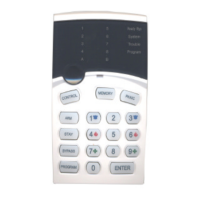
KEYPAD PORT - The terminals marked POS, NEG, CLK, & DAT are for the connection of additional keypads and
receiver cards if required. There is also a relay output board with 4 relays that can be connected at this point.
SERIAL PORT - The serial port is for the connection of the RS232 serial board or the DTU (data transfer) board.
The serial board allows for printing of the 255 event buffer to a serial printer or for PC direct up/down load
connection. The DTU board to allows program back-up and re-instatement.



 To Next Page