Model 5601MSC
Model 5601MSC Master SPG/Master Clock System
OPERATION Revision 2.2 Page - 37
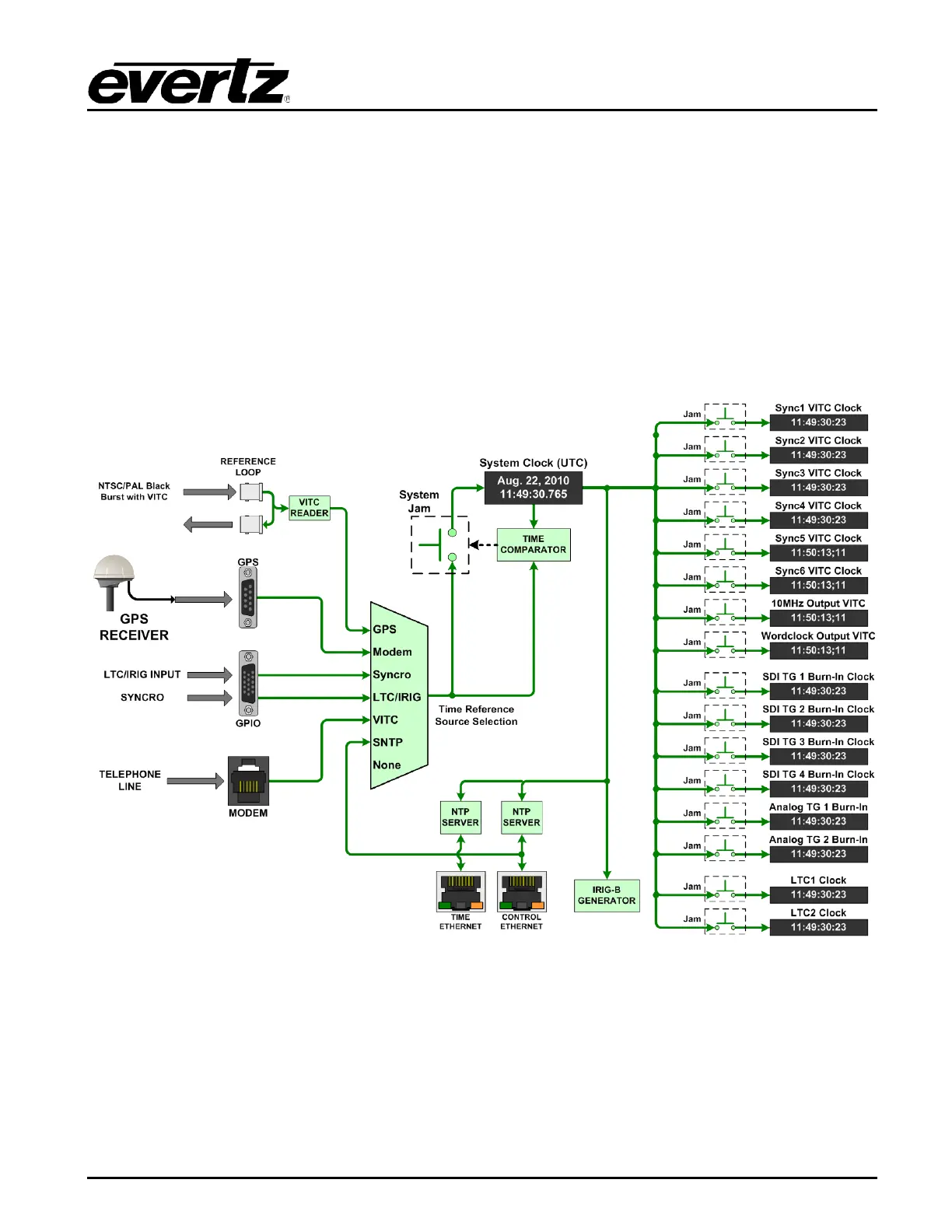
The system clock is synchronized to the selected time reference by performing a time jam. This is
different than the continuous PLL process that is used for frequency references. The system clock in
the 5601MSC runs independently at the frequency provided by the master oscillator. Ideally, once the
system clock has been set, it should keep perfect time forever. In practice stability errors, however
slight, creep in and accumulate over time. Even when locked to GPS or an atomic frequency standard,
leap seconds will occur in UTC time requiring the system clock to be occasionally adjusted.
The 5601MSC has several timecode outputs, each of which possess their own clock that runs
independently from the system clock. Each of the two LTC outputs and each sync output (including
10MHz and Wordclock) and test generator output have their own independent clock. The timecode
clocks are synchronized to the system clock once a day at user specified times. This allows for
timecode rates that do not count in real-time. Note that NTP and IRIG time is derived directly from the
system clock.
Figure 2-14: Time Locking Block Diagram
The system clock time/date is constantly compared to the time/date that is provided by the selected
time reference. Whenever a significant difference is detected, a system time jam will be required to
bring the system clock back into sync with the time reference. A system time jam effectively jams the
time and date acquired from the time reference into the system clock. This effect ripples to all timecode
output clocks jamming them as well. Exactly when a system time jam is allowed to take place is
determined by the Lock Type that is selected (see section 4.3.10). The amount of difference between
the system clock and the time reference must exceed a certain threshold before a system time jam is
declared necessary. This threshold is different for each time reference type.


 To Next Page